

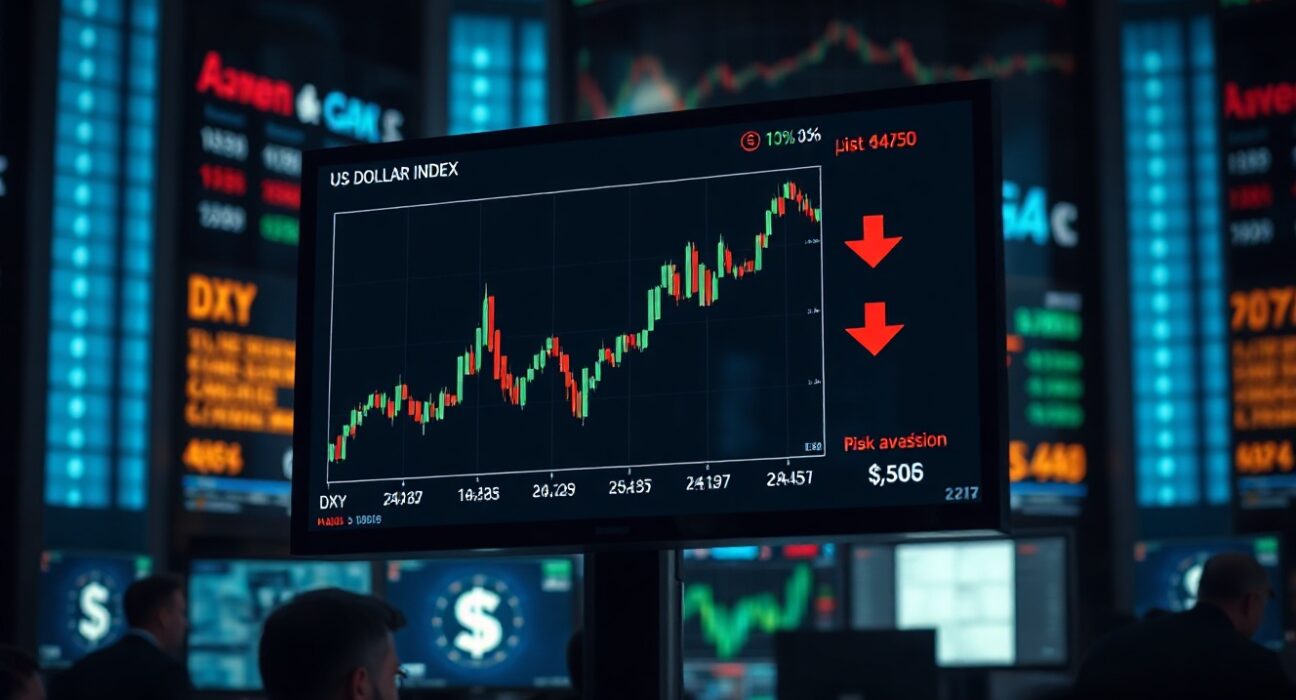
The US Dollar Index (DXY) extended its advance during Wednesday’s trading session, buoyed by a combination of escalating risk aversion in global markets and a firmly hawkish stance from the Federal Reserve. The index, which measures the greenback against a basket of six major currencies, rose as investors rotated into safe-haven assets amid renewed geopolitical tensions and uncertainty over global growth prospects.
Risk Aversion Fuels Safe-Haven Flows
Market sentiment turned cautious this week following weaker-than-expected economic data out of China and renewed trade policy friction between the US and the European Union. The deterioration in risk appetite prompted a sell-off in equities and higher-yielding currencies, with capital flowing into traditional safe havens such as the US dollar and Japanese yen. The DXY benefited directly from this shift, as traders reduced exposure to emerging market and commodity-linked currencies.
Hawkish Fed Remarks Reinforce Dollar Strength
Adding to the dollar’s momentum, several Federal Reserve officials delivered hawkish comments this week, pushing back against market expectations of imminent rate cuts. Federal Reserve Governor Christopher Waller stated that the central bank needs to see “several more months” of favorable inflation data before considering policy easing, while Atlanta Fed President Raphael Bostic emphasized that the fight against inflation is not yet won. These remarks reinforced the narrative that US interest rates will remain higher for longer, a key driver of dollar demand.
Market Implications for Traders
For forex traders, the strengthening dollar presents both opportunities and risks. A sustained DXY rally could put additional pressure on euro-dollar and sterling-dollar pairs, which have already retreated from recent highs. Meanwhile, emerging market currencies may face further headwinds if capital outflows intensify. The dollar’s rise also has implications for commodity prices, as a stronger greenback typically weighs on dollar-denominated assets like gold and oil. Investors are now closely watching Friday’s US Personal Consumption Expenditures (PCE) price index report for further clues on the Fed’s policy path.
Conclusion
The US Dollar Index’s recent advance reflects a powerful confluence of risk aversion and a hawkish Fed outlook. While the near-term trajectory appears bullish, the dollar’s strength remains contingent on incoming economic data and the evolution of global risk sentiment. Traders should prepare for potential volatility around key data releases and central bank communications in the coming weeks.
FAQs
Q1: What is the US Dollar Index (DXY)?
The US Dollar Index (DXY) measures the value of the US dollar relative to a basket of six major foreign currencies: the euro, Japanese yen, British pound, Canadian dollar, Swedish krona, and Swiss franc. It is a widely used benchmark for dollar strength.
Q2: How does a hawkish Fed affect the dollar?
A hawkish Fed signals a preference for higher interest rates or a slower pace of rate cuts. Higher interest rates make dollar-denominated assets more attractive to investors, increasing demand for the currency and pushing the DXY higher.
Q3: Why does risk aversion boost the US dollar?
During periods of global uncertainty or market stress, investors tend to sell riskier assets and move capital into safe-haven currencies like the US dollar. This flight to safety increases demand for the dollar, driving its value up against other currencies.
Disclaimer: The information provided is not trading advice, Bitcoinworld.co.in holds no liability for any investments made based on the information provided on this page. We strongly recommend independent research and/or consultation with a qualified professional before making any investment decisions.
