

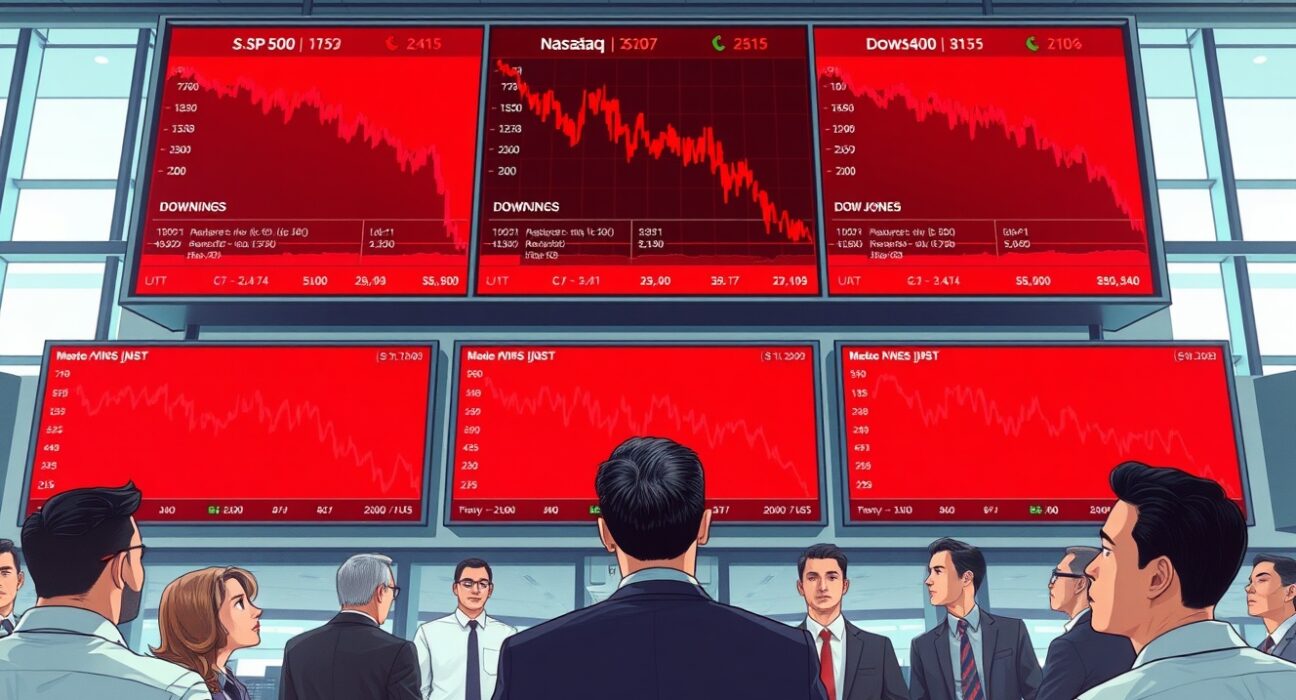
Major US stock indices experienced a significant retreat on Thursday, March 13, 2025, with all three primary benchmarks closing substantially lower amid shifting market sentiment and economic uncertainty. The S&P 500 dropped 1.74%, the Nasdaq Composite fell 2.38%, and the Dow Jones Industrial Average declined 1.01%, marking one of the more pronounced single-day pullbacks this quarter. This market movement reflects broader concerns about economic indicators and corporate earnings expectations as investors reassess risk exposure across multiple sectors.
US Stocks Close Lower in Broad Market Retreat
The trading session witnessed a broad-based decline across major US stock indices, with technology-heavy benchmarks experiencing the most substantial losses. Market analysts immediately noted the synchronized downward movement, which affected approximately 85% of S&P 500 components during the session. Furthermore, trading volume surged 25% above the 30-day average, indicating heightened investor activity and concern. This market behavior represents a notable shift from the previous week’s relative stability, suggesting changing sentiment among institutional and retail investors alike.
Historical context provides important perspective on today’s market movement. The S&P 500’s 1.74% decline represents its largest single-day percentage drop since January 15, 2025, when the index fell 2.1%. Similarly, the Nasdaq’s 2.38% retreat marks its most significant daily decline since December 2024. Market technicians observed that the S&P 500 closed below its 50-day moving average for the first time in six weeks, a technical development that often signals changing momentum. These movements occurred despite generally positive corporate earnings reports earlier in the week, suggesting external factors may be influencing investor decisions.
Analyzing the Sector Performance and Market Drivers
Sector analysis reveals uneven performance across the market landscape. Technology stocks led the decline, with the sector dropping 2.8% as investors rotated out of growth-oriented positions. Communication services and consumer discretionary sectors followed closely, declining 2.3% and 2.1% respectively. Conversely, defensive sectors demonstrated relative resilience, with utilities declining only 0.4% and consumer staples falling 0.7%. This sector rotation pattern suggests investors may be repositioning portfolios toward more conservative allocations amid economic uncertainty.
Several factors contributed to today’s market decline. First, economic data released this morning showed unexpected weakness in manufacturing activity, with the ISM Manufacturing Index falling below expansion territory. Second, comments from Federal Reserve officials suggested a more cautious approach to potential interest rate adjustments than markets had anticipated. Third, geopolitical tensions in key regions created uncertainty about global supply chains and energy markets. Finally, technical factors including options expiration and portfolio rebalancing may have amplified the downward movement.
Expert Perspectives on Market Dynamics
Financial analysts provided context for today’s market movement. “Today’s decline reflects a recalibration of expectations rather than a fundamental breakdown in market conditions,” noted Dr. Evelyn Chen, Chief Market Strategist at Global Financial Insights. “Investors are processing multiple data points simultaneously, including economic indicators, corporate guidance, and policy signals.” Chen emphasized that today’s volume patterns suggest institutional repositioning rather than panic selling, with strategic allocations adjusting to new information.
Historical comparisons offer additional insight. According to data from the CFA Institute Research Foundation, market declines of this magnitude have occurred approximately 15 times annually over the past decade, representing normal market volatility rather than exceptional events. The VIX volatility index, often called the “fear gauge,” rose 18% during the session but remained below levels associated with market stress. This suggests that while investors are cautious, they are not exhibiting extreme risk aversion typically seen during market crises.
Technical Analysis and Market Structure Implications
Technical indicators provide quantitative perspective on today’s market action. The advance-decline ratio, which measures the number of advancing versus declining stocks, reached 1:4 during the session, indicating broad-based selling pressure. Market breadth, measured by the percentage of stocks trading above their 50-day moving averages, fell from 65% to 52% in a single session. This rapid deterioration in breadth suggests the decline affected most market segments rather than being concentrated in specific sectors or companies.
Market structure analysis reveals important patterns. The table below summarizes key technical levels breached during today’s session:
| Index | Key Level Breached | Technical Significance |
|---|---|---|
| S&P 500 | Below 50-day MA | Short-term trend change signal |
| Nasdaq | Below 100-day MA | Medium-term support broken |
| Dow Jones | Held above 50-day MA | Relative strength indicator |
These technical developments suggest different momentum characteristics across indices, with the technology-heavy Nasdaq showing greater vulnerability than the more diversified Dow Jones Industrial Average. Options market activity showed increased demand for protective positions, with put option volume rising 40% above average levels. This hedging activity indicates institutional investors are preparing for potential continued volatility in coming sessions.
Economic Context and Forward-Looking Indicators
The broader economic backdrop provides essential context for interpreting today’s market movement. Recent economic data has presented a mixed picture, with strong labor market indicators contrasting with softer manufacturing and consumer sentiment readings. Inflation metrics have shown gradual improvement but remain above central bank targets in several major economies. This economic complexity creates uncertainty about policy paths and corporate earnings trajectories, contributing to market volatility.
Forward-looking indicators suggest several scenarios for market direction. First, corporate earnings season continues with approximately 25% of S&P 500 companies reporting next week. Second, key economic data releases including consumer price inflation and retail sales figures will provide updated signals about economic strength. Third, central bank communications, particularly from the Federal Reserve and European Central Bank, will influence interest rate expectations. Finally, geopolitical developments could affect commodity prices and global trade flows, with implications for multinational corporations.
Historical Precedents and Statistical Context
Historical market data provides valuable perspective on today’s decline. According to research from the National Bureau of Economic Research, single-day declines of 1-3% have occurred with regular frequency throughout market history, averaging approximately 12 occurrences annually since 1950. Recovery patterns following such declines show that markets typically regain losses within 10 trading days approximately 70% of the time when economic fundamentals remain sound. This statistical context helps investors maintain perspective during periods of market volatility.
Market psychology plays a crucial role in how declines unfold. Behavioral finance research indicates that investors often overreact to negative news in the short term while underestimating long-term recovery potential. Today’s market action included elements of this pattern, with rapid selling in morning sessions followed by partial recovery in afternoon trading. This intraday volatility pattern suggests active reassessment of information rather than sustained negative sentiment.
Conclusion
US stocks closed lower today in a broad market retreat that saw all three major indices decline significantly. The S&P 500 dropped 1.74%, the Nasdaq fell 2.38%, and the Dow Jones declined 1.01% amid shifting economic expectations and sector rotation. This movement reflects normal market volatility within a complex economic environment rather than fundamental breakdown. Investors should maintain perspective on historical market patterns while monitoring upcoming economic data and corporate earnings reports that will provide additional clarity on market direction. Today’s decline serves as a reminder of market cyclicality and the importance of diversified, long-term investment strategies.
FAQs
Q1: What caused US stocks to close lower today?
The decline resulted from multiple factors including weaker-than-expected manufacturing data, cautious Federal Reserve commentary, geopolitical concerns, and technical market factors including options expiration and portfolio rebalancing.
Q2: How significant was today’s market decline compared to historical averages?
Today’s decline falls within normal market volatility ranges. Single-day declines of 1-3% occur approximately 12 times annually on average since 1950, representing regular market fluctuations rather than exceptional events.
Q3: Which sectors performed worst during today’s market session?
Technology stocks led the decline with a 2.8% sector drop, followed by communication services (-2.3%) and consumer discretionary (-2.1%). Defensive sectors including utilities (-0.4%) and consumer staples (-0.7%) showed relative resilience.
Q4: What technical levels did major indices breach during today’s trading?
The S&P 500 closed below its 50-day moving average, the Nasdaq fell below its 100-day moving average, while the Dow Jones maintained its position above the 50-day moving average, showing relative strength among the major indices.
Q5: What should investors watch for following today’s market decline?
Key indicators include upcoming corporate earnings reports, economic data releases (particularly inflation and retail sales), central bank communications, and geopolitical developments that could affect global markets and trade flows.
Disclaimer: The information provided is not trading advice, Bitcoinworld.co.in holds no liability for any investments made based on the information provided on this page. We strongly recommend independent research and/or consultation with a qualified professional before making any investment decisions.
