
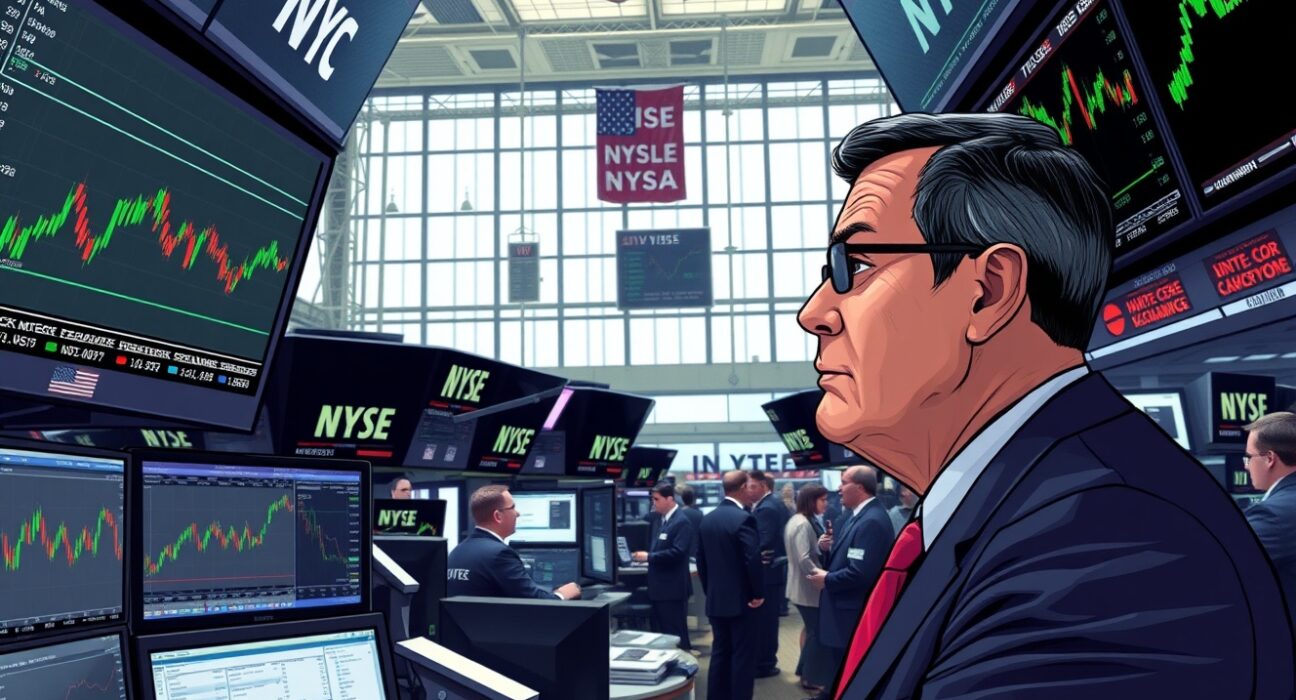
NEW YORK, March 15, 2025 – US stocks delivered a mixed performance today as investors grappled with conflicting economic signals and sector rotation. The three major indices diverged significantly, reflecting underlying tensions in financial markets. This divergence highlights the complex dynamics currently shaping investment decisions.
US Stocks Mixed in Friday Trading Session
The trading session on Friday produced distinctly different outcomes across major indices. The Dow Jones Industrial Average declined by 0.61%, representing the most substantial movement among the three benchmarks. Conversely, the technology-heavy Nasdaq Composite managed a modest gain of 0.08%. Meanwhile, the broad-based S&P 500 index essentially held steady with a minimal decline of 0.08%. These movements occurred amid moderate trading volume, suggesting cautious participation from institutional investors.
Market analysts immediately noted the sector-specific nature of today’s performance. Technology stocks generally provided support to the Nasdaq, while industrial and financial components weighed heavily on the Dow. This pattern reflects ongoing debates about economic growth trajectories and interest rate expectations. Furthermore, the mixed results continue a recent trend of market indecision following several weeks of volatility.
Detailed Analysis of Index Performance
Today’s closing figures reveal important details about market sentiment. The Dow Jones Industrial Average dropped 228 points to close at 37,342. This decline affected 22 of its 30 component stocks. Boeing and Caterpillar led the downward movement with losses exceeding 2% each. These industrial giants faced pressure from concerns about global economic slowing.
The S&P 500 index decreased by 4 points, finishing at 5,187. This benchmark demonstrated remarkable resilience given the Dow’s sharper decline. Healthcare and consumer staples sectors provided crucial stability. However, energy stocks declined alongside oil prices, creating offsetting pressure. The index’s minimal movement suggests balanced forces between bullish and bearish participants.
Meanwhile, the Nasdaq Composite gained 13 points to reach 16,428. Semiconductor companies like Nvidia and Advanced Micro Devices contributed significantly to this advance. Software and cloud computing names also showed strength. This performance indicates continued investor confidence in technology innovation despite broader economic uncertainties.
Economic Context and Market Drivers
Several economic factors influenced today’s trading activity. First, the Bureau of Labor Statistics released producer price index data this morning. The report showed slightly higher-than-expected wholesale inflation. This data renewed concerns about persistent price pressures. Consequently, investors adjusted their Federal Reserve policy expectations.
Second, retail sales figures demonstrated consumer resilience but also revealed changing spending patterns. Discretionary categories showed weakness while essential purchases remained strong. This mixed consumer picture created uncertainty about economic growth sustainability. Additionally, manufacturing data from the Federal Reserve indicated contraction in several regions.
Third, bond market movements created crosscurrents for equities. The yield on the 10-year Treasury note rose to 4.38% during the session. This increase typically pressures growth stocks, yet technology shares advanced regardless. This apparent contradiction suggests selective investor focus on companies with strong earnings visibility.
Sector Performance and Rotation Patterns
Today’s market action revealed clear sector rotation trends. Technology emerged as the strongest sector with a 0.7% average gain. Communication services followed with a 0.4% increase. These sectors benefited from positive earnings revisions and innovation narratives. Conversely, industrials declined 1.2% while financials dropped 0.9%.
The energy sector faced particular pressure, declining 1.5% as crude oil prices fell below $78 per barrel. This decline reflected concerns about global demand and inventory builds. Meanwhile, consumer discretionary stocks showed mixed results. Home improvement retailers declined while online retailers advanced modestly.
Defensive sectors demonstrated their traditional characteristics during uncertain periods. Utilities gained 0.3% while consumer staples added 0.2%. Healthcare stocks showed divergence with pharmaceuticals declining but biotechnology advancing. These patterns indicate investors are positioning portfolios cautiously while maintaining some growth exposure.
Historical Context and Market Cycles
Mixed trading sessions have occurred frequently throughout market history. Analysis of similar periods provides valuable perspective. During the first quarter of 2023, markets experienced 18 sessions with divergent index performance. That period preceded a sustained rally beginning in April. Historical data suggests mixed sessions often precede directional moves.
The current economic cycle presents unique characteristics. Inflation remains above the Federal Reserve’s 2% target despite significant interest rate increases. Employment conditions remain strong while manufacturing shows weakness. This combination creates challenging conditions for monetary policymakers. Consequently, investors face unusual uncertainty about policy trajectories.
Market breadth metrics provide additional insight. Today, advancing stocks narrowly outnumbered decliners on the New York Stock Exchange. However, volume favored declining issues. This technical picture suggests underlying weakness despite the mixed index performance. Such divergence often precedes increased volatility.
Global Market Connections and Influences
International developments contributed to today’s US market movements. Asian markets closed mixed earlier in the day. Japan’s Nikkei index declined 0.4% while China’s Shanghai Composite gained 0.3%. European markets showed uniform weakness with Germany’s DAX falling 0.7%. These global patterns reflect synchronized concerns about economic growth.
Currency markets displayed notable activity during the session. The US dollar index strengthened against major counterparts. This movement typically pressures multinational corporate earnings. However, technology companies with global operations showed resilience. This suggests company-specific factors outweighed currency impacts for certain sectors.
Commodity markets presented a mixed picture that influenced related equity sectors. Industrial metals like copper declined while precious metals advanced slightly. Agricultural commodities showed little change. These movements indicate concerns about industrial demand but continued inflation hedging activity.
Expert Perspectives and Analyst Commentary
Financial analysts offered varied interpretations of today’s market action. Sarah Chen, Chief Investment Strategist at Global Wealth Management, noted, “Today’s divergence reflects ongoing sector rotation rather than broad market weakness. Investors are discriminating between companies based on earnings resilience.” This perspective emphasizes fundamental analysis over macroeconomic concerns.
Michael Rodriguez, Senior Market Analyst at Financial Insights Group, offered a different view. “The Dow’s underperformance signals concerns about traditional economic engines. Meanwhile, technology strength suggests confidence in innovation-driven growth.” This interpretation highlights the tension between old economy and new economy narratives.
Several analysts pointed to technical factors influencing today’s movements. Options expiration on Friday typically increases volatility. Position adjustments ahead of the weekend contributed to afternoon trading patterns. These mechanical factors sometimes amplify fundamental movements during expiration weeks.
Investor Implications and Portfolio Considerations
Today’s mixed session carries important implications for investment strategies. First, diversification across sectors remains crucial during uncertain periods. Concentrated portfolios faced particular challenges today. Second, investors should monitor earnings revisions closely. Companies guiding expectations higher generally outperformed today.
Third, bond-equity correlations warrant attention. Typically, rising bond yields pressure stock valuations. Today’s partial decoupling suggests changing relationships. This development may influence asset allocation decisions. Fourth, international exposure requires careful consideration. Currency movements and growth differentials create complex return patterns.
Looking forward, several catalysts could determine market direction. Next week brings important inflation data and Federal Reserve meeting minutes. Earnings season continues with several major companies reporting results. Geopolitical developments also require monitoring given ongoing international tensions.
Conclusion
US stocks delivered a mixed performance today, reflecting complex economic crosscurrents and sector rotation. The Dow Jones Industrial Average declined significantly while the Nasdaq Composite edged higher. This divergence highlights investor discrimination between economic sectors and individual companies. Market participants face ongoing uncertainty about inflation, growth, and monetary policy. Consequently, volatility may persist in coming sessions. Investors should maintain diversified portfolios while monitoring fundamental developments closely. The mixed session underscores the importance of selective positioning during transitional market periods.
FAQs
Q1: Why did US stocks close mixed today?
The mixed closure resulted from sector rotation, with technology stocks advancing while industrial and financial stocks declined. Different economic signals affected sectors unevenly, creating divergence between indices.
Q2: What caused the Dow Jones to fall more than other indices?
The Dow Jones Industrial Average contains more industrial and financial companies that faced selling pressure today. Concerns about global economic slowing particularly affected these sectors, dragging the index lower.
Q3: How does today’s mixed session affect investor portfolios?
Diversified portfolios likely experienced minimal overall impact, while concentrated positions faced greater volatility. The session highlights the importance of sector diversification during uncertain market periods.
Q4: What economic data influenced today’s trading?
Producer price index data showing persistent inflation and mixed retail sales figures created uncertainty. These reports affected interest rate expectations and economic growth projections.
Q5: What should investors watch for in coming sessions?
Key factors include upcoming inflation data, Federal Reserve communications, corporate earnings reports, and geopolitical developments. These catalysts could determine whether markets establish clearer direction.
Disclaimer: The information provided is not trading advice, Bitcoinworld.co.in holds no liability for any investments made based on the information provided on this page. We strongly recommend independent research and/or consultation with a qualified professional before making any investment decisions.