

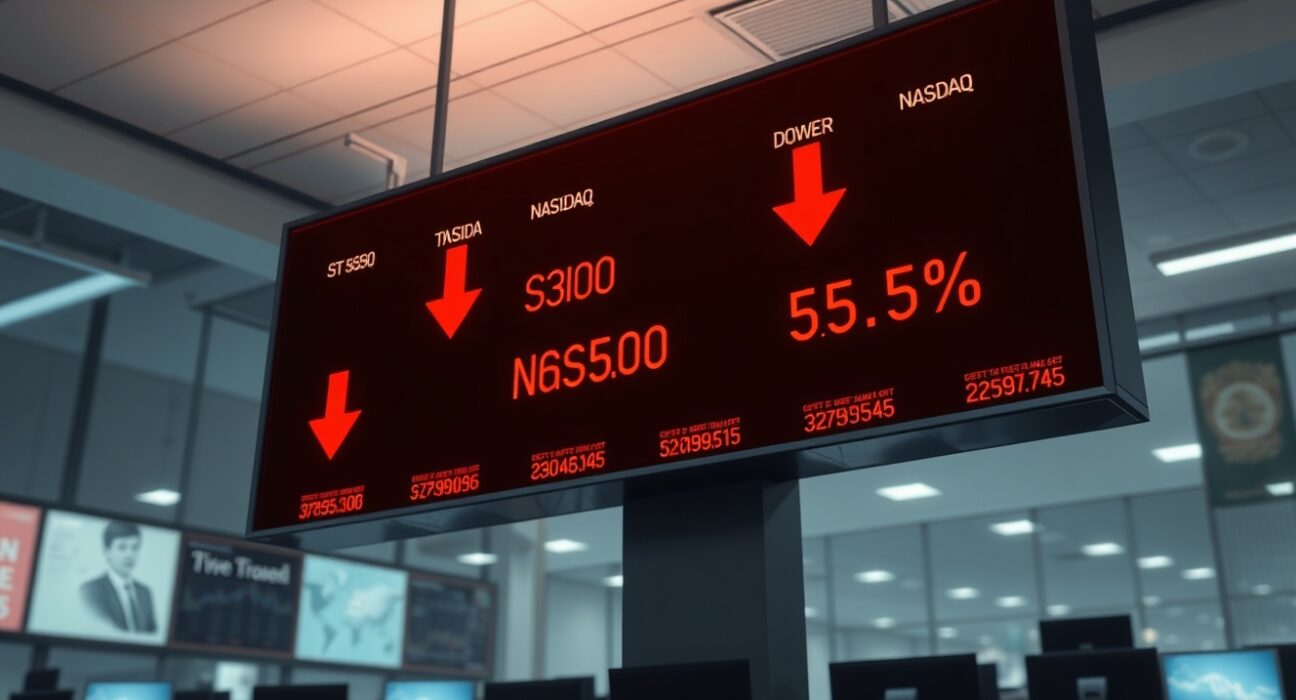
US stocks open lower today, with the three major indices declining at the start of trading. The S&P 500 falls by 0.3%, the Nasdaq drops by 0.5%, and the Dow Jones Industrial Average declines by 0.3%. This broad-based sell-off signals cautious investor sentiment amid ongoing economic uncertainties.
US Stocks Open Lower: Key Index Performance
The market downturn affects all three major indices. The S&P 500, a benchmark for large-cap US equities, slips by 0.3%. The technology-heavy Nasdaq experiences a sharper decline of 0.5%. The Dow Jones, representing 30 blue-chip companies, also falls by 0.3%. These moves indicate a risk-off mood among traders.
Market Breadth and Sector Impact
Declining stocks outnumber advancing ones across the board. Technology and consumer discretionary sectors lead the losses. Energy and utilities show relative strength. This pattern suggests investors are rotating away from growth stocks. They seek safer havens amid the downturn.
Factors Driving the Stock Market Decline
Several factors contribute to the stock market decline. Rising interest rate expectations weigh on equity valuations. The Federal Reserve maintains a hawkish stance. Geopolitical tensions also add to market uncertainty. Additionally, weaker-than-expected corporate earnings reports dampen sentiment.
Interest Rate Concerns
Bond yields rise as traders anticipate further rate hikes. The 10-year Treasury yield climbs above 4.5%. Higher yields make stocks less attractive. Growth stocks, particularly in the tech sector, feel the pressure most acutely. The Nasdaq’s larger decline reflects this sensitivity.
Geopolitical and Economic Headwinds
Ongoing trade disputes and global economic slowdown fears persist. Inflation data remains above the Fed’s target. Consumer spending shows signs of softening. These macroeconomic factors create a challenging environment for equities.
Investor Sentiment and Trading Volume
Investor sentiment turns bearish as US stocks open lower. The CBOE Volatility Index (VIX) rises by 5%, indicating increased fear. Trading volume is above average, suggesting active participation. Many institutional investors reduce their exposure to risk assets.
Technical Analysis of the S&P 500 Drop
The S&P 500 drop breaks below its 50-day moving average. This technical signal often precedes further declines. Support levels around 4,200 points are now in focus. A break below this level could trigger additional selling.
Impact on Global Markets
The US stock market decline affects global indices. European markets open lower in sympathy. Asian markets also close in the red. The sell-off reflects a synchronized risk-off move across global financial markets. Currency markets see the US dollar strengthen as a safe haven.
Commodity and Currency Reactions
Gold prices edge higher as investors seek safety. Oil prices decline on demand concerns. The Japanese yen and Swiss franc gain against the dollar. These moves highlight the broad market anxiety.
Expert Perspectives on the Nasdaq Fall
Market analysts attribute the Nasdaq fall to valuation concerns. Tech stocks trade at high price-to-earnings ratios. Rising rates reduce the present value of future earnings. This dynamic hits growth stocks hardest. “The market is repricing risk,” says a senior strategist at a major investment bank.
Earnings Season and Corporate Guidance
Second-quarter earnings reports disappoint in several key sectors. Companies cite input cost inflation and supply chain disruptions. Forward guidance from many firms is cautious. This lack of optimism fuels the sell-off.
Historical Context of the Dow Jones Lower
The Dow Jones lower move is not unprecedented. Similar declines occurred during past rate hike cycles. In 2018, the Dow fell over 10% during a similar tightening phase. Historical patterns suggest the current correction could deepen before stabilizing.
Comparison with Previous Market Corrections
Corrections of 5-10% are common in bull markets. The current decline is within normal range. However, the speed of the sell-off concerns some traders. Rapid declines often trigger stop-loss orders, accelerating the downturn.
What Investors Should Watch Next
Key economic data releases this week will guide market direction. The consumer price index (CPI) report is due on Wednesday. Producer price index (PPI) data follows on Thursday. Strong inflation numbers could exacerbate the sell-off. Weaker data might provide relief.
Federal Reserve Policy Expectations
Market participants now price in a 70% chance of a rate hike at the next meeting. The Fed’s preferred inflation measure, the core PCE index, remains elevated. Any hawkish commentary from Fed officials could further pressure stocks.
Strategies for Navigating the Stock Market Decline
Financial advisors recommend staying diversified during market downturns. Defensive sectors like healthcare and utilities offer stability. Dividend-paying stocks provide income in volatile conditions. Long-term investors should avoid panic selling.
Opportunities in the Dow Jones Lower Environment
Some value stocks become more attractive at lower prices. The Dow Jones lower move creates entry points for bargain hunters. Cyclical sectors like industrials and financials may benefit from economic recovery. Careful stock selection is crucial.
Conclusion
US stocks open lower across all major indices, reflecting widespread investor caution. The S&P 500, Nasdaq, and Dow Jones all decline amid rising rates, geopolitical tensions, and disappointing earnings. Market participants now focus on upcoming economic data and Fed policy signals. While the sell-off creates uncertainty, it also presents opportunities for disciplined investors. Staying informed and maintaining a long-term perspective remains essential in this volatile environment.
FAQs
Q1: Why did US stocks open lower today?
A1: US stocks opened lower due to a combination of rising interest rate expectations, geopolitical tensions, and disappointing corporate earnings. The S&P 500, Nasdaq, and Dow Jones all declined as investors adopted a risk-off stance.
Q2: Which sectors are most affected by the stock market decline?
A2: Technology and consumer discretionary sectors are hit hardest, with the Nasdaq falling 0.5%. Energy and utilities show relative strength as investors rotate into defensive stocks.
Q3: How does the S&P 500 drop compare to previous market corrections?
A3: The current S&P 500 drop of 0.3% is modest compared to past corrections. Historical corrections of 5-10% are common during rate hike cycles. The speed of the decline, however, concerns some traders.
Q4: What should investors do when the Dow Jones is lower?
A4: Financial advisors recommend staying diversified, avoiding panic selling, and focusing on long-term goals. Defensive sectors and dividend-paying stocks can provide stability during downturns.
Q5: Will the Nasdaq fall continue?
A5: The Nasdaq fall may continue if interest rates keep rising and earnings disappoint. Key economic data releases and Fed policy signals this week will provide further direction. Technical support levels around 4,200 points are critical to watch.
Disclaimer: The information provided is not trading advice, Bitcoinworld.co.in holds no liability for any investments made based on the information provided on this page. We strongly recommend independent research and/or consultation with a qualified professional before making any investment decisions.
