
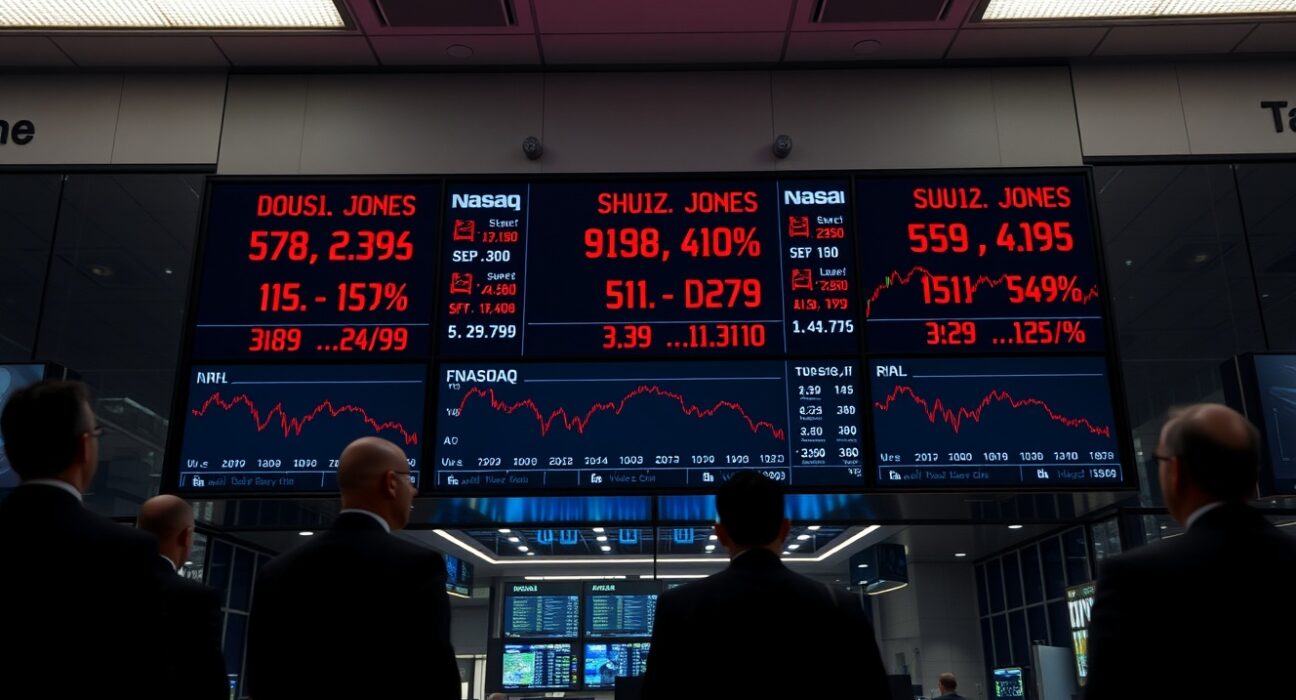
Wall Street opened the trading session on a decisively negative note today, as all three major U.S. stock indices registered significant declines at the bell. This sharp downward move immediately captured the attention of investors and analysts globally, setting a cautious tone for the day’s financial activity. The S&P 500 index fell 1.1%, the technology-heavy Nasdaq Composite dropped 1.6%, and the Dow Jones Industrial Average declined 1.2%. Consequently, this collective retreat erased billions in market capitalization within minutes and prompted a swift reassessment of near-term market sentiment.
Analyzing the US Stock Market Decline
The synchronized drop across major indices suggests a broad-based sell-off rather than sector-specific weakness. Market technicians often watch for such unified movements as they can indicate a shift in overall investor risk appetite. Furthermore, the Nasdaq’s steeper decline frequently points to heightened pressure on growth-oriented and technology stocks, which are typically more sensitive to interest rate expectations. This opening volatility follows a period of relative stability, making today’s action particularly noteworthy for portfolio managers.
Historical data shows that opening gaps of this magnitude often lead to elevated trading volume and can set the intraday trend. Market microstructure analysts examine order flow and liquidity at the open to gauge institutional participation. The immediate selling pressure likely reflected a combination of overnight news flow, pre-market futures trading, and reactions to economic data releases or corporate earnings reported before the bell.
Context and Potential Market Drivers
To understand this decline, one must consider the prevailing financial landscape. Firstly, bond market movements heavily influence equity valuations. A sudden spike in Treasury yields, for instance, can trigger a rotation out of stocks. Secondly, macroeconomic data releases on inflation, employment, or consumer spending directly impact Federal Reserve policy expectations. Thirdly, geopolitical developments or significant corporate news can create immediate risk-off sentiment.
Recent commentary from Federal Reserve officials remains a primary focus for traders. Any hint of a more aggressive or prolonged tightening cycle can dampen equity valuations. Additionally, corporate earnings season creates pockets of volatility as companies report results and issue forward guidance. A cluster of disappointing reports from key bellwether firms can catalyze wider market pessimism.
Expert Perspective on Market Mechanics
Financial economists emphasize that daily price movements represent the aggregate of millions of buy and sell decisions. A lower open often results from an imbalance of sell orders queued before trading begins. These orders can stem from algorithmic trading systems reacting to pre-defined triggers, institutional portfolio rebalancing, or risk management protocols like stop-loss orders being activated. The depth of the decline suggests meaningful selling from multiple participant types.
Seasoned traders monitor support and resistance levels identified through technical analysis. A break below key technical levels at the open can trigger further automated selling. The 1% threshold is psychologically significant, often prompting increased media coverage and retail investor attention. Market liquidity, while generally robust at the open, can be tested during rapid moves, potentially exacerbating price swings.
Sector Performance and Broader Implications
While the provided data highlights index-level performance, a deeper dive typically reveals sector dispersion. Often, cyclical sectors like financials, industrials, and materials feel the brunt of economic concern. Conversely, defensive sectors such as utilities or consumer staples may demonstrate relative strength. The performance gap between growth and value investment styles also offers clues about the market’s underlying narrative.
The opening decline has immediate implications for various market participants. For active traders, it presents both risk and opportunity. For long-term investors, it may raise questions about asset allocation. For corporate treasurers, it affects the cost of capital and timing for potential equity offerings. Moreover, global markets often take cues from U.S. action, meaning this sell-off could influence European and Asian trading sessions subsequently.
The Role of Economic Indicators
Economic calendars are critical tools for market analysts. Releases such as the Consumer Price Index (CPI), Producer Price Index (PPI), and jobless claims data directly inform the economic outlook. Stronger-than-expected data can fuel fears of persistent inflation and tighter monetary policy, weighing on stock valuations. Conversely, weaker data may spark concerns about an economic slowdown. The market’s reaction at the open may be a delayed response to such data points or anticipation of upcoming reports.
Investor sentiment surveys, like the AAII Investor Sentiment Survey or the CNN Fear & Greed Index, provide context for market psychology. A shift from greed to fear can precede or accompany market pullbacks. Additionally, volatility indices, such as the VIX (often called the “fear gauge”), typically rise when stocks fall sharply, reflecting increased demand for options protection.
Historical Comparisons and Market Cycles
Single-day declines of this size are not uncommon within a healthy market cycle. Historical analysis shows that the U.S. stock market experiences an average intra-year drawdown of approximately 14% even in positive years. Therefore, perspective is crucial. However, the context of the decline matters more than the magnitude alone. A drop following a prolonged rally may signal a healthy correction, while a drop amid deteriorating fundamentals may warrant greater caution.
Comparing current volatility to historical averages, like the average true range (ATR) of an index, helps determine if the move is statistically significant. Furthermore, monitoring trading volume is essential; a high-volume decline suggests conviction among sellers, while a low-volume drop may indicate a lack of broad participation and could be more easily reversed.
Conclusion
The significant lower open for US stocks today underscores the dynamic and ever-changing nature of financial markets. The simultaneous decline across the S&P 500, Nasdaq, and Dow Jones highlights a broad reassessment of risk and valuation by the investment community. While daily fluctuations are normal, understanding the interplay of economic data, monetary policy, corporate earnings, and global events is key to navigating such volatility. Market participants will now watch closely to see if this initial selling pressure sustains throughout the session or if buyers emerge to stabilize prices, setting the stage for the next phase of market action.
FAQs
Q1: What does it mean when the stock market opens lower?
A lower open means the first executed trades of the day occur at prices below the previous day’s closing price. It indicates immediate selling pressure, often driven by overnight news, economic data, or pre-market trading activity in futures markets.
Q2: Why did the Nasdaq fall more than the S&P 500 and Dow?
The Nasdaq Composite is heavily weighted toward technology and growth stocks. These companies are often valued on future earnings potential, making them more sensitive to changes in interest rates and economic growth expectations. A steeper decline suggests those sectors faced disproportionate selling.
Q3: Can a market decline at the open predict the rest of the day’s trading?
Not definitively. While the opening tone is important, markets often reverse or change direction intraday. Traders watch for follow-through selling or buying in the first hour to gauge the strength of the initial move.
Q4: How should a long-term investor react to a sharp market open like this?
Long-term investors are generally advised to avoid making impulsive decisions based on single-day movements. Instead, they should review their investment plan, ensure their portfolio aligns with their risk tolerance, and consider whether price declines present strategic buying opportunities for high-quality assets.
Q5: What are common causes of a broad market sell-off at the open?
Common catalysts include surprising economic data (e.g., high inflation), hawkish comments from central bankers, geopolitical tensions, a weak earnings report from a major company, a significant shift in bond yields, or a broad wave of risk aversion in global markets.
Disclaimer: The information provided is not trading advice, Bitcoinworld.co.in holds no liability for any investments made based on the information provided on this page. We strongly recommend independent research and/or consultation with a qualified professional before making any investment decisions.