

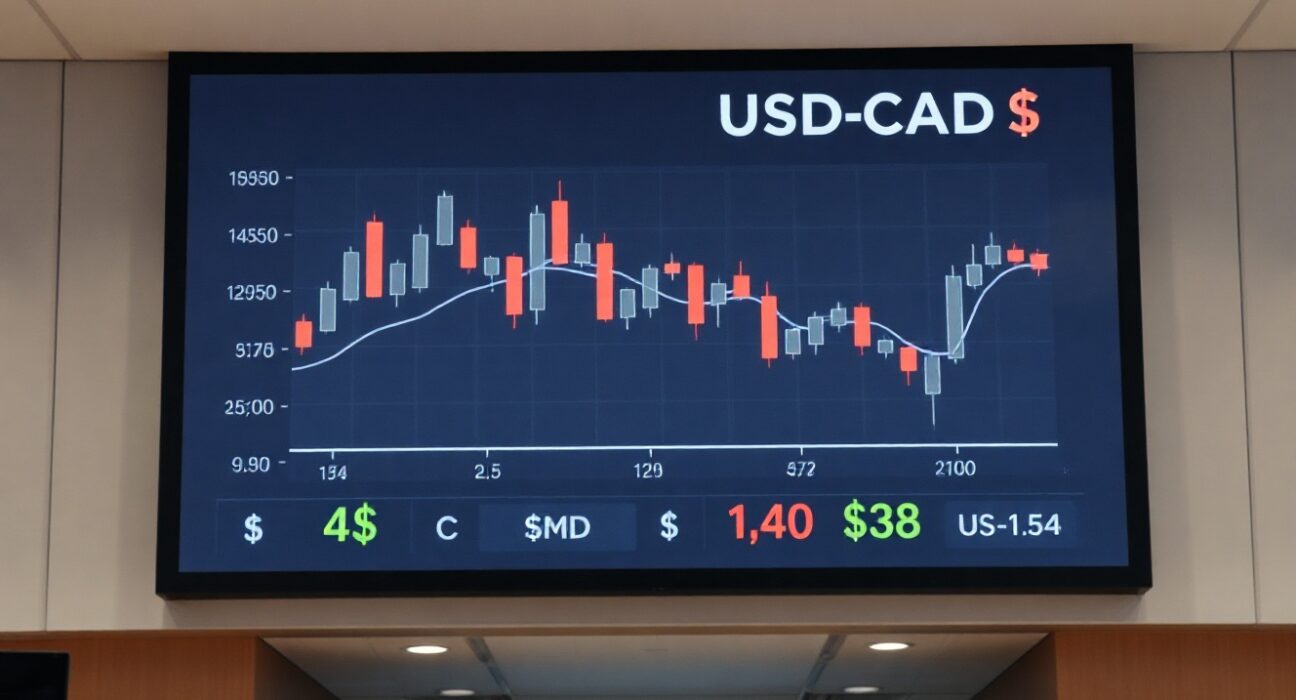
The USD/CAD pair continues to face significant bearish pressure as it trades below the key psychological level of 1.4000, a move that has caught the attention of forex traders and analysts alike. As of the latest trading session, the pair is hovering near 1.3950, reflecting a decline of about 0.3% on the day, driven by a combination of a softer US dollar and firmer oil prices, which typically support the Canadian dollar.
Technical Breakdown: Key Levels to Watch
From a technical perspective, the break below 1.4000 has opened the door for further downside, with the next major support zone identified at 1.3900, followed by 1.3850. The Relative Strength Index (RSI) on the daily chart is currently reading near 40, indicating bearish momentum but not yet oversold, leaving room for additional declines before a potential bounce.
The moving average convergence divergence (MACD) indicator has also crossed into negative territory, reinforcing the bearish outlook. Traders are closely monitoring the 50-day and 200-day moving averages, which are converging around 1.4050–1.4100, a zone that previously acted as strong support and now serves as immediate resistance.
Fundamental Drivers: Oil Prices and Central Bank Divergence
The Canadian dollar has found support from rising crude oil prices, as Canada is a major oil exporter. West Texas Intermediate (WTI) crude has climbed above $80 per barrel, up nearly 4% over the past week, buoyed by supply concerns and stronger global demand forecasts. Higher oil prices typically boost the loonie, putting additional pressure on the USD/CAD pair.
On the monetary policy front, the Bank of Canada (BoC) has signaled a more hawkish stance than the Federal Reserve, with markets pricing in a higher probability of a rate hike at the next BoC meeting. Meanwhile, the Fed has indicated it may pause its tightening cycle, widening the interest rate differential in favor of the Canadian dollar.
Market Implications: What This Means for Traders
For traders, the sustained break below 1.4000 could trigger further selling, with a potential target of 1.3800 in the coming weeks if the bearish momentum persists. However, a failure to hold above 1.3900 could lead to a short-term consolidation, as market participants await fresh catalysts.
Investors should also consider the broader economic context, including upcoming Canadian GDP data and US inflation figures, which could influence the pair’s direction. A stronger-than-expected Canadian economic report could accelerate the loonie’s gains, while a surprise uptick in US inflation might revive the dollar’s strength.
Conclusion
In summary, USD/CAD is under clear bearish pressure below 1.4000, supported by technical indicators and fundamental factors such as higher oil prices and a more hawkish Bank of Canada. While the pair may find temporary support at 1.3900, the overall trend remains negative, and traders should watch for a potential test of lower levels. As always, risk management is crucial, and market participants should stay informed about upcoming economic releases that could shift the outlook.
FAQs
Q1: What does it mean when USD/CAD falls below 1.4000?
A break below 1.4000 indicates that the Canadian dollar is strengthening relative to the US dollar, often driven by factors like higher oil prices, stronger Canadian economic data, or a weaker US dollar. It signals potential further downside for the pair.
Q2: How do oil prices affect USD/CAD?
Since Canada is a major oil exporter, higher oil prices generally increase demand for the Canadian dollar, causing USD/CAD to fall. Conversely, lower oil prices tend to weaken the loonie and push the pair higher.
Q3: What are the key support and resistance levels to watch?
Immediate support is at 1.3900, followed by 1.3850. On the upside, resistance is at 1.4000 (now a psychological barrier) and the 50-day moving average around 1.4050–1.4100.
Disclaimer: The information provided is not trading advice, Bitcoinworld.co.in holds no liability for any investments made based on the information provided on this page. We strongly recommend independent research and/or consultation with a qualified professional before making any investment decisions.
