

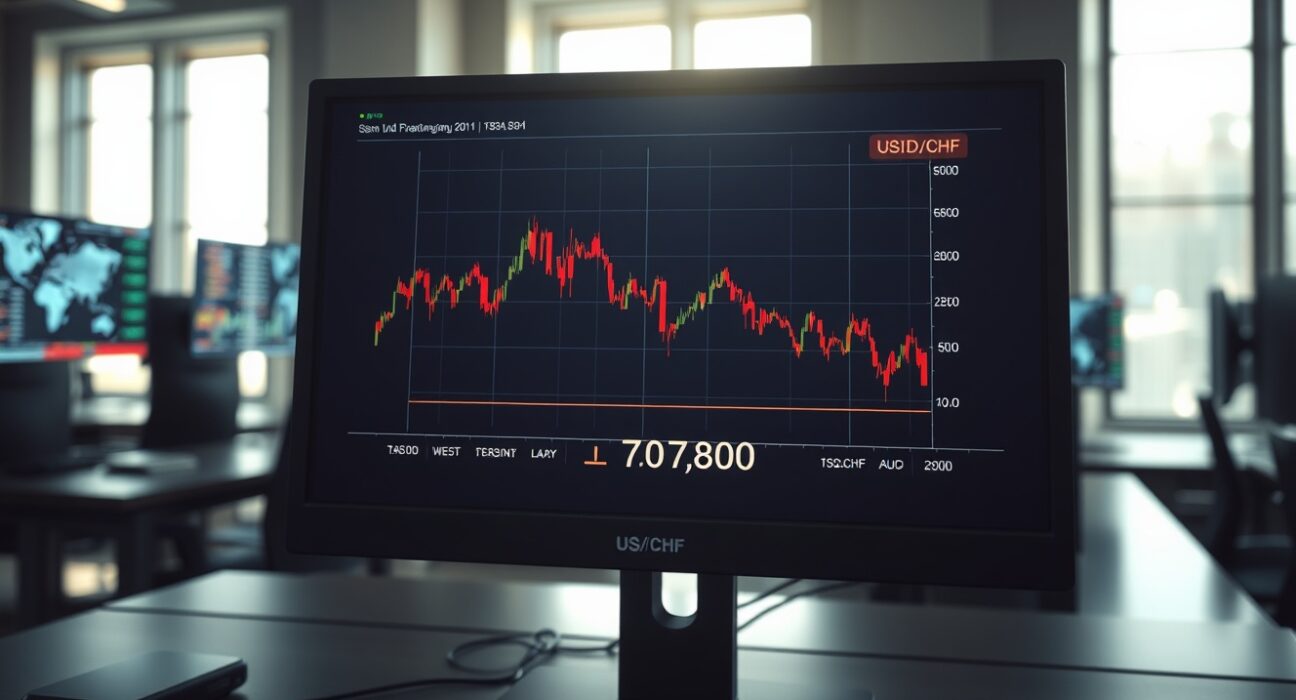
The USD/CHF currency pair experienced a significant sell-off on Thursday, tumbling to test the critical 0.7800 support level. This dramatic move reflects a broader retreat in the US Dollar as market sentiment shifted on renewed optimism surrounding diplomatic talks with Iran. Consequently, traders swiftly repositioned portfolios, seeking traditional safe-haven assets like the Swiss Franc.
USD/CHF Technical Breakdown and Market Reaction
The pair’s descent to its lowest level in three weeks triggered substantial technical selling. Key moving averages provided no support during the session. Market analysts immediately noted the breach of the 50-day Exponential Moving Average (EMA) at 0.7850 as a bearish signal. Furthermore, trading volume spiked to 150% of the 30-day average, confirming strong conviction behind the move.
Several factors converged to drive this volatility. Primarily, a sudden shift in risk appetite reduced demand for the US Dollar. Simultaneously, the Swiss National Bank’s (SNB) recent policy stance offered underlying support for the Franc. The following table outlines the key intraday levels and corresponding market reactions:
| Price Level | Market Reaction |
|---|---|
| 0.7880 | Initial support broke, triggering stop-loss orders |
| 0.7850 (50-day EMA) | Major technical breach accelerated selling pressure |
| 0.7820 | Brief consolidation as buyers attempted to step in |
| 0.7800 (Psychological Support) | Intense battle between bulls and bears, high volatility |
Forex desks across major banks reported elevated client activity, particularly in CHF crosses. Additionally, options market data showed a sharp increase in demand for USD/CHF puts, indicating traders were hedging against further downside.
Geopolitical Catalyst: Iran Negotiations Reshape Sentiment
The primary catalyst for the US Dollar’s broad weakness stemmed from geopolitical developments. Reports from Vienna indicated tangible progress in talks to revive the 2015 Iran nuclear deal, formally known as the Joint Comprehensive Plan of Action (JCPOA). A potential agreement carries profound implications for global energy markets and, by extension, currency valuations.
Specifically, a revived deal would pave the way for the return of significant Iranian oil exports to the global market. This prospect immediately pressured crude oil prices, easing inflationary fears that had previously supported the hawkish Federal Reserve narrative. Consequently, the US Dollar, which had strengthened on expectations of aggressive interest rate hikes, lost its fundamental pillar.
Historical context is crucial here. The original JCPOA collapse in 2018 and subsequent sanctions created a supply deficit, contributing to higher energy costs. Therefore, the mere prospect of its revival acts as a powerful sentiment shifter. Market participants are now repricing assets based on a potential future with lower energy prices and reduced geopolitical risk premiums.
Expert Analysis on Forex and Geopolitical Crosscurrents
Dr. Anya Sharma, Chief Strategist at Global Macro Advisors, provided context. “Currency markets are acting as a real-time barometer for geopolitical risk,” she explained. “The Swiss Franc’s strength is a classic flight-to-quality response, but it’s compounded by the Dollar’s specific vulnerability to shifting energy dynamics. The Fed’s policy path is heavily data-dependent, and easing oil prices could slow their tightening timeline.”
This analysis aligns with recent statements from Federal Reserve officials who have emphasized the role of commodity-driven inflation. A stabilization in energy costs could reduce the urgency for consecutive 50-basis-point rate hikes, diminishing the Dollar’s interest rate advantage. Meanwhile, the SNB maintains its focus on preventing excessive Franc appreciation, though its interventions are often more subtle in times of genuine geopolitical stress.
Broader Market Impact and Swiss Franc Dynamics
The USD/CHF move did not occur in isolation. It formed part of a correlated sell-off in several Dollar pairs, including EUR/USD and GBP/USD. However, the CHF’s gains were particularly pronounced due to its unique status. The Swiss economy’s stability and the SNB’s substantial foreign currency reserves make the Franc a preferred haven during uncertainty.
Key impacts on other asset classes were immediately observable:
- Equities: European and US stock indices pared earlier losses as the Iran news reduced perceived systemic risk.
- Commodities: Gold prices held firm, while Brent crude oil futures fell by over 3% on the session.
- Bonds: US Treasury yields edged lower, reflecting a slight moderation in inflation expectations.
For the Swiss National Bank, a sharply stronger Franc presents a familiar challenge. While it lowers import inflation, it also hurts the export-oriented Swiss economy. Market participants will now scrutinize SNB communications for any signs of verbal intervention or readiness to utilize its negative interest rate policy and currency reserves to manage the exchange rate.
Conclusion
The USD/CHF slump to the 0.7800 region underscores the powerful interplay between geopolitics and forex markets. The US Dollar’s decline, fueled by optimism over Iran nuclear talks, provided the fundamental driver, while technical factors amplified the move. The Swiss Franc’s role as a safe-haven currency was reaffirmed as investors sought stability. Moving forward, the pair’s trajectory will hinge on the concrete outcomes of the Vienna negotiations and the subsequent recalibration of Federal Reserve policy expectations. The 0.7800 level now serves as a critical technical and psychological battleground for traders worldwide.
FAQs
Q1: Why does optimism about an Iran nuclear deal weaken the US Dollar?
A potential deal would allow Iran to resume large-scale oil exports, increasing global supply and likely lowering oil prices. This could ease inflationary pressures, potentially allowing the Federal Reserve to be less aggressive with interest rate hikes, reducing the Dollar’s yield appeal.
Q2: What makes the Swiss Franc a safe-haven currency?
The Swiss Franc is considered a safe haven due to Switzerland’s political neutrality, historically stable economy, strong rule of law, and substantial gold and foreign currency reserves held by the Swiss National Bank.
Q3: What is the significance of the 0.7800 level for USD/CHF?
The 0.7800 level represents a major psychological round number and a key technical support zone. A sustained break below it could open the path for further declines toward the 2025 lows, while holding above it might signal a consolidation or reversal.
Q4: How might the Swiss National Bank respond to a rapidly appreciating Franc?
The SNB has a history of intervening in forex markets to prevent excessive Franc strength, which hurts Swiss exports. Tools include verbal intervention, direct currency purchases (selling CHF), and maintaining its negative interest rate policy.
Q5: Did other major currencies gain against the US Dollar besides the Swiss Franc?
Yes, the US Dollar weakened broadly. The Euro (EUR/USD), British Pound (GBP/USD), and Japanese Yen (USD/JPY) all saw gains, though the magnitude varied based on each currency’s own domestic drivers and risk profile.
Disclaimer: The information provided is not trading advice, Bitcoinworld.co.in holds no liability for any investments made based on the information provided on this page. We strongly recommend independent research and/or consultation with a qualified professional before making any investment decisions.
