

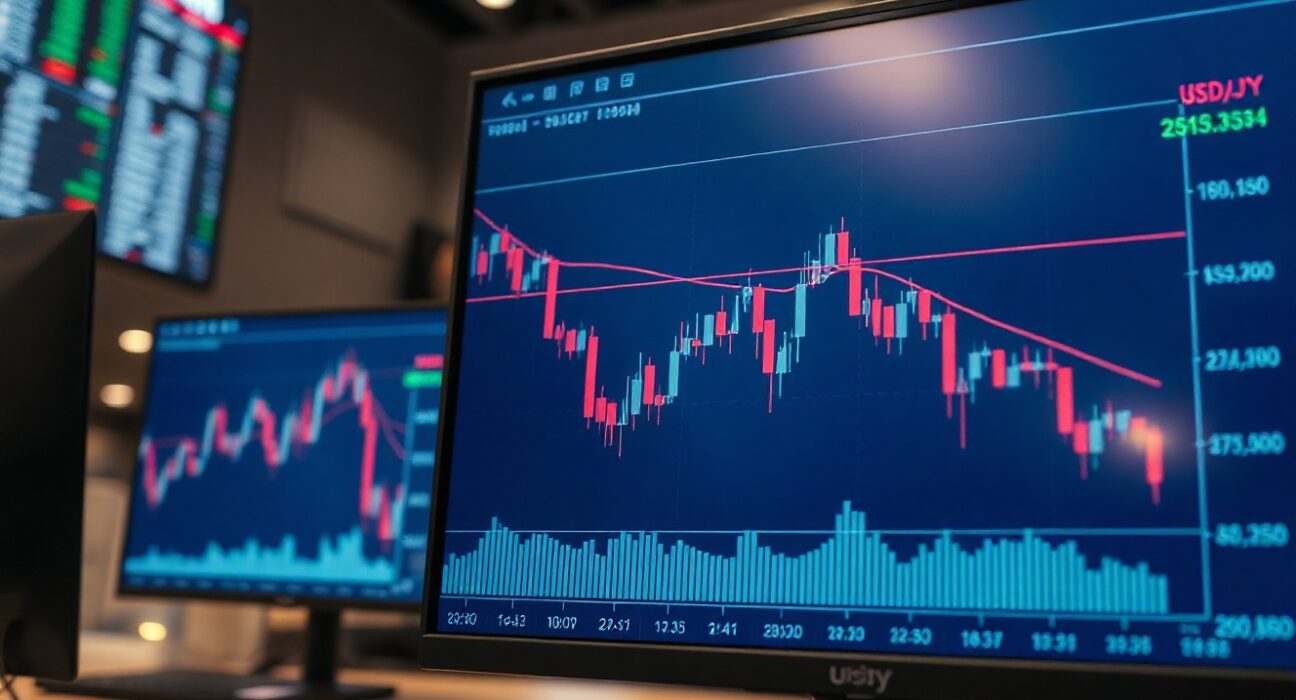
The Japanese yen strengthened sharply against the US dollar on Wednesday, with USD/JPY falling to a multi-week low amid what traders widely suspect was another round of official intervention by Japanese authorities. However, the pair’s rebound attempt has been capped by the 200-day Simple Moving Average (SMA), signaling that the broader downtrend may still be intact.
What Triggered the Yen’s Sudden Strength?
The abrupt move lower in USD/JPY occurred during a period of thin liquidity, a classic condition for intervention. While the Japanese Ministry of Finance has not confirmed any action, the scale and speed of the move—a drop of over 2% in a matter of minutes—are consistent with previous intervention episodes in 2022 and 2024. This action follows a period of sustained yen weakness, driven by a widening interest rate differential between the US and Japan.
The intervention, whether confirmed or not, serves as a clear warning to speculative traders who have been aggressively shorting the yen. It underscores the government’s resolve to combat excessive currency volatility that hurts the import-dependent economy.
Why is the 200-Day SMA a Key Resistance Level?
Following the initial shock of the intervention-led selloff, the USD/JPY pair has attempted to recover. However, this rebound has run into significant selling pressure at the 200-day SMA, a widely watched technical indicator that many institutional traders use to define the long-term trend. A break above this level could signal a shift in momentum, while a rejection here suggests the market is still bearish on the pair.
As of the latest trading session, the 200-day SMA sits just above the current price, acting as a formidable ceiling. The inability to close decisively above this level indicates that while the intervention has provided a temporary floor, underlying market forces—namely the US-Japan yield differential—continue to favor the dollar over the longer term.
Market Implications and Trader Sentiment
For traders, the situation presents a complex landscape. The immediate aftermath of intervention often leads to a sharp, two-way volatility spike. The key takeaway is that the intervention has likely established a short-term bottom, but the path of least resistance remains upward for USD/JPY unless the Bank of Japan signals a more hawkish policy shift.
The focus now shifts to upcoming US economic data, particularly inflation figures, which will influence the Federal Reserve’s policy path. A hotter-than-expected US CPI report could reignite dollar strength, putting the intervention’s effectiveness to the test once more.
Conclusion
The suspected Japanese intervention has successfully triggered a sharp yen rebound, but the USD/JPY pair faces immediate technical resistance at the 200-day SMA. The currency pair’s near-term direction will likely be dictated by this technical battle and the broader macroeconomic data flow. While the intervention provides a powerful short-term signal, it does not change the fundamental drivers of the exchange rate, leaving the pair vulnerable to renewed upside pressure.
FAQs
Q1: What is a 200-day Simple Moving Average (SMA)?
The 200-day SMA is a technical indicator calculated by averaging an asset’s closing price over the last 200 days. It is used by traders to assess the long-term trend; a price above the SMA often indicates an uptrend, while a price below it suggests a downtrend.
Q2: How does currency intervention affect the forex market?
Currency intervention, typically conducted by a central bank or finance ministry, involves buying or selling a currency to influence its exchange rate. It can cause immediate, sharp volatility and is often used to correct perceived misalignments or excessive speculation.
Q3: What is the main driver of the USD/JPY exchange rate?
The primary driver is the interest rate differential between the US Federal Reserve and the Bank of Japan. A wider differential, where US yields are higher, tends to attract capital to the dollar, strengthening USD/JPY.
Disclaimer: The information provided is not trading advice, Bitcoinworld.co.in holds no liability for any investments made based on the information provided on this page. We strongly recommend independent research and/or consultation with a qualified professional before making any investment decisions.
