

What Actually Happens When Someone “Mines” Bitcoin?
What happens when someone mines Bitcoin is one of the most searched but least clearly answered questions in crypto – the word “mining” conjures images of digging, but the reality is a global competition of specialized computers solving mathematical problems. This article explains exactly what Bitcoin mining involves, what miners earn, why it requires so much energy, how new Bitcoin gets created, and whether mining makes practical sense for users in India.
What Actually Happens When Someone “Mines” Bitcoin?
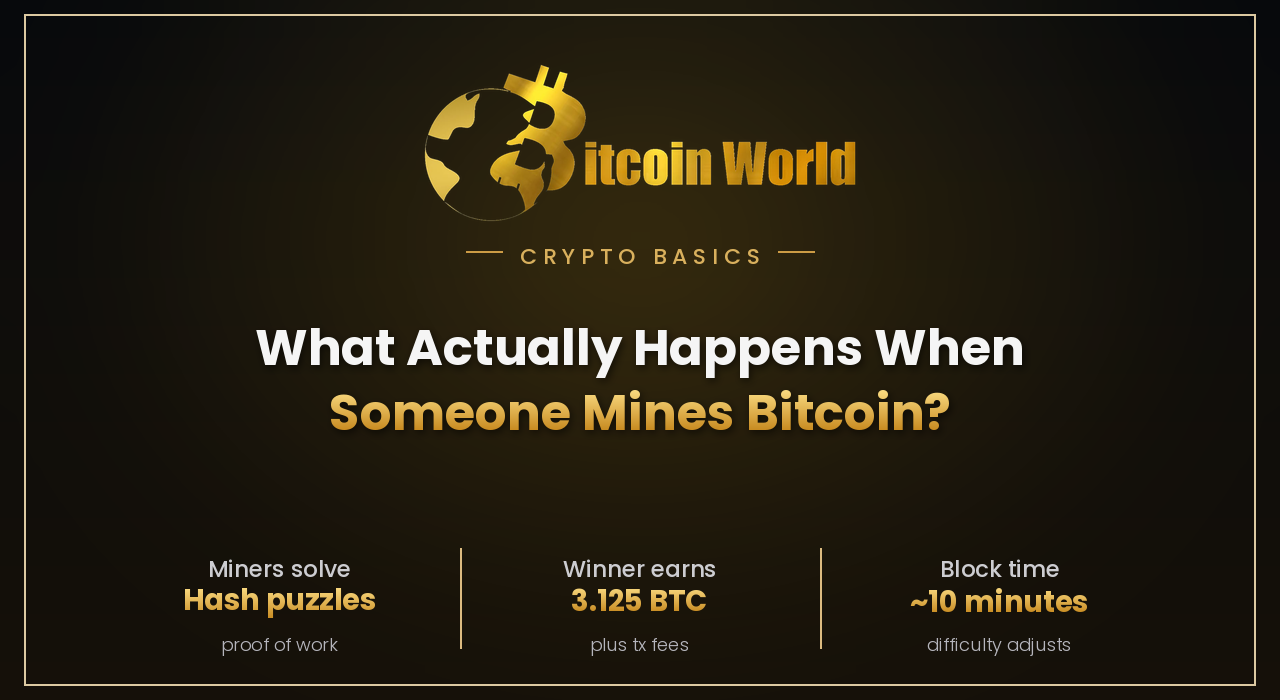
When someone mines Bitcoin, they’re using specialized computers to compete with other miners worldwide to solve a complex mathematical puzzle – and whoever solves it first gets to add the next block of transactions to the blockchain and earn a Bitcoin reward.
- The puzzle: Miners repeatedly compute a cryptographic hash (SHA-256) until they find one that meets the network’s difficulty target.
- Proof of Work: This process is called Proof of Work – the computational effort proves legitimate participation.
- Block reward: The winner earns newly created Bitcoin plus all the transaction fees in that block.
- Current reward: After the April 2024 halving, the block reward is 3.125 BTC per block.
Why Does Bitcoin Mining Require So Much Energy?
The energy use of mining is intentional and structural, not a side effect.
- Difficulty adjusts automatically: The Bitcoin network adjusts mining difficulty every 2,016 blocks (~2 weeks) to keep the average block time at ~10 minutes, regardless of how many miners are competing.
- More miners = harder puzzle: As more computing power joins the network, the puzzle gets harder, requiring more energy.
- Security through cost: The energy cost of mining is what makes rewriting blockchain history prohibitively expensive – it’s the security mechanism.
- Specialized hardware: Miners use ASIC (Application-Specific Integrated Circuit) chips designed only for this computation – far more efficient than consumer hardware but still power-hungry.
What Do Miners Actually Earn?
Mining isn’t just creating new Bitcoin – it’s a business with specific revenue streams.
- Block subsidy: New Bitcoin issued with each block – currently 3.125 BTC, halving approximately every four years.
- Transaction fees: Fees paid by users to get their transactions included in the block.
- Halving reduces supply: Every ~210,000 blocks, the block reward halves, reducing the rate of new Bitcoin creation until the final coin is mined around 2140.
- Fee dependence growing: As the block subsidy shrinks with each halving, transaction fees are expected to become the primary miner incentive over time.
Does Bitcoin Mining Make Sense for Users in India?
For individual users in India, mining economics have shifted dramatically.
- Industrial scale dominates: The era of profitably mining Bitcoin on a home computer ended years ago – the network is now dominated by large-scale operations with cheap electricity.
- High electricity cost: India’s commercial and residential electricity rates typically make small-scale mining unprofitable once hardware and power costs are factored in.
- ASIC hardware cost: A competitive mining machine costs thousands of dollars and becomes obsolete as network difficulty rises.
- Legal clarity: Mining Bitcoin is not prohibited in India, but the electricity cost and equipment investment make it viable only at industrial scale.
Frequently Asked Questions
What problem are Bitcoin miners actually solving?
Miners are repeatedly generating a cryptographic hash of a block header and looking for one that falls below the network’s current difficulty target – essentially a computational lottery where more attempts means better odds. This Proof of Work process is what actually happens when someone mines Bitcoin: it’s not solving meaningful equations but a structured guessing process designed to be hard to do and easy to verify. The first miner to find a valid hash wins the block reward.
How does Bitcoin mining create new Bitcoin?
New Bitcoin is created as the block reward – a fixed amount of BTC automatically issued to the miner who successfully adds a new block to the blockchain. This is the only mechanism by which new Bitcoin enters circulation, and the total amount is capped at 21 million coins, with the reward halving approximately every four years until all coins are mined around 2140. After that, miners will earn only transaction fees.
Is Bitcoin mining legal and profitable in India?
Bitcoin mining is legal in India – there’s no prohibition on the activity. However, individual or small-scale mining is generally unprofitable in India given current electricity rates and the industrial-scale competition from large mining operations in regions with much cheaper power. Most Indian users interested in Bitcoin exposure choose to buy on exchanges rather than mine, since the economics of small-scale mining rarely work in their favour.
Conclusion: Why Mining Is the Engine That Keeps Bitcoin Running
Understanding what actually happens when someone mines Bitcoin reveals the elegant design behind the network: mining simultaneously creates new coins, validates transactions, and secures the blockchain against tampering – all through competitive computation. For Indian users, the practical takeaway is that mining is a sophisticated industrial activity best left to large-scale operators with access to cheap electricity, while buying Bitcoin on an exchange remains the accessible route for individuals. The mining system isn’t just how Bitcoin is made – it’s why Bitcoin can be trusted.
Disclaimer: The information provided is not trading advice, Bitcoinworld.co.in holds no liability for any investments made based on the information provided on this page. We strongly recommend independent research and/or consultation with a qualified professional before making any investment decisions.
