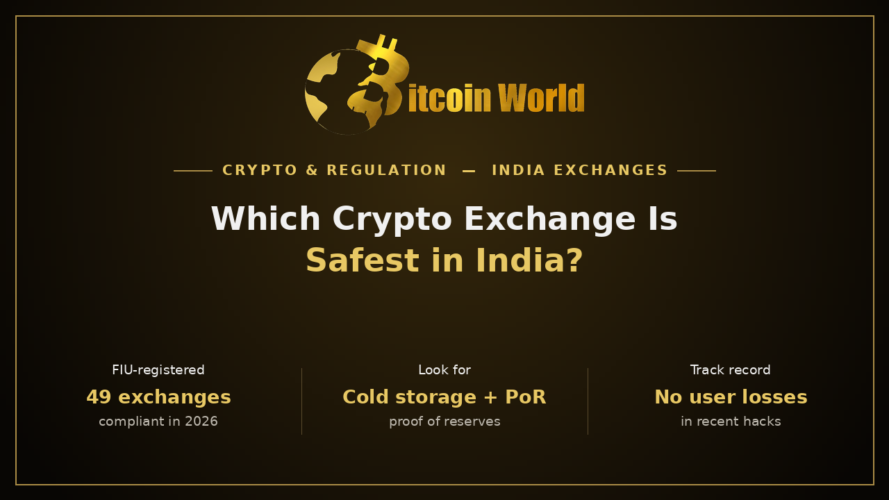
Which Crypto Exchange Is Safest in India?
In this article
No crypto exchange in India – or anywhere – can promise zero risk, but by 2026 there is a clear checklist that separates genuinely safer platforms from the rest: FIU-IND registration, segregated cold-wallet custody, published proof-of-reserves, a clean incident-response track record, and automated tax compliance. India’s crypto exchange landscape has matured considerably since the 2022–2024 period, but two major security incidents – the 2024 WazirX hack and the 2025 CoinDCX breach – showed that even large, compliant platforms remain attack targets. This article explains what “safe” actually means for an Indian exchange in 2026, which factors matter most, and how to evaluate any platform before you deposit funds.
What Does “Safe” Actually Mean for a Crypto Exchange in 2026?
Safety for an Indian crypto exchange is no longer just about avoiding hacks – it now spans three distinct pillars that together determine whether your funds and your legal standing are protected.
- Technical security: Cold-wallet storage for the majority of user funds, multi-signature controls, 2FA, withdrawal whitelisting, and resistance to both external breaches and internal fraud.
- Regulatory security: Registration as a Reporting Entity with the Financial Intelligence Unit (FIU-IND), which requires AML/CFT compliance, KYC verification, and suspicious-transaction reporting under the PMLA.
- Fiscal security: Automated 1% TDS deduction, Schedule VDA-ready tax statements, and transparent reporting – since operating on a non-compliant platform now carries its own financial and legal exposure, separate from any hack risk.
Which Factors Should You Check Before Choosing an Exchange?
Evaluating a crypto exchange’s safety in India comes down to a short list of concrete, verifiable checks rather than marketing claims.
- FIU-IND registration status: As of 2026, roughly 49 exchanges are registered as reporting entities with FIU-IND – 45 India-based and 4 offshore platforms. Confirm any exchange you’re considering is on the current list on the FIU-IND website rather than trusting the exchange’s own claims.
- Cold storage ratio: Look for exchanges that publicly state the majority of user funds are held in offline, segregated cold wallets rather than hot wallets connected to trading infrastructure – this was the single factor that protected CoinDCX customers during its 2025 breach.
- Proof-of-reserves (PoR): A small number of Indian exchanges – including CoinDCX and CoinSwitch – publish independently verifiable proof-of-reserves data. This lets users confirm the exchange actually holds the assets it claims to, rather than relying on trust alone.
- Incident history and transparency: How an exchange handled a past breach matters as much as whether one occurred. Fast public disclosure, clear communication, and use of company reserves (not user funds) to absorb losses are strong positive signals.
- Insurance or reserve funds: Some exchanges maintain a dedicated emergency fund – similar in concept to Binance’s SAFU – to reimburse users in the event of a platform-level failure.
- Withdrawal reliability: An exchange that keeps INR withdrawals running normally during a security incident, rather than freezing accounts, demonstrates operational resilience.

How Do WazirX and CoinDCX Compare After Their Recent Hacks?
The two biggest security incidents in Indian crypto exchange history offer a useful contrast in what “safe” looks like in practice.
- WazirX (2024): Attackers compromised a multisig wallet under a third-party custody arrangement, draining roughly $230 million – nearly half the exchange’s reserves. Because the breach hit the wallet holding user assets, customers were left without full access to funds for more than a year, and as of mid-2026 roughly 15% of user holdings remain locked in non-tradable Recovery Tokens.
- CoinDCX (2025): Attackers compromised an internal operational wallet used only for liquidity provisioning, stealing about $44 million. Because customer assets were held separately in segregated cold wallets, no user funds were affected, and the exchange absorbed the full loss from its own treasury while keeping INR withdrawals running.
- The key lesson: The architecture separating user funds from operational funds is what determined whether ordinary customers were exposed. An exchange can suffer a serious breach and still keep users whole – or a breach can directly hit customer holdings – depending entirely on how custody is structured behind the scenes.
What Are the Safest Practices for Indian Crypto Users, Regardless of Exchange?
No exchange-side security measure replaces good personal account hygiene – several of the biggest historical losses, in India and globally, involved compromised individual accounts rather than exchange-wide breaches.
- Enable 2FA with an authenticator app, not SMS: SIM-swap attacks make SMS-based two-factor authentication significantly weaker than app-based codes.
- Set withdrawal address whitelisting: This prevents funds from being sent to an unrecognized address even if your account is compromised.
- Don’t leave large sums on any exchange long-term: Treat exchanges as transaction points, not long-term storage – move significant holdings to a personal hardware wallet if you’re not actively trading.
- Verify official channels only: During both the WazirX and CoinDCX incidents, scammers impersonated official support accounts to phish panicked users – always confirm updates through the exchange’s verified app or website.
- Check FIU registration yourself: Don’t rely on an exchange’s homepage claim – cross-check against the FIU-IND reporting entity list directly.
Frequently Asked Questions
Is CoinDCX or WazirX safer to use in 2026?
Both are FIU-registered and operational in 2026, but they differ meaningfully in recent history. CoinDCX’s 2025 breach did not affect any customer funds, thanks to cold-wallet segregation, and the exchange absorbed the loss itself. WazirX’s 2024 hack did hit user assets directly, and a portion of affected users’ funds – about 15% – remains locked in non-tradable Recovery Tokens as of mid-2026, with full recovery dependent on the exchange’s future profitability. For users prioritizing a clean recent track record with customer funds, CoinDCX’s incident is generally viewed as the less damaging of the two from a user-impact perspective, though both exchanges have taken steps to strengthen security since.
Does FIU registration guarantee an exchange is hack-proof?
No. FIU-IND registration confirms regulatory and AML/KYC compliance – it does not certify an exchange’s technical security infrastructure or guarantee it cannot be hacked. Both WazirX and CoinDCX were FIU-compliant (or moving toward compliance) at the time of their respective breaches. Registration reduces legal and fraud risk but should be treated as one factor among several, not a standalone safety guarantee.
What is the single most reliable safety signal for an Indian crypto exchange?
There is no single perfect signal, but the separation of customer funds from operational funds in segregated cold storage is widely regarded as the most consequential technical safeguard, since it determines whether a backend breach can reach user balances at all. Combine this with FIU registration, a transparent incident history, and published proof-of-reserves for the most complete picture.
Conclusion: Safety in 2026 Is a Checklist, Not a Single Feature
Choosing the safest crypto exchange in India in 2026 means looking past marketing and checking the fundamentals yourself: confirmed FIU-IND registration, cold-wallet segregation of user funds, a transparent response history during past incidents, and – where available – published proof-of-reserves. No exchange, however large or compliant, is immune to attack; the WazirX and CoinDCX incidents both prove that determined attackers, including state-linked groups like North Korea’s Lazarus Group, continue to target Indian platforms. What separates a “safe” exchange from a risky one is not whether it has ever been targeted, but whether its architecture and response protected your funds when it was.