

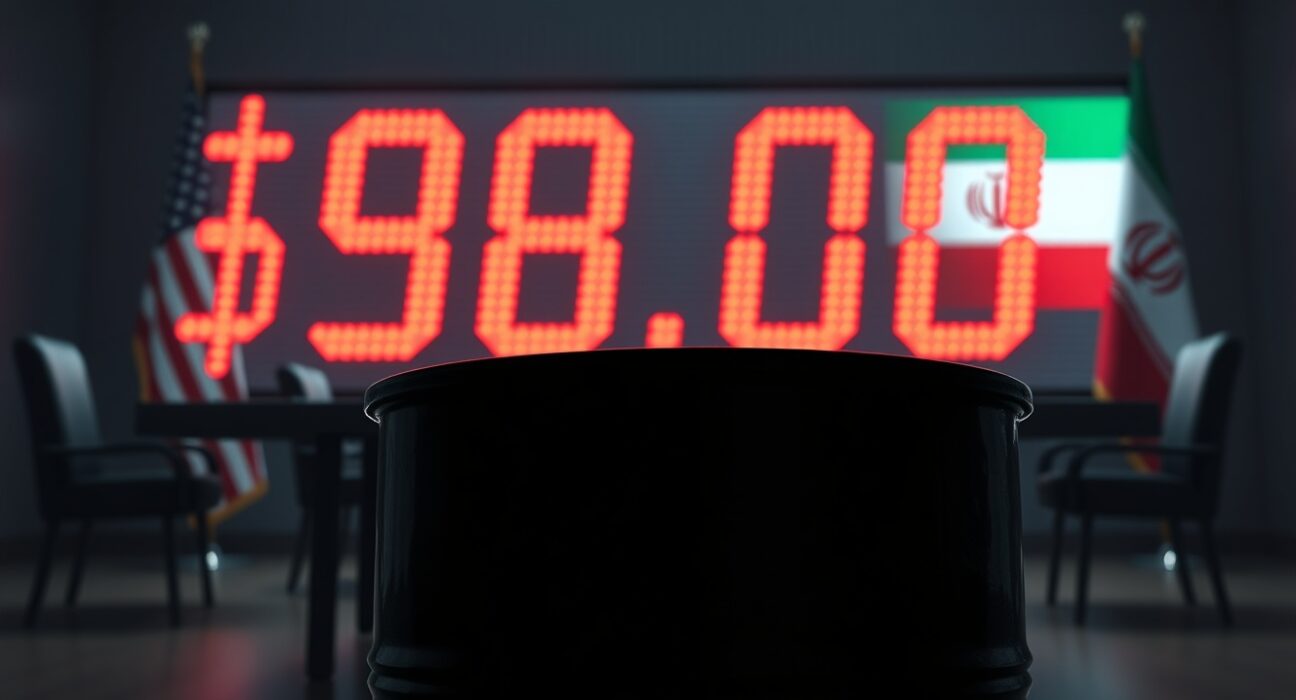
WTI Oil rises to $98.00 per barrel today as the US-Iran peace process stalls, sending shockwaves through global energy markets. This price surge marks a critical inflection point for traders, analysts, and policymakers. The stalled negotiations directly threaten supply stability in a region that produces nearly 25% of the world’s crude oil.
WTI Oil Price Surge: Key Drivers Behind the Rally
The primary catalyst for this sharp move is the breakdown in diplomatic talks between Washington and Tehran. Negotiations, which began in April 2025, aimed to revive the 2015 nuclear deal and lift sanctions on Iranian oil exports. However, both sides now accuse each other of backtracking on key commitments. This impasse eliminates the prospect of 1.5 million barrels per day (bpd) of Iranian crude returning to the market anytime soon.
Consequently, supply fears dominate trading floors. The market had priced in a gradual easing of sanctions by Q3 2025. Without that supply, the global balance tightens further. The International Energy Agency (IEA) now projects a supply deficit of 1.2 million bpd for the remainder of 2025.
Key factors driving the price jump:
- Diplomatic deadlock: Both US and Iranian officials have walked away from the table, citing unmet preconditions.
- Strategic stockpiling: Asian buyers, particularly China and India, are increasing emergency reserves, adding to demand pressure.
- OPEC+ discipline: The cartel maintains its current production cuts, refusing to compensate for lost Iranian barrels.
- Dollar weakness: The US Dollar Index (DXY) fell 0.6% today, making dollar-denominated oil cheaper for foreign buyers.
Geopolitical Risk: The US-Iran Standoff Intensifies
The stalled peace process is not just about oil. It reflects deeper strategic mistrust. The US insists on full compliance with nuclear restrictions before lifting sanctions. Iran demands a complete removal of all sanctions first. This chicken-and-egg dynamic has halted progress since mid-June 2025.
Furthermore, regional tensions have escalated. The US Navy recently deployed an additional carrier strike group to the Persian Gulf. Iran responded by accelerating its uranium enrichment program. These moves raise the risk of accidental conflict, which could disrupt the Strait of Hormuz — a chokepoint for 20% of global oil shipments.
Market participants now price in a 35% probability of a direct military confrontation within six months, according to risk consultancy Eurasia Group. This geopolitical premium adds an estimated $5–$7 per barrel to current WTI Oil prices.
Expert Analysis: What This Means for Traders
Energy analysts at Goldman Sachs revised their Q4 2025 WTI forecast upward to $105 per barrel, citing the stalled US-Iran peace process as the primary risk factor. “Without Iranian supply, the market loses its only viable buffer against OPEC+ cuts and rising demand,” the note states.
Traders should watch for:
- Weekly EIA inventory reports: Draws below 3 million barrels will confirm tightening supply.
- Iranian diplomatic signals: Any hint of resumed talks could trigger a sharp selloff.
- US SPR releases: The Strategic Petroleum Reserve stands at 375 million barrels; releases could cap prices temporarily.
Impact on Global Markets and Consumers
WTI Oil at $98.00 has immediate ripple effects across economies. Higher crude prices translate directly to elevated gasoline and diesel costs. The US national average gasoline price hit $4.15 per gallon today, up 12 cents from last week. European diesel prices rose 2.3% in a single session.
Central banks face a renewed inflation headache. The Federal Reserve and European Central Bank had expected energy prices to moderate in the second half of 2025. This rally complicates their rate-cutting plans. Markets now price in a 60% chance of a Fed hold in September, up from 40% last week.
Emerging markets suffer disproportionately. Countries like India and Turkey, which import over 80% of their oil, see their currencies weaken and trade deficits widen. India’s rupee hit a record low against the dollar today, partly due to the oil spike.
Impact summary table:
| Sector | Impact | Magnitude |
|---|---|---|
| US Gasoline | Price increase | +$0.12/gal this week |
| Airline Stocks | Share price decline | -2.5% today |
| Indian Rupee | Currency depreciation | -0.8% vs USD |
| US Dollar Index | Weakening | -0.6% |
| Brent Crude | Premium over WTI | $3.50/bbl |
Historical Context: Previous US-Iran Standoffs and Oil Prices
This is not the first time a US-Iran standoff has roiled oil markets. In 2018, the US withdrawal from the JCPOA drove WTI from $65 to $76 in three months. In 2019, the attack on Saudi Aramco’s Abqaiq facility pushed prices to $63 briefly. However, the current context is different.
Today, the global oil market is structurally tighter. OPEC+ spare capacity is at 4 million bpd, the lowest since 2022. Global oil inventories sit 150 million barrels below the five-year average. Combined with the stalled peace process, this creates a perfect storm for prices.
Moreover, the energy transition adds a new dimension. Long-term investment in new oil production has fallen by 30% since 2019. This means even if diplomacy succeeds, new supply will take years to materialize. The market’s ability to absorb shocks is structurally impaired.
Timeline of Key Events (2025)
- January 2025: US and Iran hold secret talks in Oman.
- March 2025: Both sides agree to a framework for negotiations.
- May 2025: Talks stall over verification mechanisms.
- June 2025: US imposes new sanctions on Iranian oil tankers.
- July 2025: WTI Oil breaks $90 as peace process stalls.
- August 2025: Price hits $98.00; no talks scheduled.
Supply Chain and Logistics: The Hidden Pressure Points
Beyond headline prices, the stalled US-Iran peace process affects physical oil flows. Iranian oil exports have fallen to 400,000 bpd, down from 1.5 million bpd in 2017. Most of this oil flows to China via a shadow fleet of aging tankers. Any disruption to these vessels — through sanctions enforcement or accidents — would remove even this small supply.
Insurance rates for tankers calling at Iranian ports have tripled since May 2025. Shipping companies now charge a 15% war risk premium for Gulf routes. These costs embed themselves into final crude prices, adding an estimated $1.50 per barrel.
Refineries in Europe and Asia are scrambling for alternative supply. They increasingly bid up North Sea, West African, and US grades. This competition pushes the entire crude complex higher, not just WTI.
Conclusion
WTI Oil rises to $98.00 today because the US-Iran peace process has stalled, removing a critical source of future supply. This geopolitical deadlock, combined with tight global inventories and OPEC+ discipline, creates a powerful upward price bias. For traders, the key risk is a sudden diplomatic breakthrough, which could unwind $10–$15 of premium. For consumers and policymakers, the pain is real and immediate — higher fuel costs and renewed inflation pressures. The path forward depends entirely on whether Washington and Tehran can find common ground. Until then, $100 WTI Oil looms on the horizon.
FAQs
Q1: Why did WTI Oil price rise to $98.00?
A1: WTI Oil rose to $98.00 per barrel because the US-Iran peace process stalled, removing the expectation of 1.5 million bpd of Iranian crude returning to global markets. This tightened supply outlook and added a geopolitical risk premium.
Q2: How does the stalled US-Iran peace process affect oil prices?
A2: The stalled process eliminates the chance of sanctions relief on Iranian oil exports. Markets had priced in a gradual return of Iranian barrels by late 2025. Without this supply, the global oil balance remains in deficit, pushing prices higher.
Q3: Could WTI Oil reach $100 per barrel?
A3: Yes, many analysts now see $100 as the next resistance level. If diplomatic talks remain frozen and OPEC+ continues its production cuts, WTI could test $100 within weeks. A further escalation in the Persian Gulf could accelerate this move.
Q4: What is the impact of higher WTI Oil prices on consumers?
A4: Higher WTI Oil prices directly raise gasoline, diesel, and heating oil costs. US gasoline averages $4.15 per gallon. European diesel is up 2.3%. Airline tickets and shipping costs also rise, contributing to broader inflation.
Q5: What should oil traders watch for next?
A5: Traders should monitor weekly EIA inventory reports for draws, any diplomatic signals from Washington or Tehran, and US SPR release announcements. A sudden resumption of talks could trigger a sharp selloff in WTI Oil.
Disclaimer: The information provided is not trading advice, Bitcoinworld.co.in holds no liability for any investments made based on the information provided on this page. We strongly recommend independent research and/or consultation with a qualified professional before making any investment decisions.
