

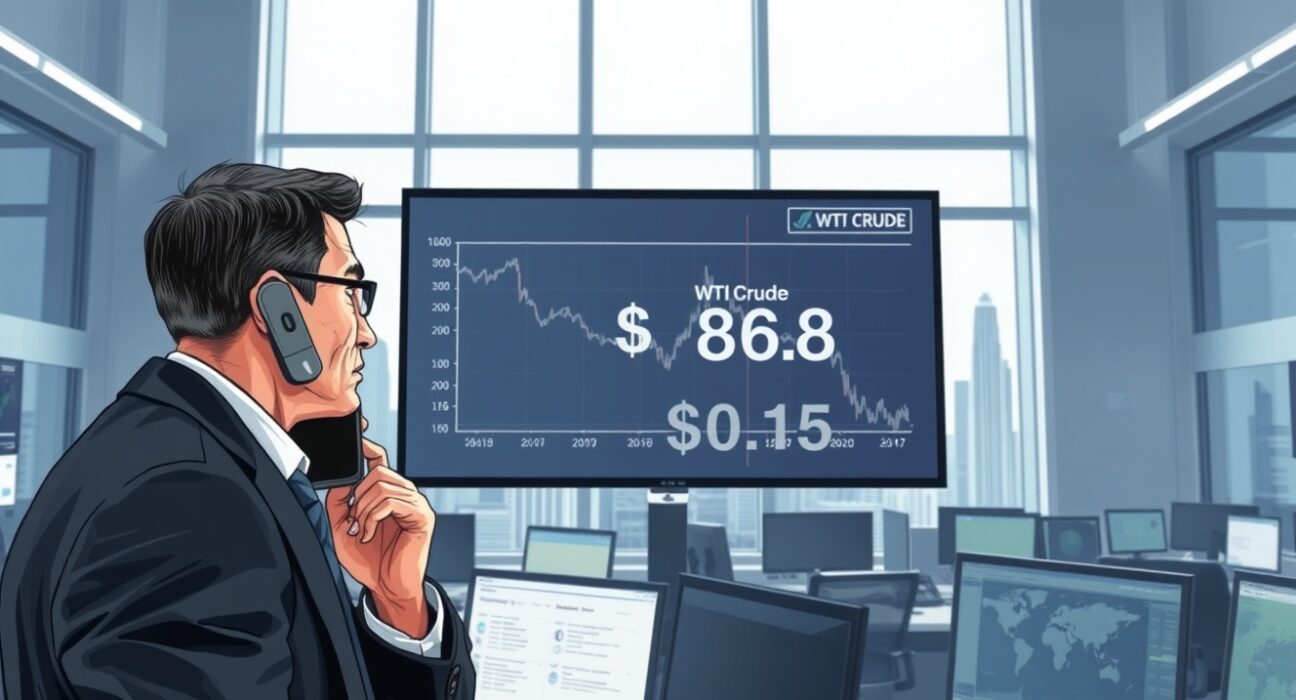
Global energy markets experienced a significant tremor on Thursday as WTI crude oil futures breached the critical $87.00 support level, tumbling to a multi-week low of $86.85 per barrel. This sudden oil price slump followed renewed diplomatic signals from former U.S. President Donald Trump regarding potential negotiations with Iran, injecting fresh uncertainty into already volatile markets. The immediate price action reflects trader concerns over a potential easing of Middle Eastern supply constraints that have supported prices throughout 2025.
WTI Price Action and Technical Breakdown
The sell-off in West Texas Intermediate (WTI) crude was both rapid and pronounced. Consequently, trading volumes spiked by approximately 45% above the 30-day average during the European session. The $87.00 level had previously acted as a strong technical support zone throughout early 2025. Furthermore, breaking this threshold triggered automated sell orders from algorithmic trading systems. Market data from the CME Group shows open interest increased during the decline, indicating new short positions rather than long liquidation.
Key technical indicators flashed bearish signals during the move:
- The 50-day moving average was decisively broken to the downside.
- The Relative Strength Index (RSI) plunged from neutral territory into oversold conditions below 30.
- Trading bands widened significantly, reflecting heightened volatility.
This technical deterioration suggests the market structure has shifted, at least temporarily. However, fundamental supply and demand factors remain the primary driver behind this geopolitical repricing.
Geopolitical Catalyst: Trump’s Iran Signals
The catalyst for the sell-off originated from political commentary rather than a physical change in oil flows. Former President Trump, during a campaign event in Michigan, suggested a renewed willingness to engage directly with Iranian leadership. “The world cannot afford another war in the Middle East,” Trump stated. “We must talk to everyone, even those we disagree with, to find solutions.” While not a formal policy announcement, financial markets interpreted these remarks as a potential precursor to diplomatic engagement.
Analysts immediately connected these signals to Iran’s substantial oil production capacity. Iran currently holds the world’s fourth-largest proven crude oil reserves. The country’s production remains constrained by U.S. sanctions, which were re-imposed after the collapse of the Joint Comprehensive Plan of Action (JCPOA). A potential diplomatic thaw could theoretically allow millions of barrels per day of Iranian oil to re-enter the global market, alleviating the structural tightness that has characterized the market.
Market Mechanics and Expert Analysis
“Markets are forward-looking mechanisms,” explained Dr. Anya Sharma, Head of Commodities Research at Global Macro Advisors. “They are pricing in a probability-weighted outcome. The mere suggestion of a U.S.-Iran dialogue introduces a non-zero chance of sanction relief. This changes the expected future supply curve, hence the price adjusts today.” Sharma emphasized that the current price move reflects a geopolitical risk premium being partially unwound. This premium, estimated by some analysts at $8-$12 per barrel, had been baked into prices due to ongoing tensions in the Strait of Hormuz and conflicts involving Iranian proxies.
The reaction also highlights the interconnected nature of modern commodity markets. Brent crude, the international benchmark, fell in tandem with WTI, though its decline was slightly less severe due to different regional supply dynamics. The price spread between the two benchmarks narrowed slightly. Meanwhile, energy sector equities and related exchange-traded funds (ETFs) also saw pronounced selling pressure.
Historical Context and Supply-Demand Balance
To understand the market’s sensitivity, one must examine the current global inventory situation. The International Energy Agency (IEA), in its latest monthly report, noted that global commercial oil stocks had fallen for five consecutive quarters. OECD industry stocks stood at their lowest level since 2015. This tight physical backdrop makes the market exceptionally reactive to any news that could alter the supply trajectory.
| Region/Factor | Status | Impact on Price |
|---|---|---|
| OPEC+ Production Cuts | Extended through Q2 | Supportive |
| U.S. Shale Growth | Moderate, capital disciplined | Neutral |
| Global Demand Growth | Steady at ~1.2 million bpd | Supportive |
| Strategic Petroleum Releases | Minimal, reserves low | Neutral/Supportive |
| Geopolitical Risk Premium | High (Middle East, Russia) | Significantly Supportive |
Into this delicate balance, the prospect of Iranian barrels represents a substantial variable. Prior to the re-imposition of sanctions in 2018, Iran was exporting over 2.5 million barrels per day. Current estimates from tanker-tracking firms place its exports below 1 million bpd, with much of the oil moving at steep discounts to shadowy buyers. A legitimate return of even half of that shut-in capacity would meaningfully alter the global supply equation.
Broader Market Impacts and Trader Sentiment
The oil price slump had immediate ripple effects across related asset classes. The U.S. Dollar Index (DXY) strengthened as oil’s decline eased inflation concerns, potentially altering the calculus for the Federal Reserve. Energy-sensitive currencies, like the Canadian and Norwegian kroner, weakened against the greenback. Conversely, transportation and industrial stocks saw a brief rally on the prospect of lower input costs.
Trader positioning data from the Commodity Futures Trading Commission (CFTC) revealed that managed money accounts, including hedge funds, had built near-record net-long positions in WTI futures in the weeks preceding the drop. This crowded trade likely exacerbated the downward move as some participants rushed for the exits. “The market was leaning heavily one way,” noted veteran floor trader Michael Chen. “When the geopolitical wind shifted, even slightly, it caused a sharp correction. This is classic risk premium evaporation.”
Physical market differentials also showed signs of softening. The premium for prompt delivery of crude (a market structure known as backwardation) narrowed slightly. This indicates that immediate supply tightness, while still present, is perceived as less severe than it was before the Trump comments.
The Road Ahead: Volatility and Verification
The critical question for traders and analysts now is whether this is a short-term sentiment-driven move or the start of a more sustained downtrend. Much depends on the verification and follow-through of the political signals. Market participants will scrutinize any official statements from the U.S. State Department or the Iranian Foreign Ministry for clarity. Furthermore, the upcoming OPEC+ monitoring committee meeting will be watched closely for any reaction from key producers like Saudi Arabia and Russia, who have a vested interest in maintaining price stability.
Technical analysts point to the next major support level for WTI around $84.50, which coincides with the 100-day moving average and a previous consolidation zone from late 2024. A break below that level could signal a deeper correction towards $80. On the upside, any retraction or clarification of the diplomatic signals could see a swift rebound, with initial resistance now established at the former support of $87.00.
Conclusion
The WTI crude oil sell-off below $87.00 serves as a powerful reminder of the commodity’s acute sensitivity to geopolitical headlines. While the fundamental supply picture remains tight, the market is proactively discounting a potential shift in one of its key risk factors: Iranian supply. The move underscores the high geopolitical risk premium embedded in current prices and the market’s fragile equilibrium. Going forward, price action will hinge on the credibility and progression of any diplomatic outreach, balanced against the unwavering realities of global inventory levels and OPEC+ policy. For now, volatility is the only certainty in the energy complex.
FAQs
Q1: Why did WTI crude oil prices fall below $87?
The primary catalyst was political commentary from former President Donald Trump suggesting a potential openness to diplomatic talks with Iran. Markets interpreted this as a risk that could lead to the easing of sanctions and a return of Iranian oil exports, increasing global supply.
Q2: How much Iranian oil could come back to the market?
Prior to sanctions, Iran exported over 2.5 million barrels per day. Current exports are estimated below 1 million bpd. A full sanction relief could theoretically bring 1.5-2.0 million barrels per day back to the formal market, though infrastructure constraints might slow the initial return.
Q3: Is this a long-term trend or a short-term reaction?
It is currently a sentiment-driven reaction to a geopolitical signal. The longevity of the price move depends on whether concrete diplomatic steps follow the rhetoric and how other supply factors, like OPEC+ production decisions, evolve.
Q4: What is the ‘geopolitical risk premium’ in oil prices?
This refers to the portion of an oil barrel’s price attributed to the potential for supply disruptions from political unrest, conflict, or sanctions. Analysts often estimate this premium by comparing current prices to models based solely on supply-demand fundamentals.
Q5: How does this affect gasoline prices for consumers?
There is typically a correlation between crude oil (the feedstock) and refined products like gasoline. A sustained drop in WTI prices would likely translate to lower wholesale gasoline costs, which could eventually be passed on to consumers at the pump, barring other refinery or distribution issues.
Disclaimer: The information provided is not trading advice, Bitcoinworld.co.in holds no liability for any investments made based on the information provided on this page. We strongly recommend independent research and/or consultation with a qualified professional before making any investment decisions.
