

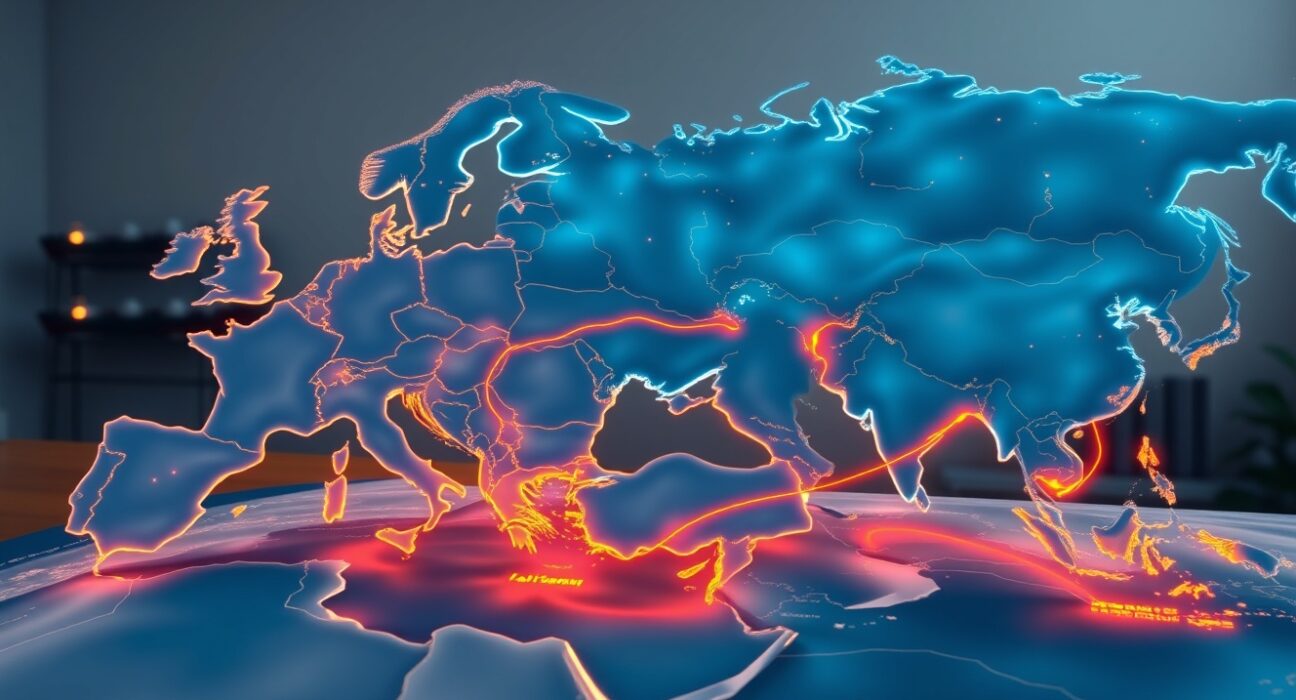
WASHINGTON, D.C., March 15, 2025 – Former U.S. President Donald Trump has issued a stark warning to key European allies, explicitly criticizing the United Kingdom and France for their reliance on vulnerable global oil supply chains. Consequently, he has urged both nations to develop and secure independent energy transit routes. This statement, made during a policy address, immediately reverberated through global energy markets and diplomatic circles. Furthermore, it highlights a growing geopolitical fault line concerning resource security.
Trump’s Directive on Oil Routes and Energy Security
Former President Trump framed energy independence as a non-negotiable component of national sovereignty. Specifically, he argued that nations controlling their resource logistics wield greater geopolitical power. His comments focused on the persistent vulnerabilities in maritime chokepoints that supply Europe. For instance, he referenced the Strait of Hormuz and the Bab el-Mandeb Strait. These narrow passages see millions of barrels of oil transit daily. Any disruption there could cripple European economies within weeks. Therefore, Trump’s message was unequivocal: allies must not outsource their energy security.
Energy analysts quickly contextualized the remarks. Dr. Anya Petrova, a senior fellow at the Global Energy Security Institute, noted, “The critique aligns with a longstanding Trump doctrine prioritizing unilateral energy resilience over multilateral dependence. However, it overlooks the complex, integrated nature of Europe’s energy grid and its decades-long diversification efforts.”
The Geopolitical Backdrop of Oil Transit
The timing of this intervention is significant. Global oil markets currently face pressure from multiple directions. Recent tensions in the Middle East have escalated insurance costs for shipping. Simultaneously, attacks on undersea infrastructure in the North Sea have raised new concerns. Additionally, the ongoing reorganization of global trade alliances post-2022 has forced nations to re-evaluate supply lines. The following table outlines key chokepoints affecting UK and French oil imports:
| Chokepoint | Location | Estimated Daily Oil Flow | Primary Risk Factors |
|---|---|---|---|
| Strait of Hormuz | Middle East | 21 million barrels | Regional conflict, maritime seizures |
| Bab el-Mandeb Strait | Red Sea / Gulf of Aden | 6.2 million barrels | Piracy, regional instability |
| Suez Canal | Egypt | 5.5 million barrels | Political instability, blockages |
| English Channel | UK/France | 3.8 million barrels | Congestion, accidents, sovereignty disputes |
UK and French Energy Strategies Under Scrutiny
The United Kingdom and France have pursued divergent, yet interconnected, energy pathways. The UK, post-Brexit, has aggressively expanded its North Sea licensing while investing in renewable sources like offshore wind. Conversely, France maintains a robust nuclear energy fleet, which supplies about 70% of its electricity. However, both nations remain heavily reliant on imported crude oil for transportation and industry. Significantly, neither possesses a strategic oil reserve network comparable to the U.S. Strategic Petroleum Reserve.
Trump’s criticism implicitly targets this import dependency. He suggested that both nations should leverage their maritime capabilities and historical ties to secure preferential transit agreements. Potential strategies could include:
- Investing in sovereign tanker fleets to reduce reliance on third-party shippers.
- Developing alternative port infrastructure on the Atlantic coast to bypass traditional chokepoints.
- Forming new bilateral energy corridors with producer nations in West Africa and the Americas.
- Accelerating strategic fuel reserve programs to buffer against supply shocks.
Market Reactions and Expert Analysis
Following the remarks, Brent crude futures experienced a brief uptick of 2.3%. Market sentiment reflected renewed anxiety over supply chain fragility. Energy security experts offered mixed reactions. “The principle of securing routes is sound,” stated Michael Thorne, a former Royal Navy commodore and logistics specialist. “However, the execution is phenomenally complex and costly. It requires decades of naval diplomacy, infrastructure investment, and likely, a renegotiation of countless international maritime laws.”
Other analysts pointed to the financial implications. A 2024 report by the Oxford Institute for Energy Studies estimated that “insuring” a national oil route could add $3-$7 per barrel to import costs. For a nation like France, importing approximately 1 million barrels per day, this could translate to over $1.5 billion in annual additional costs.
The Broader Impact on Global Energy Diplomacy
This public admonishment of close allies signals a potential shift in transatlantic energy discourse. Traditionally, European energy security has been discussed within frameworks like NATO and the G7. Trump’s unilateral framing challenges that consensus. It advocates for a more fragmented, nation-first approach to resource security. Consequently, this could encourage other import-dependent nations to pursue similar policies, potentially leading to increased competition for secure transit deals.
The long-term impacts are multifaceted. On one hand, it could spur innovation in logistics and fuel diversification. On the other, it might weaken collective bargaining power and destabilize the rules-based order governing global shipping. The International Energy Agency (IEA) has consistently warned that a “balkanization” of energy supply chains reduces overall system resilience. A diversified but cooperative system, they argue, is more robust than multiple isolated ones.
Conclusion
Donald Trump’s critique of UK and French oil route security underscores a fundamental tension in modern geopolitics: interdependence versus sovereignty. While his warning highlights genuine vulnerabilities in global energy transit networks, the path to securing independent oil routes is fraught with economic, diplomatic, and logistical hurdles. The response from London and Paris will likely involve a careful recalibration of existing strategies, blending increased domestic production, accelerated green transitions, and enhanced diplomatic efforts to safeguard existing supply lines. Ultimately, the debate over these critical oil routes will remain central to discussions of national security and economic stability for years to come.
FAQs
Q1: What specific oil routes is Donald Trump referring to?
Trump’s comments broadly refer to the maritime corridors through which the UK and France import crude oil, primarily from the Middle East and Africa. Key chokepoints include the Strait of Hormuz, the Bab el-Mandeb Strait, the Suez Canal, and the English Channel itself.
Q2: How reliant are the UK and France on imported oil?
Both nations are significant net importers. The UK imports nearly 40% of the oil it consumes, primarily for refining and transportation. France imports approximately 99% of its crude oil needs, despite its high nuclear electricity generation, as oil is vital for its transport and industrial sectors.
Q3: What does “securing their own oil routes” practically involve?
Practically, it could involve nations developing their own state-backed shipping fleets, investing in port infrastructure outside traditional chokepoints, negotiating exclusive military or security agreements for passage, and building larger strategic petroleum reserves to insulate from disruptions.
Q4: Has Europe made progress in reducing oil dependency since 2022?
Yes, but progress is mixed. The EU’s REPowerEU plan accelerated renewable energy deployment. However, oil demand for transport and industry has proven stubborn. Diversification of suppliers has increased, but the physical transit routes remain largely unchanged and concentrated.
Q5: What are the main arguments against pursuing fully independent oil routes?
The primary arguments are cost, diplomatic complexity, and diminished collective security. Building parallel, sovereign logistics chains is prohibitively expensive. It also requires navigating complex international laws and could undermine the unified diplomatic front that often deters aggression against global shipping lanes.
Disclaimer: The information provided is not trading advice, Bitcoinworld.co.in holds no liability for any investments made based on the information provided on this page. We strongly recommend independent research and/or consultation with a qualified professional before making any investment decisions.
