

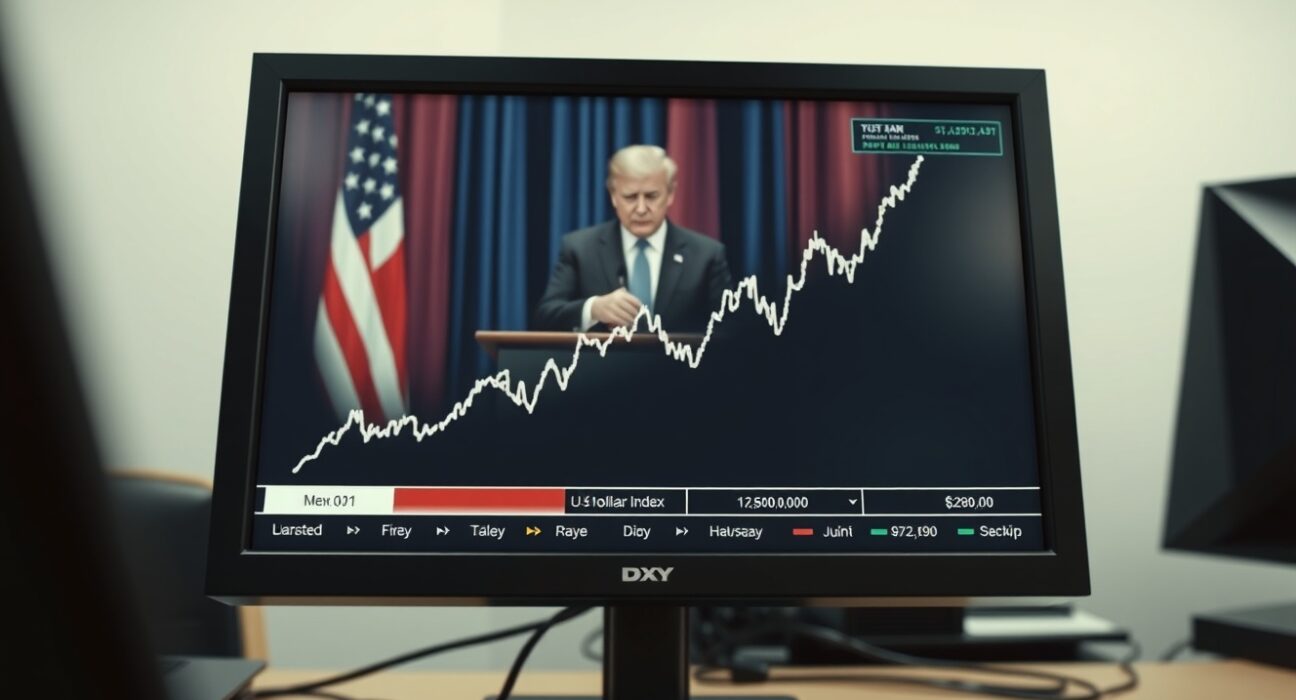
NEW YORK, March 15, 2025 – The US Dollar Index (DXY) climbed decisively in early trading, approaching the psychologically significant 100.00 level. This surge follows remarks from former President Donald Trump that provided no clear timeline for a potential Iran ceasefire, thereby injecting fresh uncertainty into global currency markets. Consequently, traders are flocking to the dollar’s traditional safe-haven status.
US Dollar Index Rally Amid Geopolitical Fog
The DXY, which measures the dollar against a basket of six major currencies, advanced by 0.8% to trade near 99.85. Market analysts immediately linked the move to heightened geopolitical risk premiums. Specifically, Trump’s comments, made during a campaign event, avoided committing to a diplomatic resolution timeline with Iran. This ambiguity contrasts with recent weeks of tentative market optimism. Therefore, currency traders are reassessing the outlook for Middle East stability and its implications for energy flows and global trade.
Historical data shows the dollar often strengthens during periods of international tension. For instance, the index saw similar rallies during the initial phases of the Russia-Ukraine conflict in 2022. The current move suggests markets are pricing in a prolonged period of friction. “The market hates uncertainty more than it hates bad news,” noted Claudia Vance, Chief Strategist at Meridian Global Advisors. “A clear, even if negative, outcome can be priced. Ambiguity forces a constant reassessment of risk, which benefits the dollar.”
Analyzing the Trump Administration’s Iran Policy Stance
Foreign policy experts are parsing the implications of the former president’s rhetoric. The lack of a defined ceasefire timeline leaves open multiple scenarios, from continued stalemate to escalated hostilities. This policy stance directly affects market sentiment. Importantly, Iran is a major oil producer, and regional instability threatens supply chains. As a result, oil prices also edged higher, reinforcing the dollar’s appeal as the primary pricing currency for commodities.
A comparison of recent administration statements reveals a strategic shift:
| Date | Official | Key Statement on Iran | Market Reaction (DXY) |
|---|---|---|---|
| Feb 28, 2025 | State Dept. Spokesperson | “Dialogue channels remain open.” | DXY -0.2% |
| Mar 10, 2025 | National Security Advisor | “All options are on the table.” | DXY +0.4% |
| Mar 15, 2025 | Former President Trump | “We’ll see what happens. No deadlines.” | DXY +0.8% |
Expert Insight on Currency Market Mechanics
Dr. Aris Thorne, a professor of international finance at Kellerton University, explains the underlying mechanics. “The dollar’s strength isn’t solely about flight to safety,” Thorne stated. “It’s also about interest rate differentials and relative economic stability. However, when geopolitical events cloud the global growth outlook, the Federal Reserve’s policy path appears more predictable relative to other central banks. This perception solidifies the dollar’s yield advantage.” Thorne’s research indicates that geopolitical risk events can account for up to 15% of major currency pair volatility in the immediate aftermath.
Broader Market Impacts and Currency Pair Movements
The dollar’s broad strength manifested across major forex pairs. The euro (EUR/USD) fell 0.9%, breaching the 1.07 support level. Similarly, the Japanese yen (USD/JPY), typically a safe haven itself, weakened as the dollar’s yield appeal overshadowed yen demand. Meanwhile, commodity-linked currencies like the Australian and Canadian dollars also retreated. This pattern underscores the dollar’s dominant role in the global financial system during stress periods.
Key immediate impacts include:
- Increased volatility in emerging market currencies and assets.
- Pressure on gold prices, which often compete with the dollar as a safe haven.
- Higher hedging costs for multinational corporations with international exposure.
Furthermore, the rising DXY has implications for US corporate earnings. A stronger dollar makes American exports more expensive abroad. It also reduces the value of overseas profits when converted back to dollars. Several S&P 500 companies have cited currency headwinds in recent earnings calls, a trend that could accelerate if the index sustains levels above 100.00.
Historical Context and the 100.00 Psychological Level
The 100.00 mark on the US Dollar Index represents a major technical and psychological barrier. The index last traded consistently above this level in the early 2020s during the initial pandemic market turmoil. A sustained break above it would signal a fundamental reassessment of the dollar’s value. Technical analysts are watching trading volume and momentum indicators closely. A clean breakout could open the path toward the 102.00 resistance area established in 2020.
Market participants are now monitoring several key data points. Upcoming US inflation data and Federal Reserve commentary will interact with the geopolitical narrative. Additionally, any official statements from European or Asian allies regarding Iran policy could shift sentiment. The interplay between geopolitics and central bank policy will likely dictate the DXY’s trajectory through the second quarter.
Conclusion
The US Dollar Index’s advance toward 100.00 highlights the market’s acute sensitivity to geopolitical guidance. Former President Trump’s ambiguous comments on an Iran ceasefire timeline have effectively removed a near-term anchor for stability expectations. Consequently, the dollar has strengthened as the default asset for risk aversion. Moving forward, traders will weigh further political developments against economic fundamentals. The durability of this rally depends on whether geopolitical uncertainty persists or gives way to clearer diplomatic signals. For now, the path of least resistance for the DXY appears upward.
FAQs
Q1: What is the US Dollar Index (DXY)?
The US Dollar Index is a measure of the value of the United States dollar relative to a basket of six major world currencies: the Euro, Japanese Yen, British Pound, Canadian Dollar, Swedish Krona, and Swiss Franc. It provides a broad indication of the dollar’s international strength.
Q2: Why does geopolitical uncertainty strengthen the US dollar?
The US dollar is considered the world’s primary reserve currency and a “safe-haven” asset. During times of global uncertainty or crisis, international investors often sell riskier assets and buy US dollars and dollar-denominated assets like Treasury bonds, seeking stability and liquidity.
Q3: How does the situation with Iran specifically affect currency markets?
Iran is a major oil producer in a volatile region. Uncertainty about conflict or supply disruptions can drive up oil prices and fears of broader economic slowdowns. This pushes investors toward safe havens. Additionally, the US dollar is the currency used for most global oil transactions.
Q4: What does a DXY level of 100.00 signify?
The 100.00 level is a key psychological and technical benchmark. It indicates the dollar is very strong relative to its historical average against the basket. A sustained break above it often requires a significant shift in fundamental drivers, such as major interest rate differentials or prolonged global risk aversion.
Q5: Could this dollar strength hurt the US economy?
Potentially, yes. A very strong dollar makes U.S. exports more expensive for foreign buyers, which can hurt manufacturing and agricultural sectors. It also reduces the value of overseas profits for American multinational companies when converted back to dollars, potentially impacting stock market earnings.
Disclaimer: The information provided is not trading advice, Bitcoinworld.co.in holds no liability for any investments made based on the information provided on this page. We strongly recommend independent research and/or consultation with a qualified professional before making any investment decisions.
