

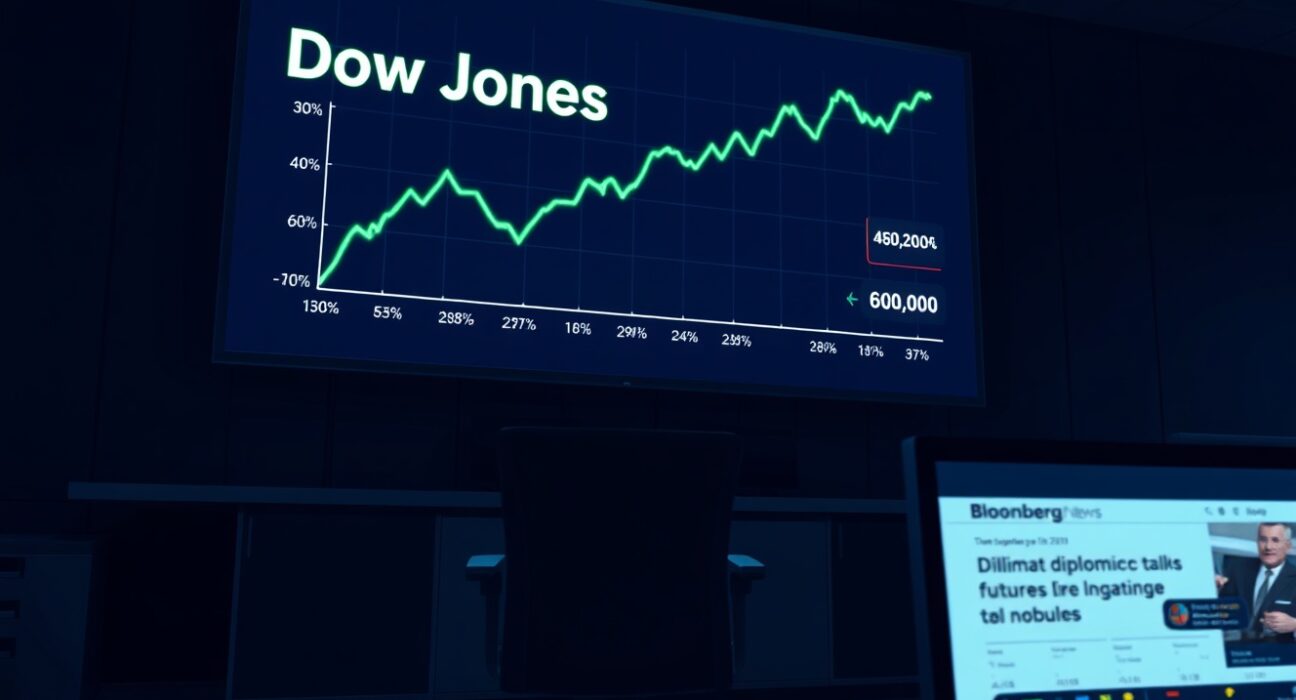
NEW YORK, January 2025 – Dow Jones Industrial Average futures staged a significant pre-market recovery early Tuesday, erasing a substantial portion of their recent geopolitical-driven losses. This sharp rebound follows multiple credible reports from diplomatic and financial news sources suggesting that backchannel communications between the United States and Iran have intensified, potentially laying the groundwork for formal ceasefire negotiations. Consequently, market participants are swiftly reassessing the premium priced into equities for Middle Eastern conflict risk.
Dow Jones Futures Rebound on Geopolitical De-escalation Hopes
The overnight trading session witnessed a pronounced shift in sentiment. Specifically, Dow Jones futures, which track the benchmark industrial average, climbed over 400 points, or approximately 1.2%. This move effectively recouped most of the losses sustained during the previous week’s sell-off. That downturn was directly triggered by escalating regional tensions and fears of a broader conflict disrupting global energy supplies and trade routes. Market analysts immediately linked the rally to a flurry of reports from agencies including Reuters and Bloomberg. These reports cited unnamed officials from neutral nations indicating that diplomatic feelers have been exchanged.
Furthermore, the price action reflects a classic ‘risk-on’ maneuver by institutional investors. The VIX volatility index, often called the market’s ‘fear gauge,’ retreated sharply by 15% in tandem with the futures rally. This inverse relationship underscores how geopolitical developments directly translate into market pricing. Trading volumes in both equity futures and key safe-haven assets like Treasury bonds and gold were notably elevated, confirming the news-driven nature of the move.
The Mechanics of a Geopolitical Market Pivot
Financial markets constantly discount future risks. Last week, traders priced in a higher probability of supply chain disruption and oil price spikes. The new reports, however, are forcing a rapid recalculation. “Markets are narrative-driven machines,” explains Dr. Anya Sharma, Chief Global Strategist at Meridian Capital. “The narrative shifted overnight from ‘escalation’ to ‘potential de-escalation.’ This doesn’t mean a deal is done, but it reduces the immediate tail risk, which is enough to fuel a short-term rally.” This analysis is supported by concurrent moves in related markets. Brent crude oil futures fell nearly 3%, while the U.S. Dollar Index softened slightly as demand for safe-haven currencies waned.
Historical Context of US-Iran Tensions and Market Impact
The relationship between Washington and Tehran has been a persistent source of market volatility for decades. Key flashpoints, such as the 2019 attacks on Saudi oil facilities and the 2020 assassination of General Qasem Soleimani, triggered immediate and severe market reactions. For instance, the S&P 500 fell over 1.5% following the latter event. The current situation carries similar weight, as the Strait of Hormuz remains a critical chokepoint for nearly 20% of the world’s oil consumption. Any threat to its stability sends shockwaves through global financial systems.
A brief timeline of recent market-moving events includes:
- Late 2024: Renewed sanctions and naval incidents lead to a steady ‘risk-off’ drift in equities.
- Early January 2025: A direct confrontation results in a 2% single-day drop in the Dow Jones Industrial Average.
- Mid-January 2025: The current reporting on backchannel talks emerges, catalyzing the futures recovery.
This pattern demonstrates the sensitivity of capital markets to headlines from this region. Importantly, the speed of the futures rebound highlights how algorithmic and high-frequency trading programs can amplify moves based on news sentiment analysis.
Sector-by-Sector Analysis of the Recovery
The rally was not uniform across all industries. Sectors most exposed to geopolitical risk and oil prices experienced the most dramatic rebounds. The following table illustrates the differential performance in key S&P 500 sector futures:
| Sector | Futures Gain (%) | Primary Catalyst |
|---|---|---|
| Energy | +2.8 | Falling oil prices reduce cost pressures, boost refining margins. |
| Industrials & Aerospace | +1.9 | Reduced fear of disrupted global supply chains and logistics. |
| Financials | +1.5 | Lower volatility and a steeper yield curve improve outlook. |
| Technology | +0.8 | Generally less directly impacted, but benefits from broader risk-on mood. |
Conversely, traditional safe-haven sectors like utilities and consumer staples underperformed. This rotation is a textbook signal of changing investor appetite for risk. Major industrial companies with significant international exposure, such as Caterpillar and Boeing, saw outsized gains in their pre-market stock prices. Meanwhile, airline stocks rallied on the prospect of lower jet fuel costs.
Expert Insight on Sustainable Momentum
While the initial reaction is positive, experts urge caution. “Futures moves on headlines are often sharp but can be fleeting,” notes Michael Chen, a veteran floor trader at the New York Stock Exchange. “The real test will be the cash market open and subsequent days. We need to see follow-through buying and expanding volume to confirm this isn’t just a short-covering bounce.” He emphasizes that the core fundamentals of the U.S. economy—interest rates, corporate earnings, and inflation—will reassert themselves as the primary drivers once the initial geopolitical shock subsides.
Global Market Reactions and Interconnected Risks
The reverberations extended far beyond Wall Street. European markets, including the FTSE 100 and DAX, opened significantly higher. Asian bourses, which had closed before the news broke fully, are anticipated to play catch-up in their next session. In the Middle East, regional stock indexes in Saudi Arabia and Qatar also posted gains. This global synchronicity underscores the interconnected nature of modern finance. A reduction in tension in the Gulf is perceived as a net positive for global trade and economic growth prospects.
However, analysts also point to remaining risks. The diplomatic process is described as fragile and preliminary. Any contradictory statement from hardline factions in either country could swiftly reverse the market’s gains. Furthermore, other global hotspots continue to present challenges. Therefore, the overall market environment remains one of elevated caution, albeit with a slightly improved outlook.
Conclusion
The powerful recovery in Dow Jones futures serves as a stark reminder of the financial market’s acute sensitivity to geopolitical developments. The reported shift toward potential US-Iran ceasefire talks provided the catalyst for a broad-based risk rally, particularly in sectors most beaten down by prior escalation fears. While this development offers a welcome respite for investors, the sustainability of the gains hinges on tangible diplomatic progress and the underlying health of the global economy. Markets will continue to monitor the situation closely, balancing hope for peace against the complex realities of international relations.
FAQs
Q1: What exactly are Dow Jones futures?
Dow Jones futures are financial contracts that allow investors to bet on or hedge against the future value of the Dow Jones Industrial Average. They trade nearly 24 hours a day and are a key indicator of where the main stock market index is expected to open when regular trading begins.
Q2: Why do US-Iran tensions affect the stock market?
Tensions threaten the stability of the Middle East, a critical region for global oil production. Fears of supply disruptions can spike oil prices, increase costs for businesses, fuel inflation, and slow economic growth, all of which are negative for corporate profits and stock valuations.
Q3: Is a futures market recovery a guarantee the main market will rise?
Not always, but it is a strong leading indicator. Pre-market futures activity sets the tone for the regular trading session. However, the cash market’s actual movement can be influenced by different factors, including economic data released after the open or changes in the news narrative.
Q4: What other assets typically move when geopolitical risk changes?
Alongside equities, key assets include crude oil prices (rise with risk, fall with peace hopes), gold (a safe-haven that rises with fear), U.S. Treasury bonds (another safe-haven), and the Swiss Franc or Japanese Yen (safe-haven currencies).
Q5: How should long-term investors react to such news-driven volatility?
Financial advisors generally recommend that long-term investors maintain a disciplined, diversified portfolio strategy and avoid making impulsive trades based on headlines. Short-term geopolitical volatility is often noise in the context of a multi-decade investment horizon focused on fundamental economic growth.
Disclaimer: The information provided is not trading advice, Bitcoinworld.co.in holds no liability for any investments made based on the information provided on this page. We strongly recommend independent research and/or consultation with a qualified professional before making any investment decisions.
