

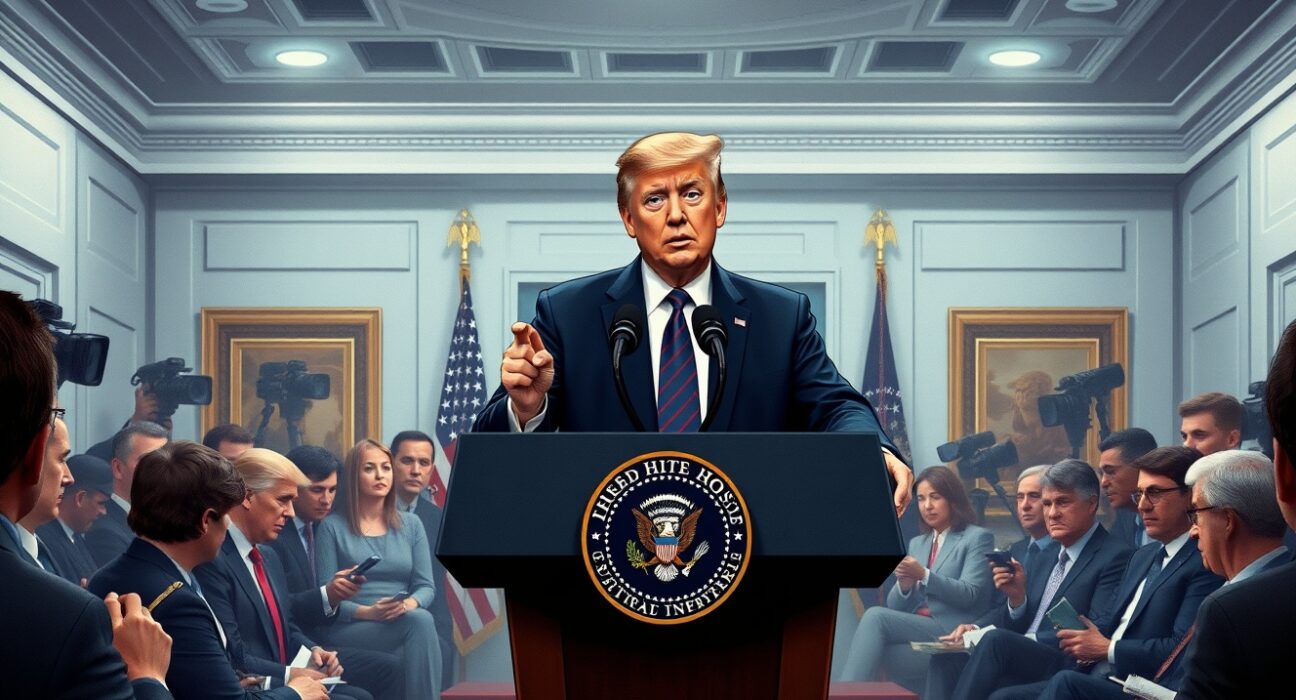
WASHINGTON, D.C., April 6 – In a startling declaration that has sent shockwaves through diplomatic circles, President Donald Trump asserted during a White House press conference that the United States military possesses operational plans capable of completely destroying Iran’s critical infrastructure within a precise four-hour window. This Trump Iran military threat represents one of the most specific public statements regarding potential military action against the Islamic Republic in recent years.
Analyzing Trump’s Specific Military Claim Against Iran
President Trump made his remarks during a scheduled press briefing at the White House. He stated unequivocally that U.S. military planners have already established detailed operational blueprints. Furthermore, these plans could paralyze Iran’s power grid and demolish all major bridges within exactly four hours. The President specified this hypothetical operation would occur between 12:00 a.m. and 4:00 a.m. UTC on April 8. Consequently, this precise timing suggests military planners have considered optimal conditions for such an operation.
Military analysts immediately began examining the technical feasibility of this claim. For instance, Iran maintains an extensive network of approximately 1,200 major bridges and hundreds of power generation facilities. Therefore, coordinating simultaneous strikes across a nation spanning 1.6 million square kilometers presents significant logistical challenges. However, modern precision-guided munitions and advanced surveillance capabilities could theoretically enable such operations.
Historical Context of US-Iran Military Tensions
The relationship between the United States and Iran has remained tense for decades. Specifically, since the 1979 Iranian Revolution, both nations have engaged in periodic confrontations. Recent years have witnessed several escalations, including the targeted killing of Iranian General Qasem Soleimani in January 2020. Additionally, Iran’s nuclear program continues to be a major point of contention in international diplomacy.
Regional experts note that infrastructure targeting represents a significant escalation in rhetoric. Traditionally, military discussions have focused on nuclear facilities or military installations. However, targeting civilian infrastructure like bridges and power plants crosses into different strategic territory. Such actions could potentially violate international laws governing armed conflict, particularly regarding proportionality and distinction between military and civilian targets.
Military Capabilities and Strategic Implications
The United States maintains substantial military assets in the Middle East region. Currently, the U.S. Fifth Fleet operates from Bahrain, while numerous air bases exist throughout the Persian Gulf. Advanced aircraft like the B-2 Spirit stealth bomber and F-35 Lightning II possess capabilities for penetrating sophisticated air defense systems. Moreover, the U.S. Navy’s carrier strike groups provide additional strike options.
Iran, meanwhile, has developed extensive asymmetric warfare capabilities. The nation’s military strategy emphasizes coastal defense, missile systems, and proxy forces throughout the region. Iranian leaders have repeatedly warned that any attack on their territory would trigger responses against U.S. interests across the Middle East. Consequently, regional stability hangs in a delicate balance.
International Reactions and Diplomatic Fallout
International responses to President Trump’s statement emerged rapidly. European allies expressed concern about escalating rhetoric. Simultaneously, regional powers monitored developments closely. The United Nations Secretary-General’s office issued a statement urging restraint from all parties. Furthermore, diplomatic channels reportedly activated to clarify the President’s comments.
Market reactions demonstrated immediate economic impacts. Oil prices experienced volatility following the announcement. Brent crude futures initially jumped before settling. Global energy markets remain sensitive to Middle Eastern stability. Additionally, shipping insurance rates for vessels transiting the Strait of Hormuz may face adjustments.
Legal and Ethical Considerations of Infrastructure Targeting
International humanitarian law establishes clear guidelines for military operations. The Geneva Conventions and Additional Protocols prohibit attacks causing excessive civilian harm. Infrastructure essential to civilian survival receives specific protections. Therefore, legal experts have begun analyzing whether Trump’s described scenario would comply with these international standards.
Power plants and bridges serve dual civilian-military purposes. However, their destruction inevitably affects civilian populations. Electricity supports hospitals, water systems, and communication networks. Bridges facilitate humanitarian aid and civilian movement. Military planners must carefully weigh these factors when considering such operations.
Technological Aspects of Precision Strikes
Modern military technology enables unprecedented precision. The U.S. military employs several systems relevant to infrastructure targeting:
- Joint Direct Attack Munitions (JDAMs): GPS-guided bombs with precision capabilities
- Stormbreaker weapons: Networked munitions that can engage moving targets
- Cyber capabilities: Potential for disrupting infrastructure without physical destruction
- Standoff weapons: Missiles launched from outside enemy airspace
Simultaneously, Iran has invested heavily in air defense systems. The Russian-made S-300 and domestically produced Bavar-373 systems provide layered protection. Additionally, Iran’s geography presents challenges with mountainous terrain protecting key facilities.
Regional Security Dynamics and Proxy Networks
The Middle East features complex security arrangements. Iran maintains influence through proxy groups across several nations. These include Hezbollah in Lebanon, various militias in Iraq, and Houthi forces in Yemen. Any direct conflict between the U.S. and Iran would likely activate these networks. Consequently, regional stability faces multiple pressure points.
Neighboring countries have developed contingency plans. Gulf Cooperation Council members maintain close security cooperation with the United States. Israel monitors Iranian capabilities closely, particularly regarding nuclear development. Turkey balances relations with both Western allies and regional neighbors.
Economic Consequences of Infrastructure Destruction
Iran’s economy already faces significant challenges due to international sanctions. Infrastructure destruction would compound these difficulties substantially. The nation’s energy sector represents a crucial revenue source. Power plant destruction would affect both domestic consumption and export capabilities.
Regional economic impacts would extend beyond Iran’s borders. The Strait of Hormuz handles approximately 20% of global oil shipments. Conflict in the area could disrupt these vital shipping lanes. Global supply chains would experience immediate disruptions. Energy-dependent industries worldwide would face uncertainty.
Humanitarian Implications and Civilian Protection
Civilian populations inevitably suffer during infrastructure attacks. Modern societies depend on electricity for basic services. Hospitals require power for medical equipment. Water treatment plants need electricity for purification systems. Communication networks enable emergency coordination.
International organizations maintain preparedness plans. The United Nations Office for the Coordination of Humanitarian Affairs monitors regional tensions. Non-governmental organizations develop contingency arrangements. However, large-scale infrastructure destruction would overwhelm existing response capabilities.
Conclusion
President Trump’s statement regarding potential infrastructure destruction in Iran represents a significant development in U.S.-Iran relations. The specific nature of the claim—detailing both capability and timeline—marks a departure from previous diplomatic rhetoric. Military analysts continue examining the technical feasibility of such operations. Meanwhile, diplomatic channels work to clarify intentions and prevent miscalculation. Regional stability remains precarious as nations monitor developments closely. The Trump Iran military threat underscores the complex interplay between military capability, diplomatic communication, and regional security dynamics in the modern geopolitical landscape.
FAQs
Q1: What exactly did President Trump claim about U.S. military capabilities against Iran?
President Trump stated that the U.S. military has operational plans to destroy all Iranian bridges and paralyze power plants within a four-hour window, specifically between 12:00 a.m. and 4:00 a.m. UTC on April 8.
Q2: How has Iran responded to these statements?
While immediate official responses are still emerging, Iran has historically warned that any attack on its territory would trigger responses against U.S. interests throughout the Middle East via its network of proxy forces and missile capabilities.
Q3: Is such infrastructure destruction militarily feasible in four hours?
Military analysts debate the feasibility, noting that while modern precision weapons and surveillance capabilities are advanced, simultaneously disabling hundreds of targets across Iran’s vast territory presents significant logistical and operational challenges.
Q4: What are the international legal implications of targeting civilian infrastructure?
International humanitarian law, including the Geneva Conventions, provides protections for civilian infrastructure and prohibits attacks causing excessive civilian harm relative to military advantage, making such operations potentially legally problematic.
Q5: How have global markets reacted to this development?
Oil prices experienced immediate volatility following the announcement, with Brent crude futures initially spiking before settling, reflecting market sensitivity to potential disruptions in Middle Eastern energy supplies and shipping routes.
Disclaimer: The information provided is not trading advice, Bitcoinworld.co.in holds no liability for any investments made based on the information provided on this page. We strongly recommend independent research and/or consultation with a qualified professional before making any investment decisions.
