

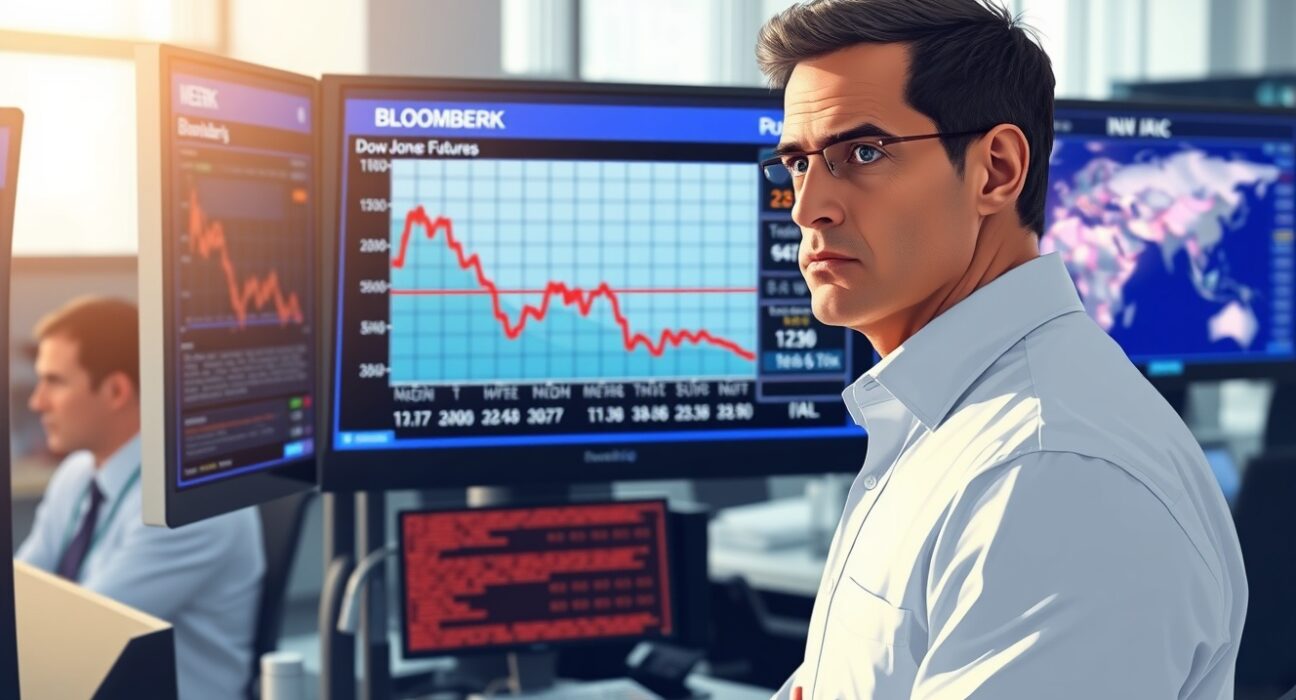
NEW YORK – January 10, 2025: Dow Jones Industrial Average futures pointed lower in pre-market trading Friday, signaling a cautious start on Wall Street as investors globally assessed the mounting geopolitical risks ahead of a critical foreign policy deadline set by former President Donald Trump. Market participants are closely monitoring developments, with the potential for renewed tensions in the Middle East injecting fresh uncertainty into an already complex economic landscape.
Dow Jones Futures Reflect Pre-Market Caution
Futures contracts tied to the Dow Jones Industrial Average slipped approximately 0.4% in early electronic trading. Similarly, S&P 500 and Nasdaq-100 futures also traded in negative territory. This movement represents a clear shift in sentiment from earlier in the week. Consequently, traders are reducing risk exposure ahead of a potentially market-moving geopolitical event. The CBOE Volatility Index (VIX), often called the market’s “fear gauge,” ticked higher, reflecting increased demand for options protection.
Market analysts immediately linked the softness to the looming deadline concerning the Iran nuclear deal. “Futures are acting as the canary in the coal mine,” noted a senior strategist at a major investment bank. “The price action tells us that institutional money is taking a defensive posture, preferring to wait for clarity rather than speculate on an outcome.” This behavior is typical before events that could trigger significant commodity price swings, particularly in oil.
Understanding the Geopolitical Catalyst
The primary driver of market anxiety is a deadline set by former President Trump for Iran to comply with a series of demands regarding its nuclear program and regional activities. This deadline, a hallmark of his stated foreign policy approach, carries the threat of reinstating severe economic sanctions. The global energy market remains acutely sensitive to any disruption in supply from the Middle East.
Historically, escalations involving Iran have led to spikes in crude oil prices. For instance, the Brent crude benchmark showed heightened volatility in trading sessions preceding the deadline. A sustained rise in oil prices acts as a tax on consumers and businesses, potentially slowing economic growth and complicating central bank efforts to manage inflation.
Expert Analysis on Market Mechanics
Financial experts explain that futures markets serve as a leading indicator for the sentiment of professional traders. The sell-off in Dow futures suggests a collective decision to hedge portfolios. “We’re seeing a classic ‘risk-off’ rotation,” explained a portfolio manager specializing in global macro strategies. “Capital is flowing, at least temporarily, out of cyclical stocks and into traditional havens like utilities, consumer staples, and the U.S. dollar.”
This dynamic creates a bifurcated market. While the broader indices may feel pressure, certain sectors may benefit. Defense and aerospace stocks, for example, often see increased attention during periods of geopolitical tension. The table below illustrates typical market reactions to similar past events:
| Event | Immediate Market Impact | Sector Most Affected |
|---|---|---|
| 2019 Iran Tensions | DJIA fell ~1.2%; Oil +5% | Energy, Airlines |
| 2022 Russia-Ukraine | Sharp volatility spike | Commodities, Tech |
| General Geopolitical Risk | Flight to safety | Bonds, Gold, USD |
Furthermore, the bond market provided corroborating signals. Yields on U.S. Treasury notes, which move inversely to prices, edged lower as investors sought the safety of government debt. This simultaneous move in futures and bonds strengthens the thesis of a cautious, wait-and-see approach dominating trading desks.
Broader Economic Context and Implications
The market’s reaction does not occur in a vacuum. The Federal Reserve’s current monetary policy stance remains a key backdrop. Persistent inflation data has made the central bank hesitant to signal aggressive rate cuts. Therefore, an external shock that pushes energy prices higher could force a reassessment of the economic outlook. Potentially, it might delay anticipated monetary easing.
Corporate earnings season also looms. Companies may begin to cite geopolitical uncertainty and potential input cost inflation in their forward guidance. Sectors with thin margins and high energy dependence, such as transportation and manufacturing, are particularly vulnerable. Analysts are scrutinizing supply chain resilience, as past disruptions have shown how quickly regional conflicts can create global economic ripples.
International markets reacted in tandem. Major European and Asian indices closed mixed but with a cautious tone. The Japanese Yen and Swiss Franc, traditional safe-haven currencies, gained ground against the dollar. Meanwhile, shipping insurance rates for vessels transiting the Strait of Hormuz, a critical oil chokepoint, became a point of focus for commodity traders.
Historical Precedents and Trader Psychology
Market veterans often refer to the “geopolitical risk premium” embedded in asset prices. This premium expands during periods of heightened tension. The current scenario shares characteristics with past episodes where markets initially sold off on the news, then stabilized or rallied once the actual event passed and outcomes were clearer. However, the key differentiator is the potential for a protracted diplomatic or military engagement.
Trading psychology plays a crucial role. The fear of missing out (FOMO) on a potential rally is currently balanced by the fear of significant loss (FOL). This balance results in lower trading volumes and increased volatility as automated algorithms react to headline news. Retail investors are advised by many advisors to avoid making drastic portfolio changes based on short-term headlines, emphasizing instead a focus on long-term financial plans and diversified asset allocation.
Conclusion
The slip in Dow Jones futures serves as a clear, real-time barometer of investor apprehension. Traders are adopting a defensive posture ahead of former President Trump’s Iran deadline, prioritizing capital preservation over aggressive positioning. This reaction underscores the market’s enduring sensitivity to geopolitical shocks, especially those impacting global energy supplies and inflation expectations. While the immediate price action reflects caution, the longer-term trajectory for equities will ultimately depend on the resolution of the diplomatic situation and its subsequent impact on economic fundamentals like corporate earnings and consumer spending.
FAQs
Q1: What are Dow Jones futures and why do they matter?
Dow Jones futures are financial contracts that allow traders to bet on or hedge against the future value of the Dow Jones Industrial Average. They trade nearly 24 hours a day and provide an early indication of market sentiment before the regular U.S. stock market opens, making them a crucial tool for professional investors.
Q2: How does geopolitical risk typically affect the stock market?
Geopolitical risk typically increases market volatility and uncertainty. Investors often move capital away from riskier assets like stocks into perceived safe havens such as gold, U.S. Treasuries, or the Swiss Franc. Sectors directly impacted, like energy or defense, may see exaggerated moves, while consumer spending and business investment plans can be delayed.
Q3: What is the “Iran deadline” that markets are watching?
The deadline refers to a specific date set by former President Donald Trump for the Iranian government to comply with demands related to its nuclear program and activities in the Middle East. The key market concern is the potential reinstatement of strict economic sanctions, which could disrupt global oil supplies and trigger a price spike.
Q4: Should individual investors change their strategy based on this news?
Most financial advisors caution against making impulsive investment decisions based on short-term geopolitical headlines. For long-term investors, maintaining a diversified portfolio aligned with personal risk tolerance and financial goals is generally considered a more prudent approach than trying to time the market around news events.
Q5: What other assets are traders watching alongside Dow futures?
Traders are monitoring a suite of assets for correlated signals. These include Brent and WTI crude oil prices, the U.S. Dollar Index (DXY), gold prices, the CBOE Volatility Index (VIX), and yields on U.S. 10-year Treasury notes. Movements in these markets together provide a fuller picture of global risk sentiment.
Disclaimer: The information provided is not trading advice, Bitcoinworld.co.in holds no liability for any investments made based on the information provided on this page. We strongly recommend independent research and/or consultation with a qualified professional before making any investment decisions.
