

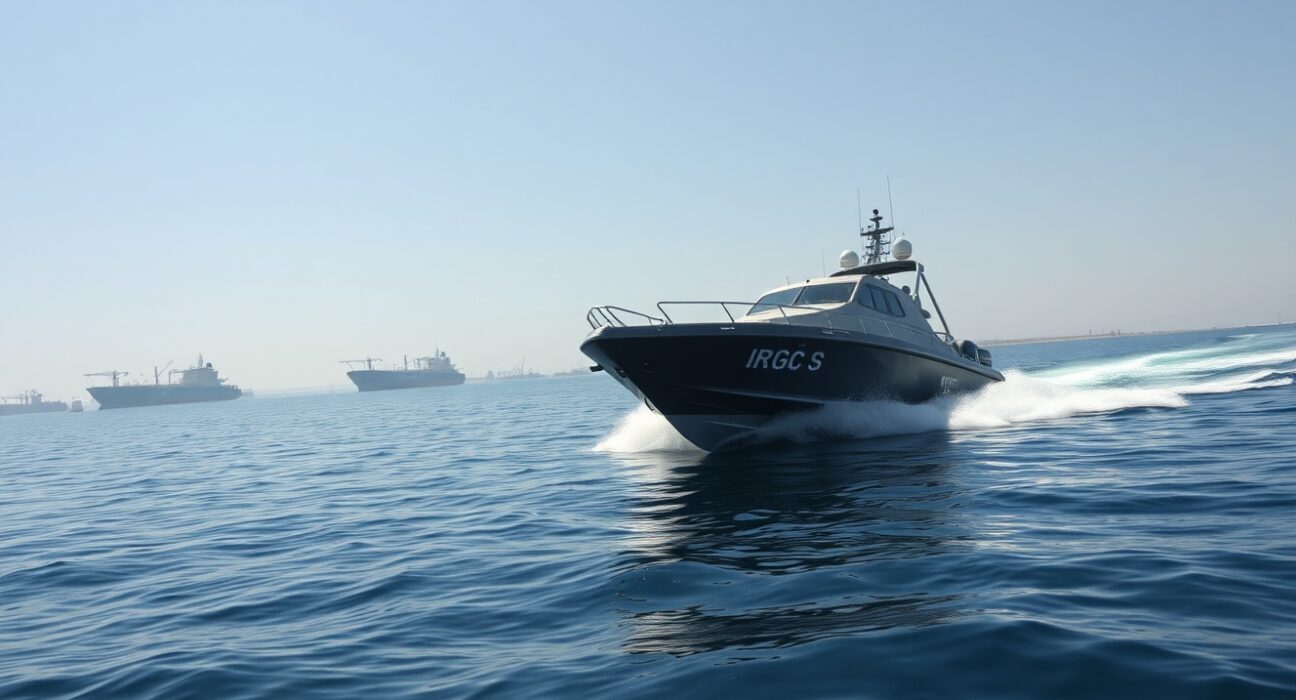
TEHRAN, Iran – The Islamic Revolutionary Guard Corps (IRGC) has issued a stark warning of military retaliation against any potential United States naval blockade, a move that threatens to escalate already volatile tensions in the world’s most critical oil transit corridor. This IRGC retaliation threat directly responds to longstanding U.S. strategic discussions about isolating Iran economically, fundamentally challenging Washington’s regional military posture.
IRGC Retaliation Doctrine and Strategic Posture
The IRGC Navy commands a significant asymmetric warfare capability specifically designed for the confined waters of the Persian Gulf. Consequently, its leadership frequently articulates a doctrine of immediate and overwhelming response to perceived encirclement. Moreover, this doctrine is not merely rhetorical; it is backed by decades of strategic investment. For instance, the force operates hundreds of fast-attack craft and swarm boats, which are equipped with sophisticated anti-ship missiles and torpedoes. Additionally, it maintains extensive coastal defense missile batteries and midget submarines. Therefore, a U.S. blockade attempt would likely trigger a multi-layered response aimed at disrupting maritime traffic and targeting naval assets.
Historical Context of US-Iran Naval Confrontations
Historical precedent provides crucial context for the current warnings. Notably, the late 1980s featured a period known as the “Tanker War,” where both nations targeted oil shipping during the Iran-Iraq conflict. Furthermore, more recent incidents underscore persistent friction. In 2016, IRGC personnel briefly detained U.S. sailors after their boats strayed into Iranian territorial waters. Similarly, in 2019 and 2020, a series of attacks on commercial vessels and a significant escalation, including the U.S. drone strike that killed IRGC Quds Force commander Qasem Soleimani, brought the region to the brink of broader conflict. These events demonstrate a pattern of calculated brinkmanship where naval forces serve as primary instruments of policy.
Expert Analysis on Blockade Feasibility and Response
Military analysts consistently highlight the extreme difficulty of enforcing a full blockade against a motivated regional power with significant asymmetric capabilities. “The geography of the Strait of Hormuz, which is only 21 nautical miles wide at its narrowest point, favors the defender,” explains Dr. Anahita Mir, a senior fellow at the Center for Strategic Studies. “The IRGC has spent 40 years developing a cost-imposing strategy to make interdiction operations prohibitively risky for a conventional blue-water navy like that of the United States.” This strategy includes:
- Swarm Tactics: Utilizing dozens of small, fast boats to overwhelm larger warships’ defense systems.
- Anti-Access Area Denial (A2/AD): Deploying land-based missiles and sea mines to restrict freedom of navigation.
- Strategic Ambiguity: Maintaining the capability to plausibly deny involvement in harassing operations.
The Economic Stakes in the Strait of Hormuz
The Strait of Hormuz represents the world’s most important maritime chokepoint for oil. According to data from the U.S. Energy Information Administration, approximately 21 million barrels of oil per day passed through it in 2023, representing about 21% of global petroleum liquid consumption. A serious disruption would have immediate and severe consequences for the global economy, triggering spikes in oil prices and potentially causing supply shortages. Global energy markets remain acutely sensitive to political rhetoric from the region, with prices often fluctuating on news of heightened tensions. The following table illustrates the strategic importance of the Strait:
| Metric | Figure | Global Share |
|---|---|---|
| Oil Flow (2023) | ~21 million bpd | ~21% |
| Liquefied Natural Gas (LNG) Flow | ~20% of global trade | ~20% |
| Width at Narrowest Point | 21 nautical miles | N/A |
| Key Exporters Using Strait | Saudi Arabia, Iraq, UAE, Kuwait, Iran | N/A |
Potential Escalation Pathways and Global Implications
An actual confrontation would likely unfold in phases rather than as a single event. Initially, the IRGC might conduct harassing maneuvers against commercial shipping or U.S. patrols, testing rules of engagement. Subsequently, a more serious phase could involve the use of sea mines or limited missile strikes against isolated targets. Ultimately, a full-scale conflict could draw in regional proxies and potentially trigger retaliatory strikes on Iranian soil. Such a scenario would force neutral shipping companies to suspend transit, effectively achieving a de facto blockade through risk rather than direct naval action. Meanwhile, global powers, including China and European nations heavily reliant on Gulf energy, would face intense diplomatic pressure to mediate, complicating the U.S. strategic calculus.
Conclusion
The IRGC retaliation warning against a U.S. blockade underscores the fragile and dangerous state of security in the Persian Gulf. It highlights a fundamental clash between U.S. coercive economic strategy and Iran’s asymmetric military doctrine. While the immediate implementation of a full naval blockade remains a low-probability, high-impact scenario, the persistent threat of miscalculation or accidental escalation ensures the Strait of Hormuz will remain a persistent global flashpoint. The dire economic consequences of closure guarantee that such warnings are analyzed with utmost seriousness in capitals worldwide.
FAQs
Q1: What is the IRGC?
The Islamic Revolutionary Guard Corps (IRGC) is a branch of Iran’s armed forces, founded after the 1979 revolution. It operates independently from Iran’s regular military and has significant political, economic, and military influence, including command of the nation’s naval asymmetric warfare units.
Q2: What would a US naval blockade of Iran entail?
A U.S. naval blockade would involve positioning warships to intercept and inspect vessels bound for or leaving Iranian ports, aiming to enforce sanctions and restrict the flow of goods, particularly oil exports. It is considered an act of war under international law.
Q3: Why is the Strait of Hormuz so important?
The Strait of Hormuz is a narrow chokepoint between the Persian Gulf and the Gulf of Oman. It is the world’s most critical oil transit channel, with about one-fifth of global oil supply passing through it daily, making its security vital to the global economy.
Q4: How capable is the IRGC Navy compared to the US Navy?
The IRGC Navy is not designed to defeat the U.S. Navy in a traditional, open-ocean battle. Instead, it employs asymmetric tactics—using swarms of small, fast boats, anti-ship missiles, mines, and coastal defenses—to threaten larger vessels in the confined, shallow waters of the Persian Gulf.
Q5: Has the US ever blockaded Iran before?
The United States has not enacted a formal, declared naval blockade against Iran. However, it has enforced severe economic sanctions and conducted naval interdiction operations as part of sanctions regimes, creating a de facto economic pressure campaign that some analysts compare to a quasi-blockade.
Disclaimer: The information provided is not trading advice, Bitcoinworld.co.in holds no liability for any investments made based on the information provided on this page. We strongly recommend independent research and/or consultation with a qualified professional before making any investment decisions.
