

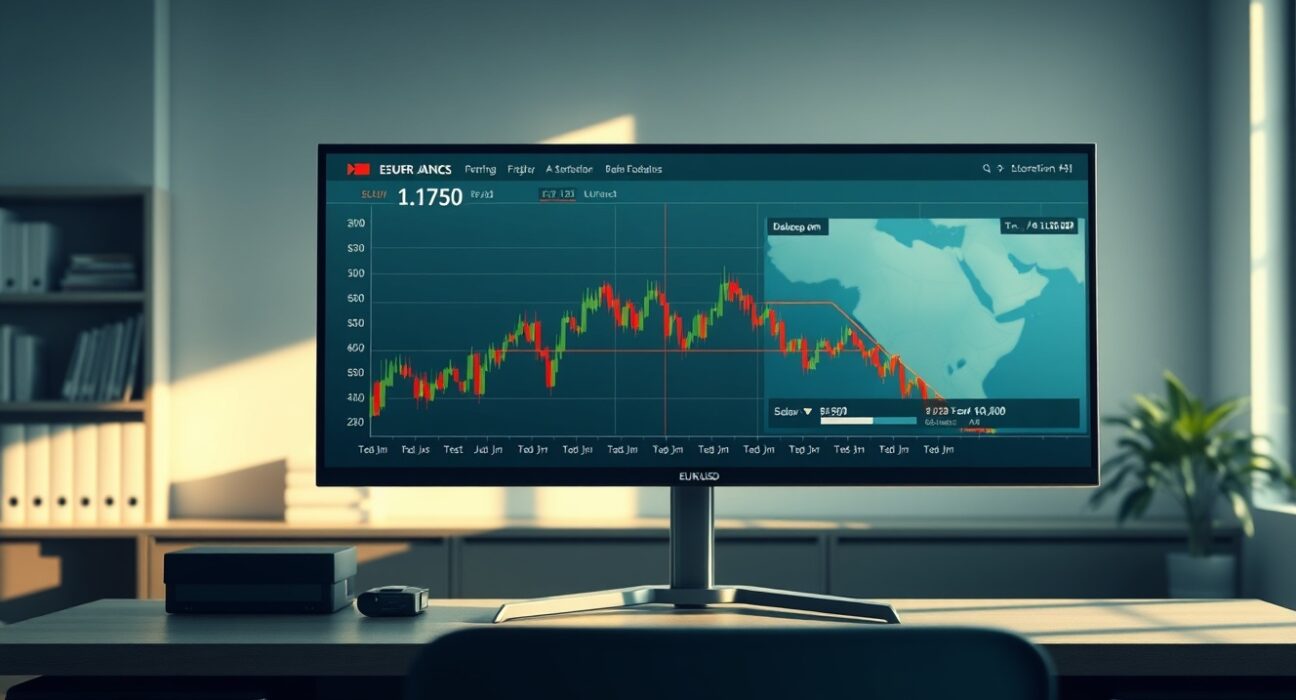
The EUR/USD currency pair faces significant downward pressure, struggling to hold ground below the critical 1.1770 level as financial markets react to heightened uncertainty surrounding the fragile US-Iran peace negotiations. This pivotal development, monitored closely by traders globally, underscores the profound impact geopolitical diplomacy exerts on major forex pairs. Consequently, analysts are scrutinizing every diplomatic signal for clues on future currency direction.
EUR/USD Technical Breakdown and Market Reaction
Market data from major trading platforms confirms the EUR/USD pair’s persistent struggle below the 1.1770 resistance zone. This level, a key psychological and technical barrier, has repeatedly capped upward movements throughout the current trading session. The pair’s inability to break higher reflects a market consensus weighed down by risk aversion. Furthermore, trading volumes have spiked, indicating heightened institutional activity. Technical indicators like the Relative Strength Index (RSI) currently hover near oversold territory, suggesting potential for a short-term bounce. However, the prevailing bearish sentiment, driven by external geopolitical factors, continues to dominate price action. The 50-day and 200-day moving averages now act as dynamic resistance levels above the current price.
Key technical levels to watch include:
- Immediate Resistance: 1.1770 – 1.1800
- Primary Support: 1.1720 (Recent Low)
- Major Support: 1.1680 (Monthly Low)
Geopolitical Catalyst: The US-Iran Negotiation Landscape
The immediate catalyst for the EUR/USD’s weakness stems directly from the precarious state of US-Iran peace talks. Recent diplomatic communications have revealed significant sticking points, casting doubt on a near-term resolution. Historically, tensions in the Middle East trigger a flight to safety, often benefiting the US Dollar as a global reserve currency. This dynamic places downward pressure on the Euro in the EUR/USD pair. The current talks, aimed at reviving a nuclear accord and easing regional tensions, directly influence global oil prices and, by extension, inflation expectations in both Europe and the United States. A breakdown in negotiations could exacerbate energy market volatility, forcing central banks to reconsider monetary policy timelines.
Expert Analysis on Forex and Geopolitical Risk
Financial strategists emphasize the complex interplay at work. “Currency markets are acting as a real-time barometer for geopolitical risk,” notes a senior analyst from a major European bank. “The EUR/USD pair is particularly sensitive because it balances Eurozone exposure to energy imports against the Dollar’s safe-haven status. Any sign of escalating Middle East tensions automatically triggers a bid for Dollars.” This analysis is supported by historical correlation data. For instance, during previous periods of US-Iran friction, the Dollar Index (DXY) frequently experienced short-term appreciations of 1-2%. Market participants are now pricing in a sustained period of uncertainty, which typically suppresses risk appetite and supports the US currency against its peers.
Broader Market Impacts and Comparative Analysis
The ripple effects extend beyond EUR/USD. Other currency pairs and asset classes are displaying correlated movements. For example, the USD/CHF pair, another safe-haven proxy, has seen concurrent strength. Conversely, commodity-linked currencies like the Australian Dollar (AUD) have softened. The following table illustrates the intraday moves of major pairs relative to the USD:
| Currency Pair | Price Change | Key Driver |
|---|---|---|
| EUR/USD | -0.45% | Geopolitical Risk Aversion |
| USD/CHF | +0.30% | Safe-Haven Flow |
| GBP/USD | -0.25% | Broad USD Strength |
| AUD/USD | -0.60% | Commodity & Risk Downturn |
Additionally, European equity markets have opened lower, while US Treasury yields have dipped slightly as capital seeks security. This synchronized movement confirms the narrative of a broad-based, geopolitically-driven risk-off shift. The Euro’s fate is thus tied not only to European Central Bank policy but also to external diplomatic developments far from its borders.
Fundamental Backdrop: Diverging Central Bank Policies
Beneath the geopolitical headlines, fundamental monetary policy divergence provides a structural bearish context for EUR/USD. The Federal Reserve maintains a decidedly hawkish stance, focused on combating persistent inflation. In contrast, the European Central Bank (ECB) projects a more cautious and gradual approach to policy normalization. This interest rate differential inherently supports the US Dollar over the Euro. The current geopolitical uncertainty amplifies this fundamental bias. Investors anticipate that the Fed may prove more resilient in tightening policy amid global turmoil, while the ECB, facing a potential energy shock from Middle East instability, could be forced to delay hikes. This policy divergence calculus is a critical component of the pair’s multi-week downtrend.
Conclusion
The EUR/USD pair’s struggle below 1.1770 is a direct consequence of faltering US-Iran peace talks and the resultant flight to safety. Technical selling pressure combines with profound geopolitical risk and underlying central bank policy divergence to create a challenging environment for the Euro. Traders and investors must monitor diplomatic communications with heightened vigilance, as headlines from the negotiation table will likely continue to dictate short-term directional moves for the EUR/USD and other major currency pairs. The path of least resistance remains downward until a clear de-escalation or diplomatic breakthrough materializes.
FAQs
Q1: Why does the EUR/USD pair fall when US-Iran tensions rise?
The US Dollar is considered a primary global safe-haven asset. During geopolitical uncertainty, investors sell riskier assets and currencies, like the Euro, and buy US Dollars, pushing the EUR/USD exchange rate lower.
Q2: What is the significance of the 1.1770 level for EUR/USD?
1.1770 represents a key technical and psychological resistance level. Repeated failure to break above it signals strong selling pressure and can trigger further technical selling from algorithmic and institutional traders.
Q3: How do US-Iran talks affect the broader forex market?
They primarily drive risk sentiment. A negative development strengthens the USD, CHF, and JPY (safe havens) and weakens commodity and growth-linked currencies like AUD, NZD, and emerging market currencies.
Q4: Could the ECB’s policy change this dynamic for the Euro?
Yes, a decisive hawkish shift from the ECB that outpaces the Fed could override short-term geopolitical risks and support the Euro. However, current instability makes such a shift less likely in the near term.
Q5: What other assets should I watch alongside EUR/USD during this period?
Monitor Brent Crude Oil prices (rising on tension), the US Dollar Index (DXY), US Treasury yields (often fall on safe-haven bids), and equity market volatility indices like the VIX.
Disclaimer: The information provided is not trading advice, Bitcoinworld.co.in holds no liability for any investments made based on the information provided on this page. We strongly recommend independent research and/or consultation with a qualified professional before making any investment decisions.
