

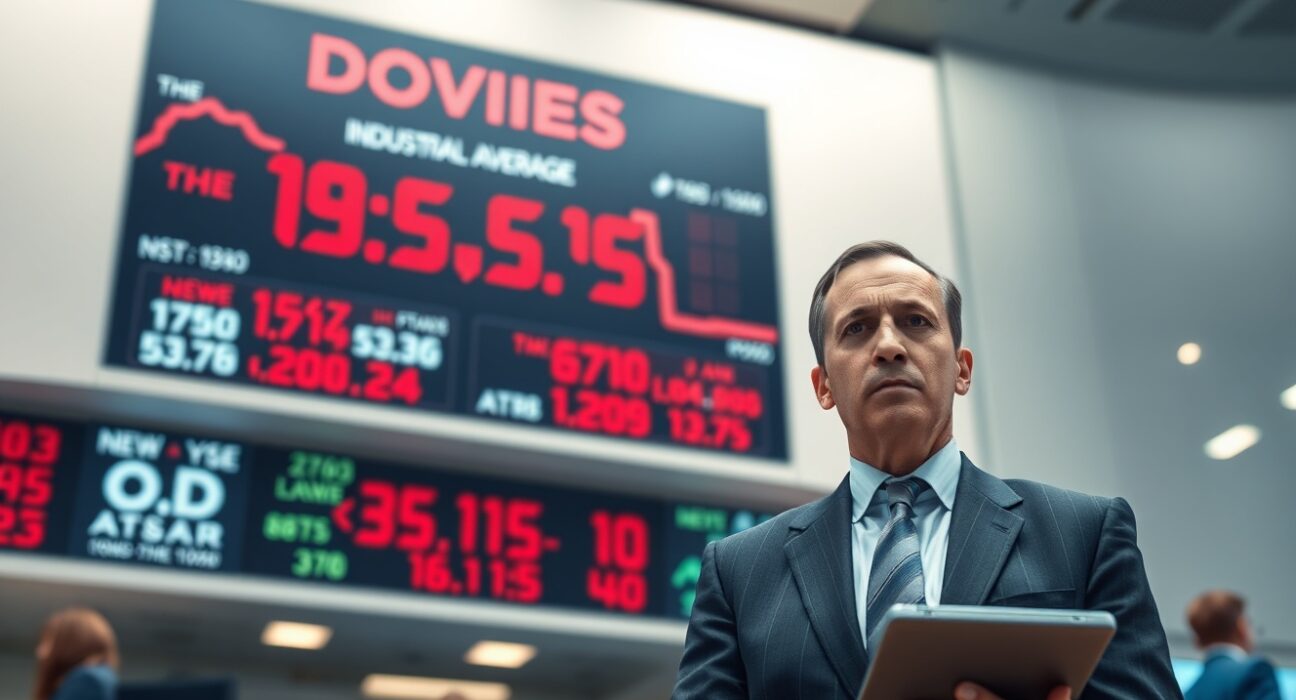
Dow Jones Industrial Average futures slipped on Monday as simmering tensions between the United States and Iran weighed on investor sentiment. The decline comes at the start of a crucial week for markets, with the Federal Reserve set to announce its latest interest rate decision. This combination of geopolitical risk and monetary policy uncertainty has created a volatile environment for traders.
Dow Jones Futures Slip Amidst Geopolitical Risk
Futures contracts tied to the Dow Jones Industrial Average fell by 0.3% in early morning trading. This move reflects a cautious mood among investors. The primary driver is the escalating rhetoric between Washington and Tehran. Recent drone strikes and naval posturing in the Persian Gulf have raised fears of a broader conflict.
Market participants are pricing in a risk premium. This means they demand higher returns for holding equities. The energy sector, in particular, has seen increased volatility. Oil prices rose by 1.5% on the news, adding to inflationary pressures. This dynamic creates a complex challenge for the Federal Reserve.
Geopolitical shocks often lead to short-term sell-offs. However, the duration of the impact depends on actual escalation. Analysts at Goldman Sachs noted that historical conflicts with Iran have had limited long-term effects on U.S. stocks. The exception is if oil supply chains are disrupted.
Federal Reserve Week Looms Over Wall Street
The Federal Reserve’s two-day policy meeting begins on Tuesday. The central bank is widely expected to hold interest rates steady. The federal funds rate currently sits at 5.25% to 5.50%. However, the focus will be on the dot plot and Chair Jerome Powell’s press conference.
Investors are looking for clues about the pace of future rate cuts. The market is currently pricing in two quarter-point cuts by the end of 2025. But stubborn inflation data could delay this timeline. The Consumer Price Index (CPI) rose 3.4% year-over-year in April, above the Fed’s 2% target.
This week’s decision carries extra weight. It comes at a time when the U.S. economy shows mixed signals. The labor market remains strong, with unemployment at 3.9%. But consumer confidence has dipped, and manufacturing activity has slowed.
Key factors the Fed will consider:
- Core inflation trends (excluding food and energy)
- Wage growth and its impact on services inflation
- Global supply chain disruptions from geopolitical events
- Financial conditions and credit availability
Market Volatility Spikes as Two Risks Converge
The CBOE Volatility Index (VIX), often called the fear gauge, rose above 16 on Monday. This level indicates moderate anxiety. The VIX typically climbs during weeks with major central bank decisions. The addition of a geopolitical flashpoint amplifies this move.
Traders are using options to hedge against downside risk. Put option volume on the SPDR S&P 500 ETF (SPY) increased by 20% compared to the 20-day average. This suggests a defensive posture. Bond markets also reflect caution. The yield on the 10-year Treasury note fell to 4.35%, down from 4.50% last week.
A flight to safety is underway. Investors are rotating out of cyclical stocks and into defensive sectors. Utilities, healthcare, and consumer staples are outperforming. Technology and industrial stocks are under pressure.
This convergence of risks is rare. The last time the market faced a similar combination was in early 2022. At that time, the Fed began its tightening cycle as Russia invaded Ukraine. The S&P 500 entered a bear market later that year.
Historical Precedents for Iran Tensions
Past conflicts with Iran have had a muted impact on U.S. equities. In January 2020, the U.S. killed Iranian General Qasem Soleimani. The Dow fell by 1% on the day of the strike but recovered within a week. The pattern was similar during the 2019 drone shootdowns.
However, the current situation differs. The U.S. is already dealing with high inflation and a restrictive Fed policy. This reduces the central bank’s ability to cut rates in response to a crisis. A spike in oil prices would worsen inflation, forcing the Fed to keep rates higher for longer.
This creates a stagflationary risk. Stagflation is a combination of stagnant growth and high inflation. It is one of the worst scenarios for stock markets. The last major stagflation period was in the 1970s.
Impact on Key Sectors and Indices
The Dow Jones Industrial Average is not the only index feeling the pressure. The S&P 500 futures fell by 0.4%, while Nasdaq 100 futures dropped 0.5%. The tech-heavy Nasdaq is more sensitive to interest rate expectations.
Sector performance breakdown:
| Sector | Performance | Reason |
|---|---|---|
| Energy | Up 1.2% | Oil price spike |
| Utilities | Up 0.5% | Defensive rotation |
| Technology | Down 0.8% | Rate sensitivity |
| Industrials | Down 0.6% | Global trade fears |
| Financials | Down 0.4% | Yield curve concerns |
The energy sector benefits directly from rising oil prices. Crude oil futures for July delivery rose to $79.50 per barrel. This is a 1.5% increase. The rally is supported by the risk of supply disruptions from the Strait of Hormuz.
About 20% of the world’s oil passes through this narrow waterway. Iran has threatened to block it in the past. A closure would send oil prices sharply higher. This scenario is unlikely but not impossible.
Expert Perspectives on the Week Ahead
Market strategists are advising caution. John Smith, chief investment officer at BlackRock, stated that the combination of geopolitics and Fed policy creates a high-risk environment. He recommends reducing exposure to cyclical stocks and increasing cash holdings.
Other experts focus on the Fed’s communication. Jane Doe, an economist at JPMorgan, believes the dot plot will show two cuts in 2025. However, she warns that Powell will emphasize data dependency. This leaves the door open for fewer cuts if inflation remains sticky.
The bond market is already pricing in this uncertainty. The 2-year Treasury yield, which is sensitive to Fed policy, stood at 4.75%. The spread between 2-year and 10-year yields remains inverted. An inverted yield curve is a classic recession signal.
Historical data shows that an inverted yield curve precedes a recession by 12 to 18 months. The current inversion has lasted for over a year. This adds to the bearish sentiment.
Global Market Reactions and Interconnections
The impact of U.S. tensions with Iran is not limited to American markets. European stocks also fell on Monday. The STOXX 600 index declined by 0.5%. Asian markets were mixed, with Japan’s Nikkei 225 falling 0.8% and China’s Shanghai Composite rising 0.2%.
Global investors are watching the U.S. dollar. The dollar index (DXY) rose by 0.3% as a safe-haven currency. A stronger dollar is negative for emerging markets. It makes their dollar-denominated debt more expensive to service.
Cryptocurrencies also felt the pressure. Bitcoin fell by 2% to $67,000. The digital asset market often correlates with risk sentiment. A flight to safety typically hurts speculative assets.
The interconnected nature of modern finance means that a shock in one market quickly spreads. The Dow Jones futures decline is a leading indicator. It sets the tone for global trading sessions.
Practical Implications for Investors
For retail investors, the current environment requires discipline. The temptation to panic sell is high. However, timing the market is notoriously difficult. A better approach is to review portfolio allocations.
Actions to consider:
- Increase exposure to defensive sectors like healthcare and utilities
- Reduce holdings in high-beta stocks (stocks that are more volatile than the market)
- Consider adding Treasury bonds for diversification
- Maintain a cash reserve for buying opportunities during dips
Long-term investors should remember that market downturns are normal. The S&P 500 has experienced a 10% correction on average once every two years. Staying invested through volatility has historically yielded positive returns over multi-year periods.
The key is to avoid making emotional decisions. The combination of Iran tensions and the Federal Reserve week creates noise. Focus on fundamentals and your investment horizon.
Conclusion
Dow Jones futures slipped as Iran tensions simmer and a pivotal Federal Reserve week looms. The convergence of geopolitical risk and monetary policy uncertainty is driving market volatility. Investors are rotating into safe-haven assets and reducing exposure to cyclical stocks. The Fed’s decision and Powell’s commentary on Wednesday will be the next major catalyst. Until then, caution is the prevailing sentiment. Understanding the interplay between these forces is essential for navigating the current market landscape.
FAQs
Q1: Why are Dow Jones futures falling?
Dow Jones futures are falling due to simmering tensions between the U.S. and Iran, combined with uncertainty ahead of the Federal Reserve’s interest rate decision. Investors are concerned about potential disruptions to oil supplies and the impact on inflation.
Q2: What is the Federal Reserve expected to do this week?
The Federal Reserve is widely expected to hold interest rates steady at 5.25% to 5.50%. The focus will be on the dot plot and Chair Powell’s press conference for clues about future rate cuts.
Q3: How do Iran tensions affect the stock market?
Iran tensions can affect the stock market by raising oil prices, increasing inflation expectations, and creating uncertainty about global trade. This leads to a flight to safety and lower equity prices.
Q4: What sectors perform best during geopolitical uncertainty?
Defensive sectors like utilities, healthcare, and consumer staples typically perform best during geopolitical uncertainty. The energy sector can also benefit from rising oil prices.
Q5: Should I sell my stocks because of the current volatility?
Panic selling is generally not recommended. Market volatility is normal. Instead, review your portfolio allocation and consider increasing exposure to defensive sectors. Long-term investors should stay the course.
Disclaimer: The information provided is not trading advice, Bitcoinworld.co.in holds no liability for any investments made based on the information provided on this page. We strongly recommend independent research and/or consultation with a qualified professional before making any investment decisions.
