

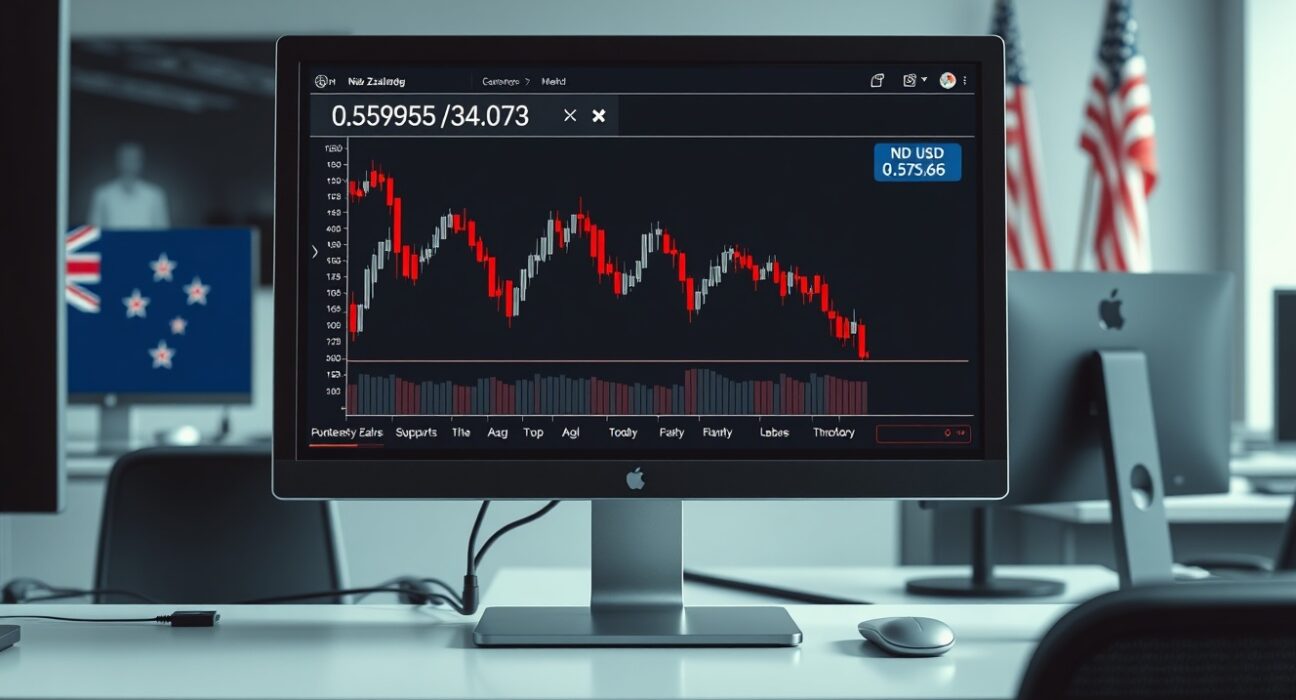
The New Zealand dollar extended its recent corrective move against the US dollar during Monday’s trading session, with the NZD/USD pair edging lower and testing the key support zone around 0.5965. The move follows a period of relative strength for the Kiwi, which had rallied in prior weeks on the back of improved risk appetite and a softer US dollar. However, renewed headwinds are now testing the pair’s near-term bullish momentum.
Technical Picture: Support Under Pressure
The 0.5965 level represents a critical near-term support for the NZD/USD pair. This zone has acted as both resistance and support over the past several trading sessions, and a decisive break below it could open the door for further downside toward the 0.5900 psychological handle. On the upside, immediate resistance sits at 0.6000, followed by the recent swing high near 0.6050. The pair’s 20-day moving average is converging with the 0.6000 level, reinforcing its importance as a short-term ceiling.
Momentum indicators are beginning to turn bearish. The Relative Strength Index (RSI) on the daily chart has slipped below the 50 midpoint, signaling a shift in momentum in favor of sellers. The MACD histogram has also turned negative, suggesting that downside pressure is building. Traders will be watching for a daily close below 0.5965 to confirm the bearish bias.
Fundamental Drivers Weighing on the Kiwi
The corrective move in NZD/USD comes amid a broader reassessment of risk sentiment in global markets. The US dollar has found some support as markets price in a slightly more cautious outlook for Federal Reserve rate cuts. Meanwhile, the Reserve Bank of New Zealand (RBNZ) has signaled that it remains data-dependent, and recent domestic economic data has been mixed. New Zealand’s terms of trade have also faced pressure from softer dairy prices, a key export commodity for the country.
Additionally, the ongoing slowdown in China’s economy continues to cast a shadow over the New Zealand dollar, given the close trade relationship between the two nations. Any further signs of weakness in Chinese economic data could amplify downside pressure on the Kiwi.
What to Watch This Week
Several key events this week could determine the next directional move for NZD/USD. On the US side, the release of the latest inflation data and Federal Reserve meeting minutes will be closely scrutinized for clues on the timing and pace of rate cuts. On the New Zealand front, any fresh commentary from RBNZ officials or changes in global dairy auction prices could provide catalysts. The pair remains sensitive to shifts in risk appetite, so broader equity market performance will also be a factor.
Conclusion
The NZD/USD pair is at a pivotal juncture as it tests support at 0.5965. A breakdown below this level would likely confirm a near-term bearish trend, targeting the 0.5900 area. Conversely, a bounce from support could see the pair attempt to reclaim the 0.6000 handle. With key data and central bank commentary on the horizon, volatility is expected to remain elevated. Traders should manage risk carefully and watch for confirmation signals before committing to directional positions.
FAQs
Q1: Why is the 0.5965 level important for NZD/USD?
The 0.5965 level has acted as both support and resistance in recent trading, making it a key technical reference point. A break below it could signal further downside, while a hold could lead to a bounce toward 0.6000.
Q2: What is driving the current correction in the Kiwi dollar?
The correction is driven by a combination of a slightly firmer US dollar, mixed New Zealand economic data, and cautious risk sentiment amid concerns about global growth, particularly in China.
Q3: How might upcoming US inflation data affect NZD/USD?
Stronger-than-expected US inflation could reduce expectations for Federal Reserve rate cuts, boosting the US dollar and pushing NZD/USD lower. Weaker inflation would have the opposite effect, potentially supporting the Kiwi.
Disclaimer: The information provided is not trading advice, Bitcoinworld.co.in holds no liability for any investments made based on the information provided on this page. We strongly recommend independent research and/or consultation with a qualified professional before making any investment decisions.
