

Key Takeaways
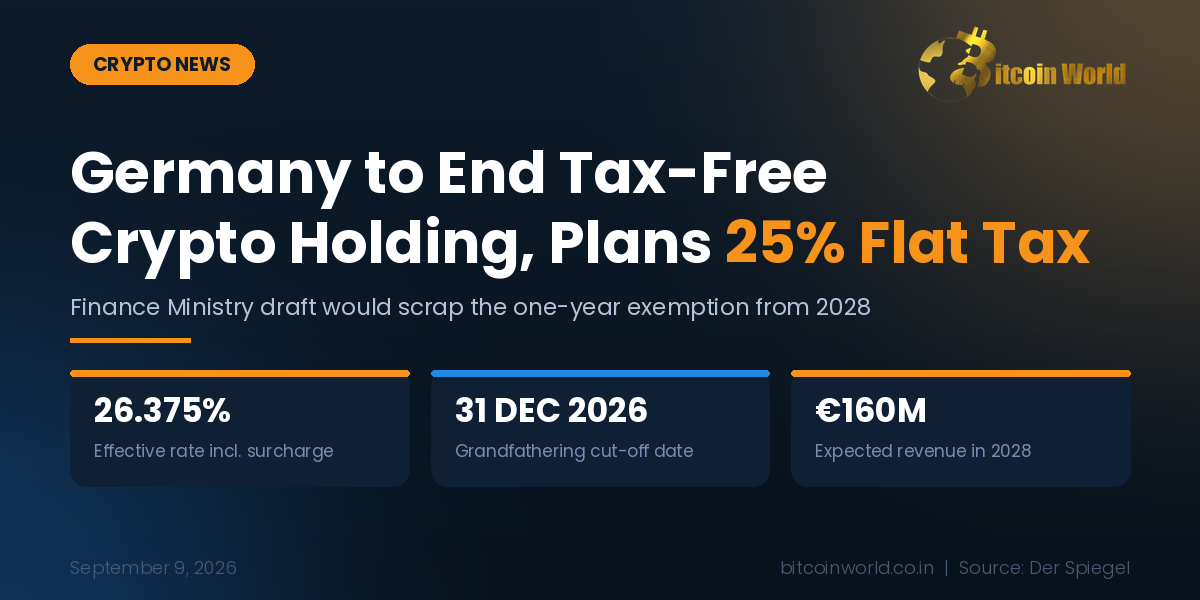
- Germany’s Finance Ministry has circulated a draft bill that would scrap the one-year tax-free holding rule and tax crypto gains as capital income from 2028.
- The headline says 25%. The real number is 26.375% once the solidarity surcharge is added – closer to 28% with church tax.
- The draft grandfathers anything bought on or before December 31, 2026. Buy before New Year’s Eve and the old rules still apply.
- Expected revenue: €160 million in 2028, rising to about €350 million by 2031. Against a federal budget north of €555 billion.
For years, Germany had one line in its tax code that quietly made it one of the best places in the developed world to hold Bitcoin. Section 23 of the Income Tax Act treats crypto as a private asset, not a security. Hold it for more than twelve months, sell it, pay nothing. No cap, no tapering, no conditions.
That line is now on the chopping block.
What’s Actually in the Draft
Der Spiegel obtained a working draft from the Federal Ministry of Finance that would move crypto out of Section 23 and into Section 20 – the bucket that holds interest, dividends and stock gains. Once there, gains face the Abgeltungsteuer, Germany’s flat withholding tax on capital income.
The rate everyone is quoting is 25%. That’s the base. Add the 5.5% solidarity surcharge levied on the tax itself and you get 26.375%. Church tax, where applicable, pushes the effective burden toward 28% depending on the federal state.
Two things soften the blow. The €1,000 personal allowance survives. And – genuinely useful – crypto gains and losses could be offset against gains and losses from stocks and other securities. Under the current Section 23 regime, crypto losses can only be netted against other private disposals, which is a far narrower box. Anyone whose personal rate sits below 25% can also request a Günstigerprüfung, an assessment that applies the lower personal rate instead.
The cut-off matters most. As the draft stands, assets acquired on or before December 31, 2026 stay under the old rules. Hold twelve months, sell tax-free. Only crypto bought after that date falls into the new regime.
The Timeline
- April 2025 – The SPD pushes to scrap the holding period during coalition negotiations, and wants the flat rate raised to 30%. CDU/CSU blocks it.
- May 2025 – The proposal is dropped from the coalition agreement that brings the Merz government to power.
- April 29, 2026 – Finance Minister Lars Klingbeil, now SPD chair, revives the plan under new framing, tied to a package meant to raise €2 billion and tighten enforcement against financial crime.
- Early July 2026 – A budget draft includes removal of the holding period. Cabinet approves the key points paper.
- July 13, 2026 – The working draft of the Annual Tax Act 2026 contains nothing on crypto. Nothing legally binding exists yet.
- September 9, 2026 – Der Spiegel reports the ministerial draft bill. For the first time there are numbers, a rate, and a cut-off date. It enters interdepartmental consultation.
- Ahead – Cabinet approval, three Bundestag readings, the Bundesrat, then the Federal Law Gazette. Any of those stages can change the rate, the cut-off, or kill it entirely.
The Number That Doesn’t Add Up
Here is the part worth sitting with. The ministry projects €160 million in 2028 from this measure. Germany’s federal budget runs past €555 billion.
That is roughly 0.03% of spending. Even at the 2031 figure of €350 million, it barely registers.
Germany is not doing this because it needs the money. €160 million doesn’t fix anything. It’s doing this because the exemption became politically awkward – a rule that let one asset class walk away untaxed while wage earners paid up to 45%. The SPD has framed it as parity, and on paper, parity is a fair argument. Crypto now gets treated exactly like stocks, with the same rate and the same loss-offsetting rights.
But parity cuts both ways. Germany’s holding period wasn’t an accident or an oversight. It was a genuine competitive differentiator, one of the few things that made German exchanges and German-resident traders distinct in Europe. Trading that for a rounding error is a choice, not a necessity.
Conclusion
Nothing is law yet. A ministerial draft in interdepartmental consultation is several long steps from the Federal Law Gazette, and this exact proposal has already died once, in 2025.
Disclaimer: The information provided is not trading advice, Bitcoinworld.co.in holds no liability for any investments made based on the information provided on this page. We strongly recommend independent research and/or consultation with a qualified professional before making any investment decisions.
