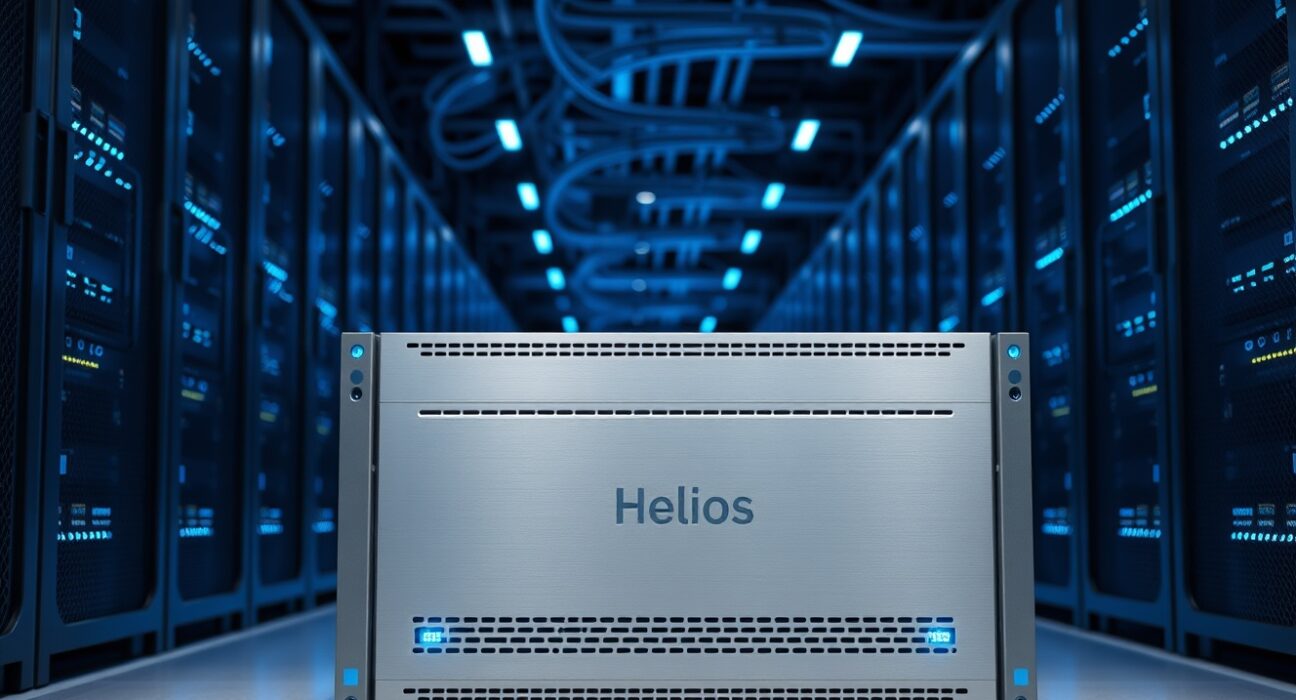
AMD officially unveiled its Helios rack-scale AI system at the company’s Advancing AI conference in San Francisco on Thursday, directly challenging Nvidia’s dominance in the high-performance computing market for artificial intelligence workloads. The system, which combines multiple processors into a single high-powered unit designed for data centers, is already backed by major customers including Microsoft, OpenAI, Meta, Oracle, and Anthropic, with shipments expected later this year.
What is Helios and why does it matter?
Helios is a rack-scale system that integrates numerous AMD processors into a single, powerful computing unit optimized for training and running large AI models. AMD Chair and CEO Dr. Lisa Su described it as the tech industry’s “highest performance AI rack,” built to handle the most demanding frontier models at massive scale. The system is designed to compete directly with Nvidia’s Vera Rubin and Grace Blackwell rack-scale systems, which have historically dominated this segment. Early performance metrics suggest Helios outperforms Vera Rubin in several benchmarks, according to reports from The Register.
The system was first revealed in 2025 and demonstrated at CES 2026 in January. Its deployment is planned at gigawatt-scale by leading AI companies, signaling AMD’s ambition to capture a significant share of the data center AI hardware market.
Major customers and strategic partnerships
AMD’s customer list for Helios includes some of the most prominent names in AI. Microsoft CEO Satya Nadella confirmed on Monday that the company will expand its Azure infrastructure with Helios deployments. Separately, Anthropic and AMD announced a strategic partnership on Wednesday to deploy up to two gigawatts of GPUs using the new rack system. OpenAI, Meta, and Oracle have also committed to deploying Helios, giving AMD a strong foothold in the enterprise AI market.
New hardware announcements
Alongside Helios, AMD introduced the Venice-X CPU, a data center processor designed for high-computing workloads, expected to launch in 2027. The company is positioning these products to meet the growing demand for compute power driven by agentic AI, which requires multiple reasoning steps and tool calls per task, dramatically increasing GPU requirements.
Market outlook and industry implications
During her keynote, Su projected that the AI accelerator market will reach approximately $1.4 trillion by 2030, approaching the size of the entire semiconductor market today. She emphasized that GPUs will make up the vast majority of that market due to the early stage of AI algorithm development and the need for programmability as workloads continue to evolve. “We’re seeing a step change in compute demand,” Su said, driven largely by the rise of agentic AI systems that require multiple GPU-intensive steps to complete tasks.
This announcement intensifies the competition between AMD and Nvidia, which has long dominated the AI hardware space. AMD’s success with Helios could reshape the data center landscape, offering AI labs and cloud providers an alternative to Nvidia’s ecosystem at a time when compute costs are a growing concern.
Conclusion
AMD’s Helios launch represents a significant escalation in the AI hardware arms race, backed by major customer commitments and a bold market forecast. With shipments beginning later this year, the system could provide much-needed competition in a market currently dominated by Nvidia, potentially lowering costs and accelerating AI development. The company’s long-term roadmap, including the Venice-X CPU and its $1.4 trillion market projection, underscores its commitment to becoming a central player in the AI infrastructure space.
FAQs
Q1: What is AMD Helios?
Helios is a rack-scale AI system from AMD that combines multiple processors into a single high-powered unit for data centers, designed to train and run large AI models at massive scale.
Q2: When will AMD Helios ship?
AMD plans to begin shipping Helios later this year, with deployments expected at gigawatt-scale by leading AI companies.
Q3: How does Helios compare to Nvidia’s systems?
Early performance metrics indicate Helios outperforms Nvidia’s Vera Rubin system in several benchmarks, though Nvidia remains the dominant player in the AI rack-scale market with its Vera Rubin and Grace Blackwell systems.
Disclaimer: The information provided is not trading advice, Bitcoinworld.co.in holds no liability for any investments made based on the information provided on this page. We strongly recommend independent research and/or consultation with a qualified professional before making any investment decisions.