Assure DeFi Is Shutting Down as the Web3 Slowdown Hits Its KYC Business
In this article
Assure DeFi, a US based company that verified the identity of crypto project founders and audited smart contracts, announced on Thursday that it is closing its doors after more than five years in the business.
In a post shared on social media, the company said that since starting in 2021, it had verified more than 1,500 crypto projects, covering more than 2 billion dollars in total project value. The company said it is no longer taking on any new work.
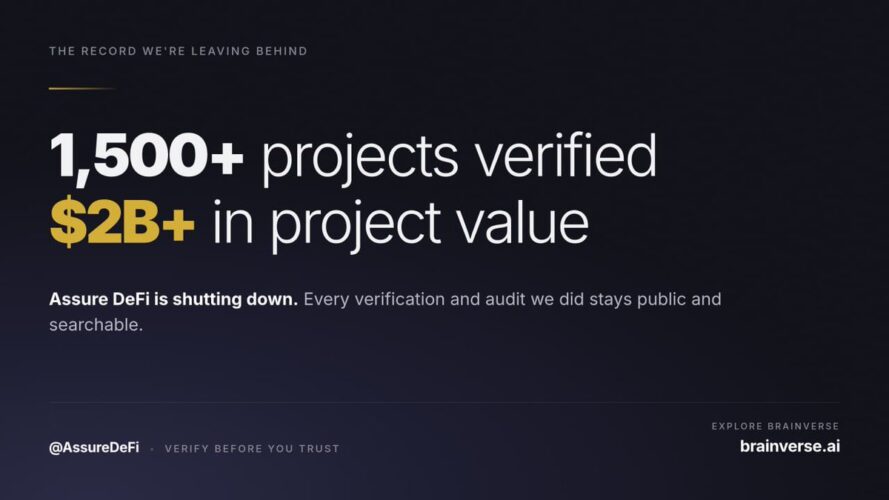
The company explained the shutdown fairly directly, saying that
The Web3 market has not been what it used to be for a long time now, and their verification business shrank along with it.
They said they wanted to close the business cleanly rather than let it drag on.

Assure DeFi confirmed that any KYC certificates or audit results they issued in the past will remain valid even after the company shuts down. Past verification records and audit history will stay public and searchable, so investors will still be able to look up a project’s history even after the company stops operating. Any clients who need to discuss how this affects an active token listing were told to reach out to the team directly.
Assure DeFi was one of the early companies to introduce the idea of project level KYC for crypto teams, especially ones led by anonymous or publicly unnamed founders. Their process involved private identity verification paired with a public compliance certificate, often issued in the form of an NFT. Along with this, they also offered smart contract audits and something they called a Fraud Pursuit Guarantee, where they claimed they would work with law enforcement if a verified team later turned out to commit fraud. The company describes itself as an Ohio based LLC, and has previously stated it assisted the FBI and a US Attorney’s Office under subpoena. These are claims made by the company itself and are not independently confirmed here as proven outcomes.
The founder and CEO, who goes by the name El Crypto Chapo, posted a longer personal note the same day. He said he originally started the company after being scammed himself, and that his goal had been to make project level KYC a standard practice across the entire industry. He admitted that identifying a bad actor and actually holding them accountable in the real world remained two very different challenges. He said he believes the company made the space better overall, but acknowledged that the market for verification services had shrunk significantly due to the broader slowdown in Web3. He also made it clear that he personally is not leaving the crypto industry and remains reachable going forward.
It is worth pointing out here that the CEO operates under a nickname rather than a real legal name, which is fairly common in crypto circles but still worth noticing given that his entire business was built around verifying other people’s real world identities.
It is important to understand that this shutdown is simply a business closing down, it is not a statement suggesting that previously verified projects are now unsafe, and it does not mean existing certificates have been revoked in any way. Assure DeFi has always said that their KYC process was never meant to be a guarantee of investment safety. Investors should treat any existing badge as just one piece of research to consider, not as some kind of ongoing monitoring or protection.
The company said that most of its team has actually spent the past year building a separate company called Brainverse, which focuses on AI agents that businesses can deploy and run entirely within their own systems. Assure DeFi said it currently runs more than 100 of these agents within its own internal operations. This shift toward Brainverse is described as simply the company’s next business focus, this is not an acquisition, and Brainverse is not taking on any responsibility or liability related to the previous KYC certifications. Whether Brainverse was already being built quietly alongside the KYC business, and whether it shares any staff, funding, or leadership with Assure DeFi beyond what has been stated, is not something the company has laid out in detail.
What this actually means for projects and investors
Existing Assure DeFi KYC certificates and audit results are still described as valid by the company. The public database of records is expected to remain searchable, though it would be wise to double check that the directory, any GitHub certificate repositories, and any related NFTs still actually work and load properly before relying on them, especially further down the line. A company can promise its records will stay online after it closes, but keeping a website, a database, and a set of repositories running costs money and requires someone to maintain them, and it is not always clear who takes on that responsibility once the original team moves on to something else.
There is also a separate question specific to the NFT certificates. Many NFT projects do not store the actual certificate image or details fully on the blockchain itself, they instead point to a link hosted on the company’s own servers. If those servers eventually go offline, the NFT could technically still exist in someone’s wallet while showing nothing useful at all, and it is unclear whether that risk applies here.
No new verifications or audits will be issued going forward. A company shutting down does not automatically change anything about a project’s actual code, treasury funds, or team, it simply removes one vendor that some launchpads and investors previously used as a screening tool. It is also worth repeating that KYC was never meant to guarantee that a project was safe to invest in, Assure DeFi’s own frequently asked questions page had already stated that verification is not a guarantee of legitimacy.
Some background context
Project level KYC became more popular after the 2021 to 2022 crypto cycle, as a way to attach a real verified identity to anonymous token teams without fully revealing the founders’ identities to the public. Demand for this kind of service tends to rise and fall along with new token launches and retail investor activity. When the number of new launches and marketing spending drops, a business that charges fees for verification naturally shrinks along with it. Assure DeFi is simply one company exiting this space, this does not mean every KYC provider in the industry is shutting down as well.
The bigger question nobody has really answered
Out of the 1,500 projects this company verified, there is no mention anywhere of how many of them later turned out to be scams, failed launches, or rug pulls anyway. That number matters more than almost anything else in this story. Without it, there is no way to actually judge whether this kind of verification ever meaningfully protected investors, or whether it mostly gave people a false sense of comfort while doing very little to stop bad actors who were determined to cause harm regardless.
There are also simpler, more practical questions left open. How exactly did this company make money, and was the business already struggling well before this announcement, or did things fall apart more suddenly than the calm wording of their shutdown post suggests. If someone had already paid for an audit or a KYC check that was still in progress when this was announced, it is not clear whether they are getting that work finished, getting refunded, or simply left with nothing.
None of this means Assure DeFi acted dishonestly or that their work was worthless. But a badge, a certificate, or a past audit was always a snapshot of one moment in time, checked once and then left alone. Now that the company behind those checks is stepping away entirely, there is even less watching over what happens next. For anyone still relying on one of these certificates, it is probably a good moment to treat it as a piece of history worth knowing about, not as active protection still working in the background today.