

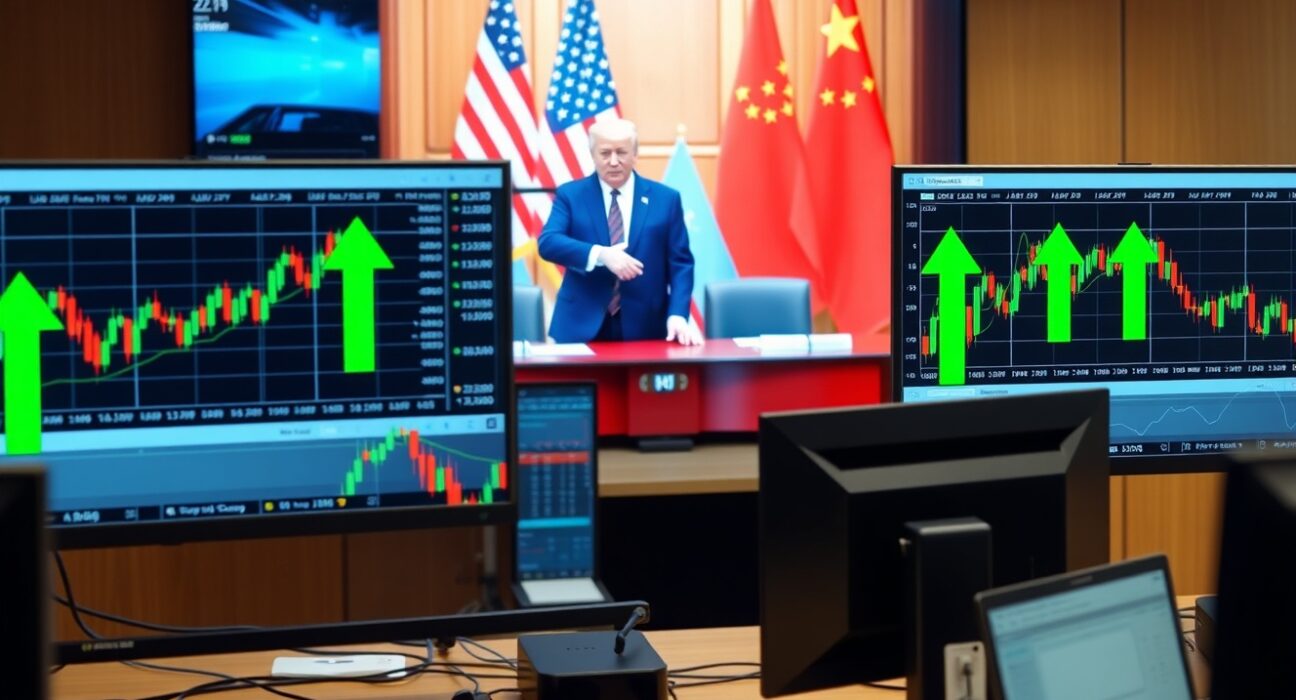
The AUD/JPY currency pair has extended its recent gains, drawing strength from a highly anticipated meeting between U.S. President Donald Trump and Chinese President Xi Jinping in Beijing. The summit, which signals a potential de-escalation in trade tensions between the world’s two largest economies, has injected a fresh wave of risk-on sentiment into the forex market, particularly benefiting the Australian dollar against the Japanese yen.
Trump-Xi Summit Fuels Risk Appetite
The meeting between Trump and Xi, held in the Chinese capital on [Date of event], marks the first high-level face-to-face dialogue between the two leaders in over a year. Market participants widely view the summit as a positive step toward resolving ongoing tariff disputes and stabilizing global supply chains. The Australian dollar, often used as a proxy for China-related risk exposure, has been a direct beneficiary of the improved sentiment.
Analysts note that any concrete agreement or even a joint statement signaling a truce in the trade war could further propel the AUD/JPY pair toward key resistance levels. The Japanese yen, meanwhile, has weakened as demand for safe-haven assets subsides in the face of growing optimism.
Technical Analysis: Bullish Bias Intact
From a technical perspective, the AUD/JPY pair is trading above its 50-day and 200-day moving averages, a classic configuration that reinforces the bullish bias. The recent price action has broken above the 95.00 psychological barrier, with the next major resistance zone sitting near the 96.50 level, a region that has capped upside attempts in previous months.
The Relative Strength Index (RSI) is currently hovering in the mid-60s, indicating that there is still room for further upside before the pair enters overbought territory. Support on any pullback is expected at the 94.50 level, followed by the 94.00 handle.
Key Levels to Watch
Traders are closely monitoring the 96.00 and 96.50 resistance levels. A sustained break above 96.50 could open the door for a move toward the 97.00 mark, a level not seen since early this year. On the downside, a close below 94.50 would signal a weakening of the current bullish momentum and could lead to a retest of the 94.00 support zone.
Why This Matters for Forex Traders
The AUD/JPY pair is highly sensitive to shifts in global risk sentiment and trade policy. For traders, the current environment offers a clear directional bias, but it also carries risks. The outcome of the Trump-Xi summit remains fluid, and any unexpected breakdown in talks could quickly reverse the pair’s gains. Additionally, upcoming economic data from both Australia and Japan, including retail sales and industrial production figures, will provide further catalysts.
Long-term investors should also consider the interest rate differential between the Reserve Bank of Australia (RBA) and the Bank of Japan (BOJ). With the RBA maintaining a relatively hawkish stance compared to the BOJ’s ultra-loose policy, the carry trade remains favorable for AUD/JPY bulls.
Conclusion
The AUD/JPY pair is riding a wave of optimism generated by the Trump-Xi summit in Beijing. While the technical setup supports further gains, traders should remain vigilant about headline risk and potential reversals. The pair’s ability to hold above key support levels will be crucial in determining whether the current bullish trend can sustain itself in the coming sessions.
FAQs
Q1: Why is the AUD/JPY pair rising during the Trump-Xi meeting?
A: The Australian dollar is sensitive to China-related trade news because China is Australia’s largest trading partner. Positive signals from the Trump-Xi summit reduce trade war fears, boosting risk appetite and the Aussie, while the yen weakens as safe-haven demand drops.
Q2: What are the key technical levels to watch in AUD/JPY?
A: The immediate resistance is at 96.00 and 96.50. A break above 96.50 could target 97.00. Key support lies at 94.50 and 94.00. The pair is trading above its 50-day and 200-day moving averages, confirming a bullish trend.
Q3: How long can the bullish bias in AUD/JPY last?
A: The bullish bias could persist as long as trade talks remain constructive and risk sentiment stays elevated. However, any negative headlines from the summit, disappointing economic data from Australia or Japan, or a shift in central bank policy could quickly change the outlook.
Disclaimer: The information provided is not trading advice, Bitcoinworld.co.in holds no liability for any investments made based on the information provided on this page. We strongly recommend independent research and/or consultation with a qualified professional before making any investment decisions.
