

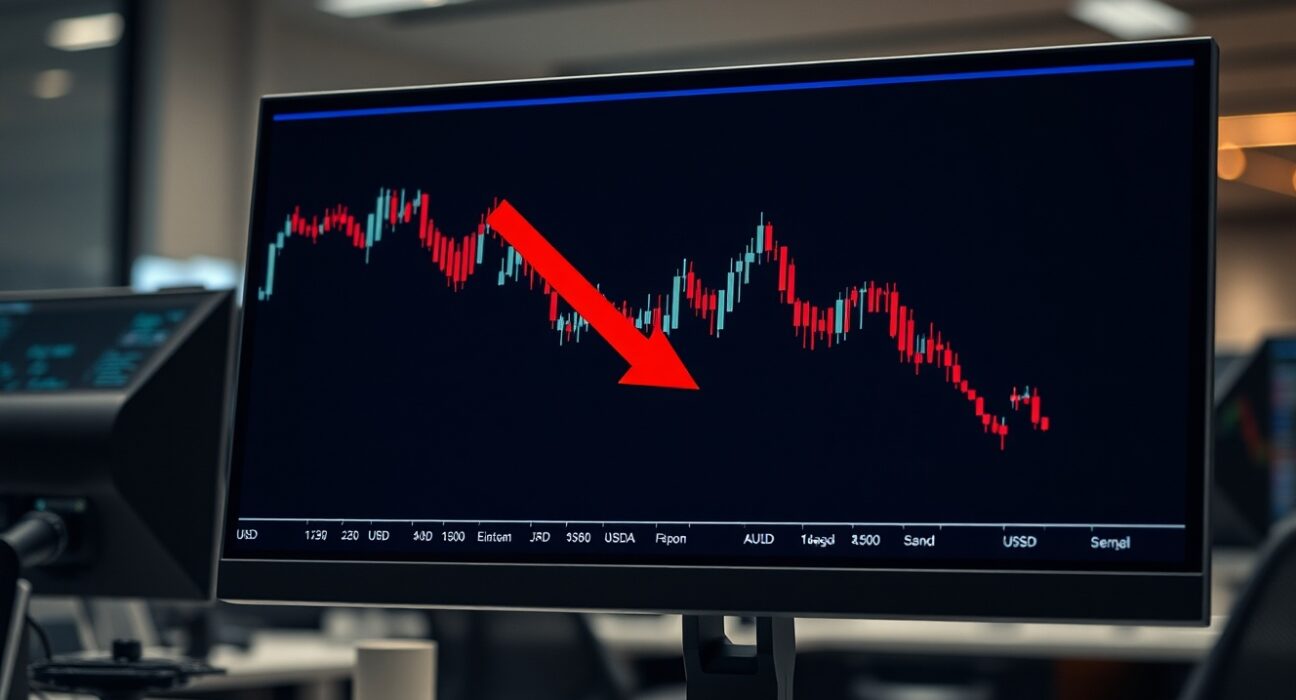
The Australian dollar continues to face headwinds against its US counterpart, with technical indicators signaling further downside potential. The downward-sloping 20-day Exponential Moving Average (EMA) is reinforcing a bearish bias, suggesting that sellers remain in control of the near-term trend.
Technical Setup: Bearish Momentum Intact
The 20-day EMA, a widely followed short-term trend indicator, has been sloping lower since late March, reflecting persistent selling pressure. Price action has consistently remained below this moving average, a classic sign of bearish momentum. The last two trading sessions saw the AUD/USD pair test the 0.6480 support zone, a level that has held on multiple occasions over the past month.
Traders are watching for a decisive break below 0.6480, which could open the door to the next support cluster near 0.6420, a level last seen in mid-February. On the upside, resistance is now firmly established at the 20-day EMA, currently around 0.6540, and any recovery attempts are likely to face selling pressure near that zone.
Fundamental Drivers Weighing on the Aussie
The bearish technical outlook aligns with a challenging fundamental backdrop. The Reserve Bank of Australia (RBA) has maintained a cautious stance, with market expectations of rate cuts later this year. Meanwhile, the US dollar has been buoyed by resilient economic data and hawkish signals from the Federal Reserve, which has pushed back against expectations of near-term rate reductions.
Commodity prices, a key driver for the Australian dollar, have also softened. Iron ore, Australia’s top export, has declined amid concerns over Chinese demand, adding to the currency’s headwinds. The combination of a stronger US dollar and weaker commodity prices is creating a formidable barrier for any AUD/USD recovery.
Key Levels to Watch
For traders, the immediate focus is on the 0.6480 support level. A daily close below this level would confirm the bearish breakout and likely trigger a move toward 0.6420. On the flip side, a bounce from current levels would need to clear the 20-day EMA and the 0.6550 resistance zone to signal a potential shift in sentiment.
The Relative Strength Index (RSI) is hovering near 40, not yet in oversold territory, suggesting there is room for further downside before a corrective bounce becomes technically justified. This leaves the path of least resistance tilted to the downside in the short term.
Conclusion
The AUD/USD pair remains under bearish pressure, with the downward-sloping 20-day EMA acting as a key technical barrier. While the 0.6480 support level has provided a floor in recent sessions, the combination of a strong US dollar, weak commodity prices, and a cautious RBA suggests that the risks are skewed to the downside. A break below 0.6480 would likely accelerate selling pressure toward the 0.6420 area.
FAQs
Q1: What does a downward-sloping 20-day EMA mean for AUD/USD?
A downward-sloping 20-day EMA indicates that the average price over the last 20 trading days is declining, which is a bearish signal. It suggests that sellers are in control and that the short-term trend is down.
Q2: What is the next key support level for AUD/USD?
The immediate support is at 0.6480. If that level breaks, the next major support is near 0.6420, which was a key low in February.
Q3: Why is the Australian dollar weakening?
The Australian dollar is under pressure due to a combination of a stronger US dollar, expectations of RBA rate cuts, and falling commodity prices, particularly iron ore, which is Australia’s largest export.
Disclaimer: The information provided is not trading advice, Bitcoinworld.co.in holds no liability for any investments made based on the information provided on this page. We strongly recommend independent research and/or consultation with a qualified professional before making any investment decisions.
