

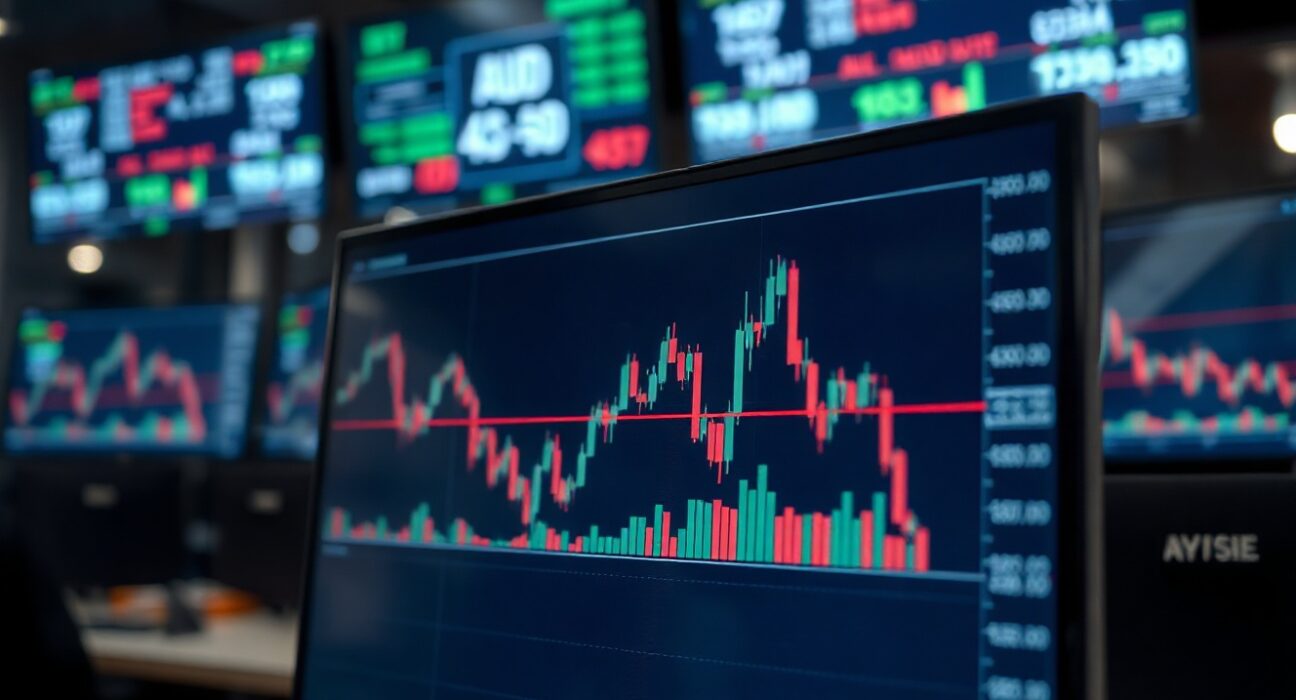
The Australian dollar is facing renewed selling pressure as bullish momentum fades, with the currency struggling to hold recent gains amid a softer commodity outlook and growing uncertainty over the Reserve Bank of Australia’s policy path.
Why the Australian Dollar Is Losing Ground
The AUD/USD pair has retreated from its recent highs as market participants reassess the likelihood of further rate hikes by the RBA. As of this week, the currency is trading near its lowest level in over a month, reflecting a shift in sentiment driven by weaker iron ore prices and a cautious tone from global risk markets.
Commodity prices, a key driver of Australia’s export revenues, have softened in recent sessions. Iron ore, the country’s top export, has declined on concerns about Chinese demand, while copper and gold have also pulled back. This has reduced the terms-of-trade support that previously underpinned the Aussie.
At the same time, the RBA’s monetary policy outlook has become less clear. While the central bank has kept rates on hold at 4.35% for several meetings, recent inflation data has been mixed, leading traders to pare back expectations for near-term tightening. This divergence from the U.S. Federal Reserve, which has signaled a slower pace of cuts, has widened the yield differential in favor of the U.S. dollar.
Market Context and Technical Picture
From a technical perspective, the AUD/USD pair has broken below its 50-day moving average, a signal often watched by traders as an early warning of further downside. The next support level sits around 0.6500, a psychological barrier that has held multiple times over the past year. A decisive break below that could open the door to a test of the 2024 low near 0.6360.
On the upside, the pair faces resistance at 0.6600 and then at the 200-day moving average near 0.6650. Without a fresh catalyst, such as stronger Chinese economic data or a hawkish surprise from the RBA, the path of least resistance appears to be lower.
Investors are also keeping an eye on the upcoming U.S. non-farm payrolls report, which could influence the Federal Reserve’s rate trajectory and, by extension, the U.S. dollar. A stronger-than-expected jobs number would likely boost the greenback further, adding to the Aussie’s woes.
What This Means for Traders and the Broader Economy
For currency traders, the current environment favors a cautious approach. The lack of bullish momentum suggests that rallies are likely to be sold, at least until there is a clear shift in the fundamental drivers. Hedging strategies may become more relevant for businesses with exposure to AUD/USD fluctuations.
Beyond the markets, a weaker Australian dollar has mixed implications for the domestic economy. On one hand, it supports exporters and makes Australian goods more competitive globally. On the other, it raises the cost of imported goods, which could feed into inflation at a time when the RBA is still trying to bring price pressures under control.
Conclusion
The Australian dollar’s near-term outlook remains clouded by soft commodity prices and an uncertain RBA policy path. While the currency is not in freefall, the absence of bullish momentum suggests that any recovery will be gradual and require a positive catalyst. Traders should monitor key data releases and technical levels for clearer direction.
FAQs
Q1: What is the main reason for the Australian dollar’s recent weakness?
The main reason is a combination of softer commodity prices, particularly iron ore, and a less hawkish stance from the RBA compared to the U.S. Federal Reserve, which has strengthened the U.S. dollar.
Q2: What are the key support and resistance levels for AUD/USD?
Immediate support is around 0.6500, with a break potentially leading to 0.6360. Resistance is at 0.6600 and then the 200-day moving average near 0.6650.
Q3: How could upcoming U.S. economic data affect the Australian dollar?
Stronger U.S. data, such as non-farm payrolls, could boost the U.S. dollar and put further downward pressure on AUD/USD, while weaker data could provide some relief to the Aussie.
Disclaimer: The information provided is not trading advice, Bitcoinworld.co.in holds no liability for any investments made based on the information provided on this page. We strongly recommend independent research and/or consultation with a qualified professional before making any investment decisions.
