

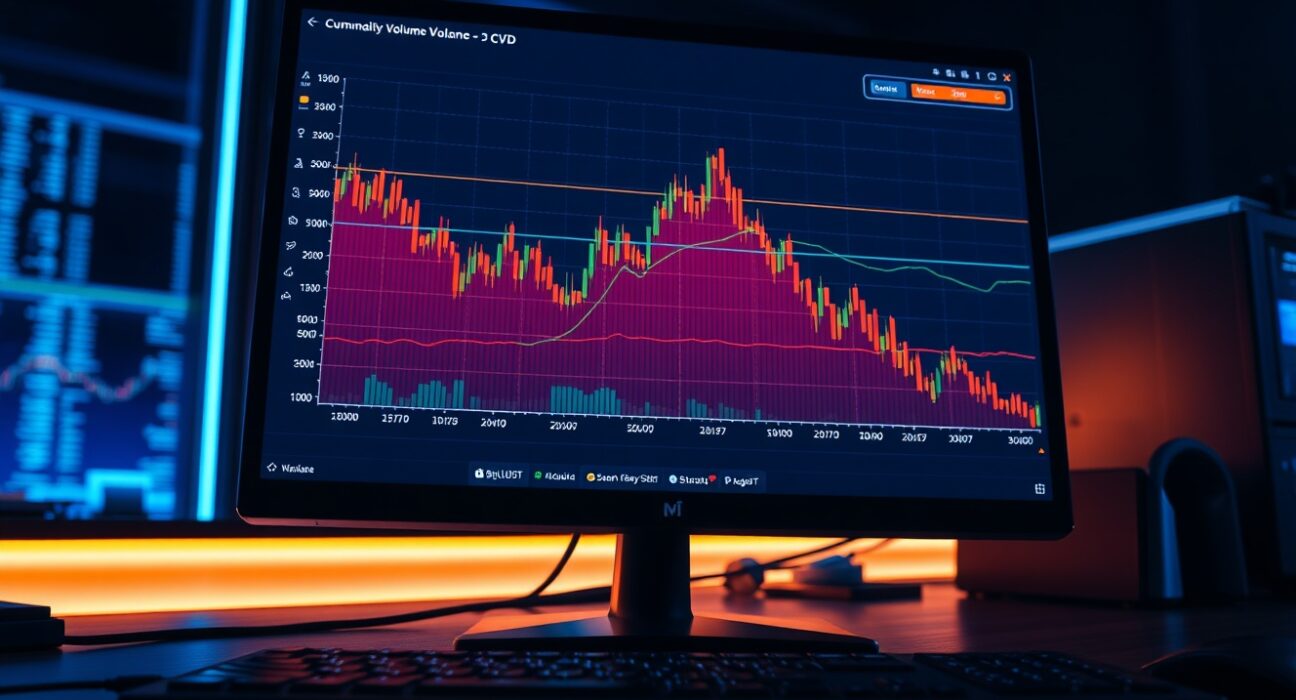
Traders monitoring the BTC/USDT spot pair on May 7, 2025, at 6:00 a.m. UTC are seeing a detailed breakdown of order book dynamics through the Cumulative Volume Delta (CVD) chart. This tool offers a granular view of buying and selling pressure, helping identify potential support and resistance levels based on actual trade activity rather than just price action.
Understanding the Volume Heatmap
The top section of the chart displays a Volume Heatmap, which tracks the concentration of trades at specific price levels. When the price lingers in a certain range or moves significantly through a level, the background color brightens, indicating higher trading activity. These brighter zones often act as technical markers, with traders watching them as potential support or resistance areas where the price may react.
Cumulative Volume Delta (CVD) and Trade Size
The lower portion of the chart shows the Cumulative Volume Delta (CVD) indicator, which separates buy and sell orders by trade size. As buy orders increase, the corresponding colored line rises. The yellow line represents smaller retail orders between $100 and $1,000, while the brown line tracks large institutional-sized orders ranging from $1 million to $10 million. This distinction allows traders to gauge whether market moves are being driven by retail participants or larger players, which can signal the strength or weakness of a trend.
Implications for Traders
By comparing the CVD lines, traders can observe shifts in order flow composition. A divergence between retail and large order activity may suggest an impending reversal or acceleration in price. For example, if the price rises but large orders (brown line) are declining while retail orders (yellow line) increase, it could indicate weaker conviction behind the move. Conversely, a surge in large buy orders often signals strong institutional interest.
Conclusion
The BTC/USDT spot CVD chart for May 7 provides a data-rich view of market microstructure. For traders, the combination of volume heatmap levels and CVD trade size analysis offers actionable insights into where liquidity is concentrated and who is driving the market. This type of order book analysis remains a key tool for short-term trading decisions in the cryptocurrency spot market.
FAQs
Q1: What is the Cumulative Volume Delta (CVD) indicator?
The CVD indicator tracks the cumulative difference between buy and sell orders in the order book, categorized by trade size. It helps traders see whether buying or selling pressure is dominant at any given time.
Q2: How does the volume heatmap help identify support and resistance?
The heatmap brightens in price zones where a high volume of trades has occurred. These zones often act as areas where the price may find support (if tested from above) or resistance (if tested from below) due to concentrated order activity.
Q3: Why is trade size analysis important in CVD?
Trade size analysis separates retail orders (e.g., $100–$1,000) from institutional orders (e.g., $1M–$10M). This helps traders understand whether price movements are driven by smaller individual traders or larger professional entities, which can indicate the sustainability of a trend.
Disclaimer: The information provided is not trading advice, Bitcoinworld.co.in holds no liability for any investments made based on the information provided on this page. We strongly recommend independent research and/or consultation with a qualified professional before making any investment decisions.
