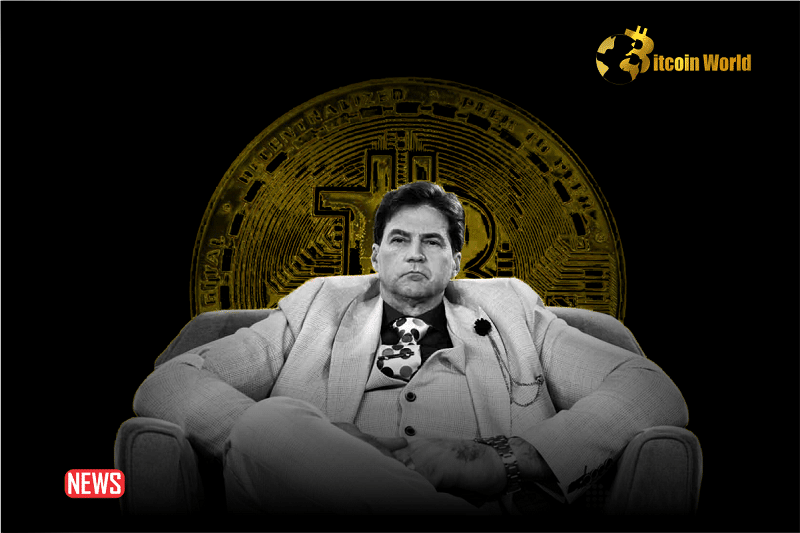
The courtroom drama surrounding Craig Wright’s claim to be Satoshi Nakamoto took another dramatic turn this week. Day seven of the COPA v. Wright trial witnessed a moment that could be a significant blow to his already controversial self-proclaimed identity. Imagine trying to prove you invented something revolutionary, yet when asked for simple, supporting details, your memory suddenly… vanishes. This is essentially what happened to Craig Wright when questioned about sending Bitcoin as Satoshi.
Satoshi’s Bitcoin Transfers: A Blank Space in Wright’s Memory?
During intense cross-examination, prosecutors honed in on a fundamental aspect of Satoshi Nakamoto’s early activity: sending Bitcoin. Think about it – the pseudonymous creator of Bitcoin didn’t just conjure the cryptocurrency into existence; they actively used it. They transacted. They interacted. So, naturally, a key question arises: if Craig Wright *is* Satoshi, shouldn’t he remember who he sent Bitcoin to in those early days?
According to reports from the courtroom, summarized expertly by crypto commentator @bitnorbert on X (formerly Twitter), the answer appears to be a resounding… no.
COPA’s legal team reportedly pressed Wright to confirm if he had ever sent Bitcoin to anyone other than the well-known figures of Hal Finney and Zooko Wilcox (co-founder of ZCash). These two names are already in the public domain and often associated with early Bitcoin discussions. The crucial point here? COPA was asking about individuals *outside* of this established circle.
Wright’s response? He asserted that he had indeed sent Bitcoin to “hundreds” of people through his various companies, implying these transactions were linked to the Satoshi Nakamoto persona. He even stated these blockchain addresses were publicly understood to be Satoshi’s. However, when it came to specifics, the details became hazy, very hazy.
Interestingly, despite Wright claiming to have sent Bitcoin to hundreds, he explicitly stated Zooko Wilcox wasn’t among them – a direct contradiction to Zooko’s own public statements denying ever receiving Bitcoin from Satoshi. This discrepancy adds another layer of complexity to Wright’s narrative.
“I Don’t Remember Them All Now”: A Convenient Memory Lapse?
The courtroom then pressed Wright for names. Just one name. Surely, out of “hundreds” of people he supposedly sent Bitcoin to as Satoshi, he could recall at least *one*? This is where Wright’s defense seemed to falter significantly.
When questioned about these numerous Bitcoin recipients, Wright reportedly stated, “I don’t remember them all now.”
Judge Edward James Mellor, presiding over the case, then asked Wright to simply name *one* person. Just one individual he sent Bitcoin to as Satoshi, outside of the already known figures. But, according to reports, Wright couldn’t. He fell short.
Instead of providing a name, Wright deflected, stating, “Gavin has talked about that now. It had no value at the time, My Lord. Most were pseudonymous,” referencing Gavin Andresen, a prominent early Bitcoin developer. This response raises more questions than answers. The lack of monetary value at the time doesn’t negate the act of sending Bitcoin, and pseudonymity doesn’t erase all memory of interactions, especially significant ones related to the creation of a groundbreaking technology.
Signing Sessions and the Essence of Proof: Knowledge vs. Possession
The questioning didn’t stop there. Wright also faced scrutiny regarding a public blog post he had previously claimed to have digitally signed to prove his Satoshi identity. This post has been heavily criticized by cryptographic experts, casting doubt on its validity as proof.
When asked if these “signing sessions” would be invalid if the private keys used could be accessed by individuals other than Satoshi, Wright offered a somewhat philosophical, and perhaps evasive, response. He stated, “Not at all.”
Expanding on this, Wright argued, “You don’t prove by having identity through possession of something. You prove by knowledge. Who you are. What you create,”
While the concept of proving identity through knowledge is intriguing, in the context of cryptography and digital signatures, possession of private keys is generally considered a fundamental aspect of proving control and identity. Wright’s argument seems to downplay the importance of cryptographic proof in favor of a more abstract notion of “knowledge.”
Is Craig Wright’s Defense “Falling Apart”?
Day seven marked Craig Wright’s sixth day on the stand under intense cross-examination by the Crypto Open Patent Alliance (COPA). COPA, backed by tech giants like Meta, Block, and MicroStrategy, is determined to demonstrate that Wright has engaged in “industrial scale forgery” and to prevent him from pursuing further lawsuits against those who deny his Satoshi claim. This trial is not just about Wright’s identity; it has significant implications for the Bitcoin community and the open-source ethos of cryptocurrency.
Reflecting on Tuesday’s courtroom proceedings, @bitnorbert described it as “the strongest showing of Bitcoiners in court today.”
He further added on X, “All in all, it was another day of a cornered man helplessly falling apart in court, his counsel forced to sit in silence and watch,” noting that Judge Mellor had to repeatedly interrupt Wright to elicit direct answers.
Throughout his cross-examination, Wright has attempted to discredit expert witnesses who have presented evidence of forgery in his defense materials. This includes Spencer Lynch, an expert witness initially hired by Wright’s *own* legal team, who also raised concerns about the authenticity of the evidence.
The inability to recall even a single name of someone he sent Bitcoin to as Satoshi, coupled with the ongoing challenges to his evidence, paints a picture of a defense struggling to maintain its credibility. As the trial progresses, the question remains: will Craig Wright be able to convincingly prove he is Satoshi Nakamoto, or is this memory lapse just the latest sign that his claims are indeed “falling apart”?
#Binance #WRITE2EARN
Disclaimer: The information provided is not trading advice, Bitcoinworld.co.in holds no liability for any investments made based on the information provided on this page. We strongly recommend independent research and/or consultation with a qualified professional before making any investment decisions.