

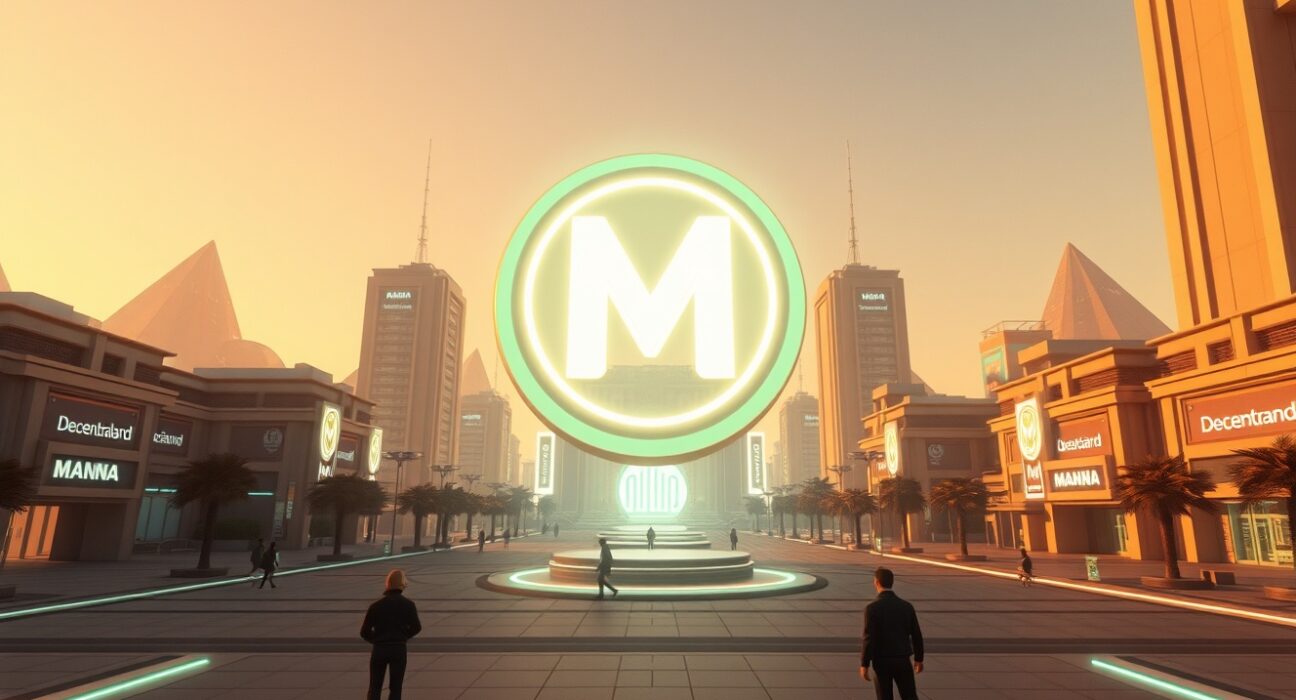
Decentraland (MANA), the native token of the blockchain-based virtual world, has experienced significant volatility since its peak in late 2021. As the broader cryptocurrency market matures and the metaverse sector evolves, investors are closely watching whether MANA can regain momentum and potentially reach the $1 mark in the coming years. This analysis examines key factors that could influence MANA’s price trajectory from 2026 through 2030, focusing on utility, adoption, and market conditions rather than speculative targets.
Understanding Decentraland and MANA’s Role
Decentraland is a decentralized virtual reality platform powered by the Ethereum blockchain. MANA serves as its primary currency, used for purchasing virtual land (LAND), digital goods, and services within the ecosystem. The platform also allows users to create, experience, and monetize content and applications. Since its launch in 2020, Decentraland has become one of the most recognized metaverse projects, hosting virtual events, concerts, and even corporate headquarters for major brands.
Tokenomics play a crucial role in MANA’s valuation. The total supply is capped at approximately 2.19 billion tokens, with a significant portion already in circulation. Burning mechanisms, introduced through platform fees and land sales, reduce supply over time, which could support price appreciation if demand grows. However, inflation from staking rewards and ecosystem incentives partially offsets these deflationary pressures.
Price History and Key Levels
MANA reached its all-time high of $5.85 in November 2021, driven by the broader crypto bull run and heightened interest in the metaverse following Facebook’s rebrand to Meta. Since then, the token has corrected sharply, trading in a range between $0.20 and $0.60 throughout 2023–2025. The $1 level represents a psychological resistance point that MANA has not sustainably breached since early 2022.
To reach $1 from current levels (assuming approximately $0.40–$0.50), MANA would need to more than double its market capitalization. This would require a combination of renewed speculative interest, tangible platform growth, and favorable macroeconomic conditions. Historical data shows that MANA has responded strongly to metaverse-related news cycles, but sustained price increases have only occurred during periods of broad market expansion.
Factors That Could Drive MANA Toward $1
Several developments could support a move toward $1:
- Metaverse adoption acceleration: If major brands and institutions deepen their presence in Decentraland, demand for LAND and MANA could rise. Real-world partnerships, such as those with Samsung, Sotheby’s, and Atari, have previously boosted sentiment.
- Platform upgrades: Improvements to scalability, user experience, and interoperability with other metaverses could attract more users and developers. The transition to Ethereum layer-2 solutions may reduce transaction costs and improve performance.
- Token utility expansion: New use cases for MANA, such as governance voting, staking rewards, or integration with decentralized finance (DeFi) protocols, could increase holding demand and reduce circulating supply.
- Macroeconomic environment: A return to risk-on sentiment in global markets, driven by lower interest rates or regulatory clarity for cryptocurrencies, could lift all digital assets, including MANA.
Challenges and Risks
Conversely, several headwinds could prevent MANA from reaching $1:
- Metaverse hype cycle fatigue: Investor interest in virtual worlds has waned since 2022, with many projects failing to deliver on promised user engagement. Daily active users on Decentraland remain modest compared to traditional gaming platforms.
- Competition: Other metaverse platforms like The Sandbox, Somnium Space, and Voxels, as well as emerging AI-driven virtual worlds, compete for user attention and developer resources. Decentraland’s first-mover advantage is eroding.
- Regulatory uncertainty: Potential classification of MANA as a security by regulators could impact its trading and availability on exchanges. Stricter rules around virtual land and digital assets could also dampen demand.
- Token supply overhang: Large vesting schedules for early investors and the Decentraland foundation could introduce selling pressure. If demand does not keep pace with unlocked tokens, price appreciation may be limited.
Price Scenarios for 2026–2030
Projecting prices for any cryptocurrency beyond short-term horizons involves significant uncertainty. However, based on current fundamentals and adoption trends, three broad scenarios emerge:
| Scenario | Key Assumptions | Estimated MANA Price Range (2026–2030) |
|---|---|---|
| Bearish | Metaverse interest continues to decline; limited platform growth; regulatory crackdowns; broader crypto bear market. | $0.10 – $0.30 |
| Base | Moderate adoption; steady platform improvements; mixed macro environment; MANA trades in line with other mid-cap altcoins. | $0.40 – $0.80 |
| Bullish | Renewed metaverse hype; major brand adoption; technological breakthroughs; strong crypto bull run. | $1.00 – $2.50 |
In the bullish scenario, MANA could reach $1 as early as 2026 if a new crypto bull market coincides with significant metaverse milestones. However, the base case suggests that $1 may remain out of reach until at least 2028–2030, assuming gradual accumulation and ecosystem maturation.
What Investors Should Consider
Price predictions for MANA, like all cryptocurrencies, should be viewed with caution. The token’s value is highly correlated with broader market sentiment, technological development, and user adoption—all of which are difficult to forecast. Investors should focus on the underlying fundamentals of Decentraland, including its development roadmap, partnership pipeline, and community activity, rather than short-term price targets.
Diversification and risk management remain essential. MANA is a volatile asset that has experienced drawdowns of over 90% from its peak. Allocating only a small portion of a portfolio to such high-risk investments is prudent.
Conclusion
Whether Decentraland’s MANA token will hit $1 by 2030 depends on a confluence of factors: sustained metaverse adoption, platform innovation, favorable regulation, and a supportive macro environment. While the token has the potential to reach that level in a bullish scenario, the base case suggests a more modest trajectory. For now, $1 remains an aspirational target rather than a certainty. Investors should monitor real-world usage metrics and development activity as more reliable indicators of long-term value than price speculation alone.
FAQs
Q1: What is the maximum supply of MANA?
The total maximum supply of MANA is capped at approximately 2.19 billion tokens. As of 2025, over 90% of this supply is already in circulation, with the remainder released gradually through ecosystem incentives.
Q2: How does Decentraland generate demand for MANA?
MANA is required for purchasing virtual land, wearables, and other digital assets within Decentraland. It is also used for governance voting and transaction fees. Demand increases when more users and brands participate in the platform.
Q3: Is MANA a good long-term investment?
MANA carries high risk and high potential reward. Its long-term value depends on Decentraland’s ability to maintain relevance in the competitive metaverse space. Investors should conduct their own research and consider their risk tolerance before investing.
Disclaimer: The information provided is not trading advice, Bitcoinworld.co.in holds no liability for any investments made based on the information provided on this page. We strongly recommend independent research and/or consultation with a qualified professional before making any investment decisions.
