

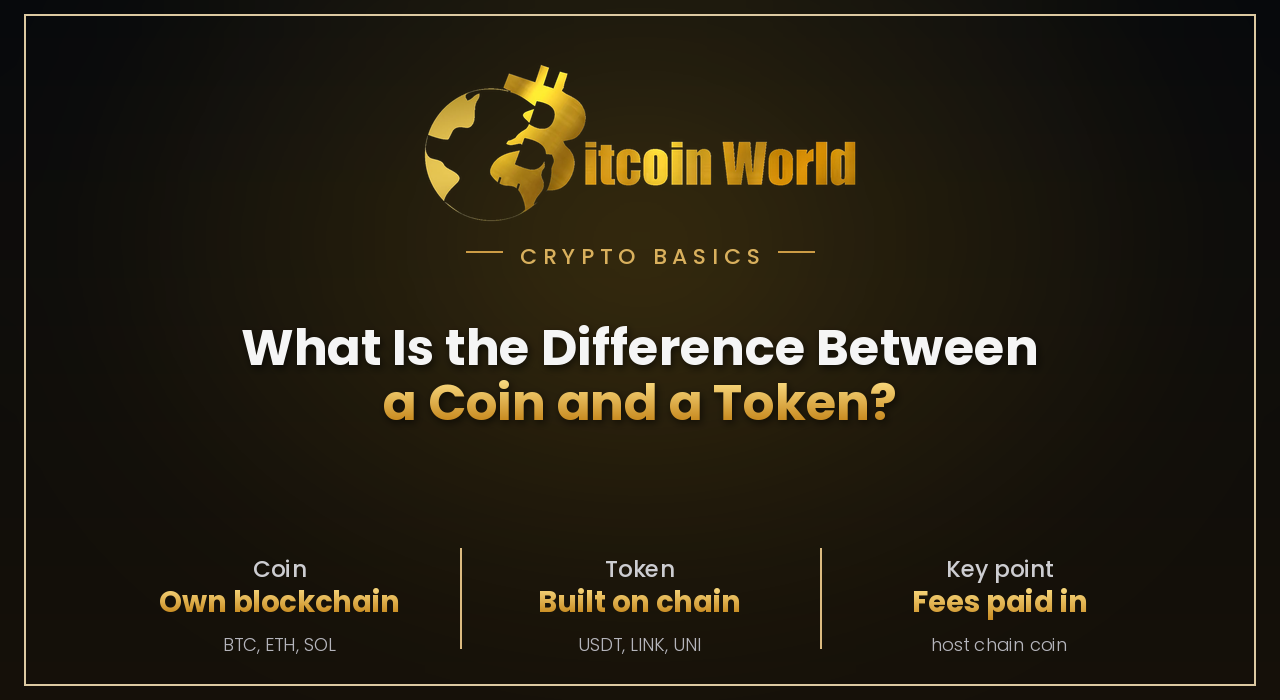
What’s the Difference Between a Coin and a Token in Crypto?
The difference between a coin and a token in crypto is one of the most useful foundational distinctions to understand – and most beginners use the two words interchangeably without realizing they describe fundamentally different things. A coin has its own blockchain; a token exists on someone else’s. This article explains the distinction clearly, gives practical examples, explains why it matters for fees and functionality, and helps Indian users understand what they’re actually holding.
What’s the Difference Between a Coin and a Token in Crypto?
The core difference between a coin and a token is whether the asset has its own independent blockchain.
- Coin: A cryptocurrency that operates on its own native blockchain – Bitcoin on the Bitcoin blockchain, Ether on Ethereum.
- Token: A cryptocurrency built on top of another blockchain’s infrastructure, using that chain’s security and consensus.
- Coins power their network: A coin is typically the native asset used to pay fees and incentivize network validators.
- Tokens use the host chain: A token like USDT on Ethereum is a smart contract on Ethereum – it uses ETH for gas fees, not its own network.
What Are the Best Examples of Coins vs Tokens?
Familiar names illustrate the distinction clearly.
Coins (own blockchain):
- Bitcoin (BTC) – Bitcoin blockchain
- Ether (ETH) – Ethereum blockchain
- Solana (SOL) – Solana blockchain
- BNB – BNB Chain
Tokens (built on another chain):
- USDT (Tether) – exists on Ethereum (ERC-20), Tron (TRC-20), BNB Chain (BEP-20), and others
- LINK (Chainlink) – ERC-20 token on Ethereum
- UNI (Uniswap) – ERC-20 token on Ethereum
- Most DeFi and NFT projects – typically tokens on Ethereum or other smart contract chains
Why Does the Distinction Matter in Practice?
Coin vs token isn’t just a label – it affects fees, wallets, and how you interact with assets.
- Fee currency: When sending a token, you pay fees in the host blockchain’s coin – sending ERC-20 USDT costs ETH gas, not USDT itself.
- Wallet compatibility: Your wallet needs to support the host chain to hold tokens on it; a Bitcoin-only wallet can’t hold ERC-20 tokens.
- Network dependency: A token’s transferability depends on the host blockchain being live and not congested.
- Security model: Tokens inherit the security of their host chain – an ERC-20 token is as secure as Ethereum itself.
What Does This Mean for Indian Crypto Users?
For users in India managing multiple assets across platforms, the coin/token distinction has practical daily relevance.
- Keep ETH for gas: If you hold ERC-20 tokens, always keep some ETH in the same wallet for transaction fees.
- TRC-20 USDT is a token on Tron: Sending it requires a small TRX (Tron’s coin) balance for fees – a common surprise for new users.
- Indian exchange listings: Many assets listed on Indian exchanges are tokens, not coins – their value depends on the health of their host chain too.
- VDA tax applies to both: India’s 30% tax on crypto gains applies equally to coins and tokens – the distinction doesn’t affect tax treatment.
Frequently Asked Questions
Is Ethereum a coin or a token?
Ether (ETH) is a coin – it runs on its own native blockchain (the Ethereum network) and is the asset used to pay gas fees on that network. However, Ethereum is also a platform on which thousands of tokens (ERC-20 tokens) are built. So Ethereum is a blockchain, ETH is its native coin, and assets like USDT or LINK built on top of Ethereum are tokens.
Why does USDT exist on multiple blockchains?
USDT is a token deployed on multiple blockchains – including Ethereum (ERC-20), Tron (TRC-20), and BNB Chain (BEP-20) – because each deployment is a separate smart contract on a separate chain. This gives users flexibility to move USDT on whichever network has lower fees or better compatibility with their wallet. The different versions are separate tokens that happen to be pegged to the same dollar value.
Do you need separate wallets for coins and tokens?
Not always – multi-chain wallets like MetaMask or Trust Wallet support multiple blockchains and the tokens on them in one interface. However, a Bitcoin-only wallet cannot hold Ethereum-based tokens, and vice versa. The key requirement is that your wallet supports the specific blockchain on which the coin or token you want to hold operates.
Conclusion: Why Coin vs Token Is More Than Just Vocabulary
Knowing the difference between a coin and a token in crypto is practical knowledge that affects every transaction. For Indian users, it explains why sending ERC-20 USDT requires ETH for fees, why TRC-20 transfers need TRX, and why the asset you’re holding may depend on another blockchain’s health entirely. The distinction is foundational – get it right once, and a large part of crypto’s apparent complexity starts to make sense.
Disclaimer: The information provided is not trading advice, Bitcoinworld.co.in holds no liability for any investments made based on the information provided on this page. We strongly recommend independent research and/or consultation with a qualified professional before making any investment decisions.
