

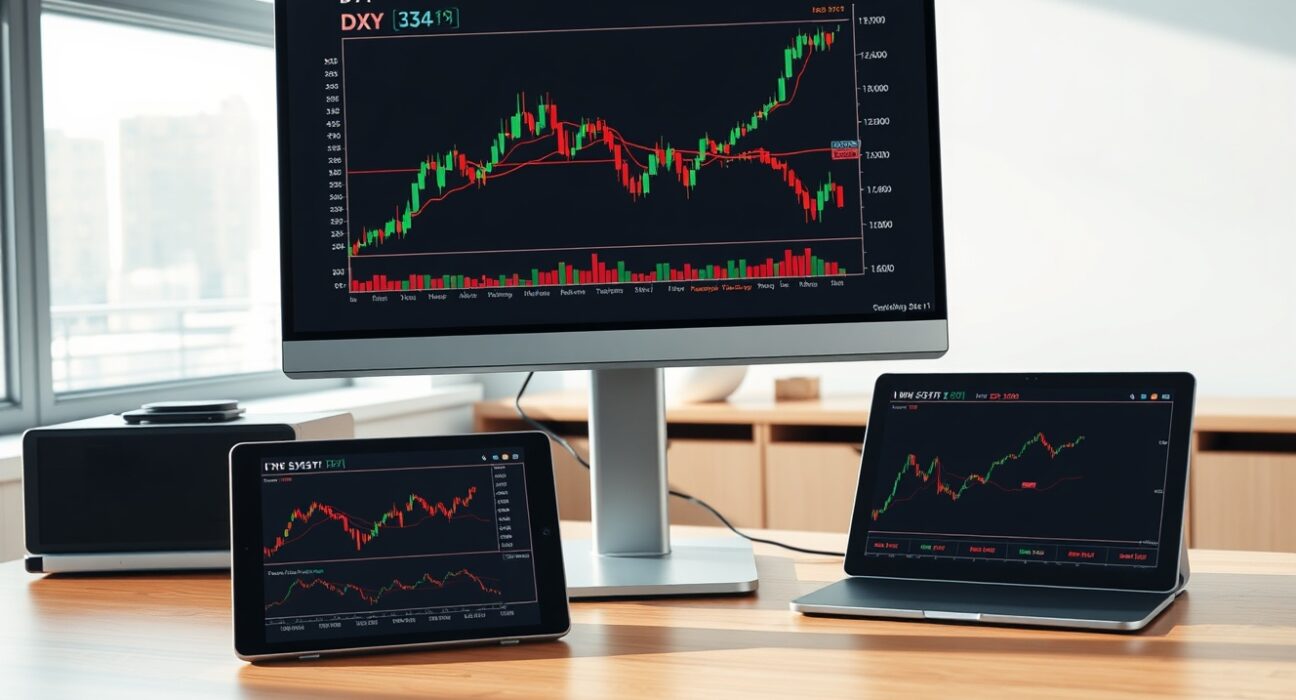
In global financial markets for March 2025, a resurgent US Dollar Index (DXY) presents a formidable headwind for equity investors hoping for a sustained recovery. Technical analysis from ING, a prominent multinational banking group, illustrates this dynamic through detailed chart patterns. Consequently, market participants now scrutinize the inverse correlation between the dollar’s strength and risk asset performance. This relationship remains a cornerstone of modern portfolio theory and tactical asset allocation.
DXY Dollar Index Technical Structure and Current Levels
ING’s analysis focuses on the DXY’s technical posture, which has strengthened significantly in early 2025. The index, which measures the US dollar against a basket of six major currencies, recently breached key resistance levels. Specifically, it moved above the 105.50 handle, a zone that previously capped rallies throughout late 2024. This breakout suggests underlying momentum fueled by relative monetary policy expectations. Furthermore, the 50-day and 200-day moving averages now slope upward, confirming the bullish trend’s durability. Market technicians often view such a configuration as a strong buy signal for the currency itself.
Key technical levels from ING’s assessment include:
- Immediate Support: 105.00 (previous resistance, now support)
- Primary Resistance: 107.80 (2024 high)
- 200-Day Moving Average: 103.40 (long-term trend guide)
- Relative Strength Index (RSI): Currently near 65, indicating bullish momentum without extreme overbought conditions.
The Mechanics of Dollar Strength on Equity Markets
A robust dollar creates a multi-faceted challenge for corporate earnings and equity valuations. Firstly, multinational companies generating substantial revenue overseas face translational headwinds. When these foreign earnings convert back into a stronger dollar, their US-reported value diminishes. Secondly, a strong dollar often reflects tighter US financial conditions or higher real yields, which increase the discount rate applied to future corporate cash flows. This process directly pressures equity valuations, particularly for growth stocks. Historically, periods of rapid DXY appreciation have coincided with volatility spikes in the S&P 500 and Nasdaq Composite.
Historical Context and Correlation Data
Examining the past decade reveals a persistent, though not perfect, inverse relationship. For instance, during the 2014-2016 DXY bull run, the S&P 500 experienced heightened volatility and multiple corrections. Conversely, the dollar’s bear market from 2017 to 2020 coincided with a powerful equity rally. The current environment echoes aspects of the 2014-2016 period, where markets anticipated a Federal Reserve tightening cycle diverging from other central banks. This divergence creates the “policy gap” that fuels dollar rallies and simultaneously saps liquidity from global risk assets.
The table below summarizes recent correlation regimes:
| Period | DXY Trend | S&P 500 Performance | Primary Driver |
|---|---|---|---|
| 2020-2021 | Bearish | Strong Bull Market | Global Fiscal/Monetary Stimulus |
| 2022 | Bullish | Bear Market | Aggressive Fed Hiking Cycle |
| 2023 | Range-bound | Rebound | Peak Rate Expectations |
| 2025 YTD | Bullish Breakout | Capped Rebound | Policy Divergence Renewed |
Global Macro Backdrop and Central Bank Policy
The dollar’s 2025 strength stems from a clear macroeconomic narrative. The Federal Reserve has signaled a slower path to rate cuts than markets initially priced, citing persistent services inflation. Meanwhile, other major central banks, like the European Central Bank and the Bank of England, face weaker growth profiles, prompting earlier or deeper easing cycles. This policy divergence widens interest rate differentials, making dollar-denominated assets more attractive to yield-seeking capital. Consequently, flows move into US Treasuries and money markets, supporting the dollar but diverting funds from global equities. The Japanese Yen’s role as a funding currency also amplifies this dynamic during risk-off periods.
Sectoral Impacts and Relative Winners & Losers
Not all equities suffer equally under a strong dollar regime. Domestic-focused US small-cap companies, which derive nearly all revenue domestically, often show relative resilience. Conversely, large-cap technology and semiconductor firms with vast international exposure face significant earnings risk. The materials and energy sectors present a mixed picture; while a strong dollar pressures commodity prices globally, US energy firms can benefit from lower domestic input costs. ING’s charts likely highlight these divergences, showing sector performance dispersion correlating to DXY movements. Investors, therefore, must adopt a selective, sector-aware approach rather than a broad market call.
Expert Perspective on Market Positioning
Market strategists note that hedge fund positioning data shows a crowded long dollar trade. While this supports the trend in the near term, it also increases the risk of a sharp reversal if macroeconomic data softens. The key watchpoint for Q2 2025 will be US labor market and inflation prints. Any sign of unexpected cooling could quickly unwind policy divergence expectations, weakening the DXY and potentially unleashing pent-up demand for equities. However, until such data emerges, the technical and fundamental picture described by ING suggests the path of least resistance favors dollar strength and contained equity rallies.
Conclusion
In summary, the technical breakout in the DXY dollar index, as analyzed by ING, acts as a significant cap on equity rebound prospects for 2025. The interplay of central bank policy divergence, currency translation effects, and shifting global capital flows creates a challenging environment for risk assets. While selective opportunities exist in domestically-oriented sectors, the broad market’s ability to stage a sustained recovery remains contingent on the dollar’s trajectory. Therefore, monitoring the DXY’s key technical levels remains paramount for investors navigating this complex macro landscape.
FAQs
Q1: What is the DXY dollar index?
The US Dollar Index (DXY or DX) is a measure of the value of the United States dollar relative to a basket of six major world currencies: the Euro, Japanese Yen, British Pound, Canadian Dollar, Swedish Krona, and Swiss Franc. It is a key benchmark in global forex markets.
Q2: Why does a strong dollar hurt stock markets?
A strong dollar can hurt US stock markets, particularly large multinational companies, by reducing the value of overseas earnings when converted back to USD. It can also reflect tighter financial conditions and higher real yields, which increase the discount rate for future corporate profits, pressuring valuations.
Q3: What does ING’s analysis specifically show?
While the provided content note is brief, ING’s typical analysis in this context would involve technical charts showing the DXY breaking above key resistance levels (like 105.50), suggesting bullish momentum that historically correlates with periods of challenged or capped equity market performance.
Q4: Are there any stock market sectors that benefit from a strong dollar?
Yes, sectors with primarily domestic US revenue, such as certain small-cap companies, regional banks, and utilities, can be relatively insulated. Some US-based commodity producers may also benefit from lower domestic input costs even as global commodity prices face downward pressure from the strong dollar.
Q5: What could cause the current strong dollar trend to reverse?
A reversal could be triggered by a shift in central bank policy expectations, such as the Federal Reserve signaling more aggressive rate cuts than anticipated, or other major central banks halting their easing cycles. Weaker-than-expected US economic data, particularly on inflation and employment, would also be a key catalyst.
Disclaimer: The information provided is not trading advice, Bitcoinworld.co.in holds no liability for any investments made based on the information provided on this page. We strongly recommend independent research and/or consultation with a qualified professional before making any investment decisions.
