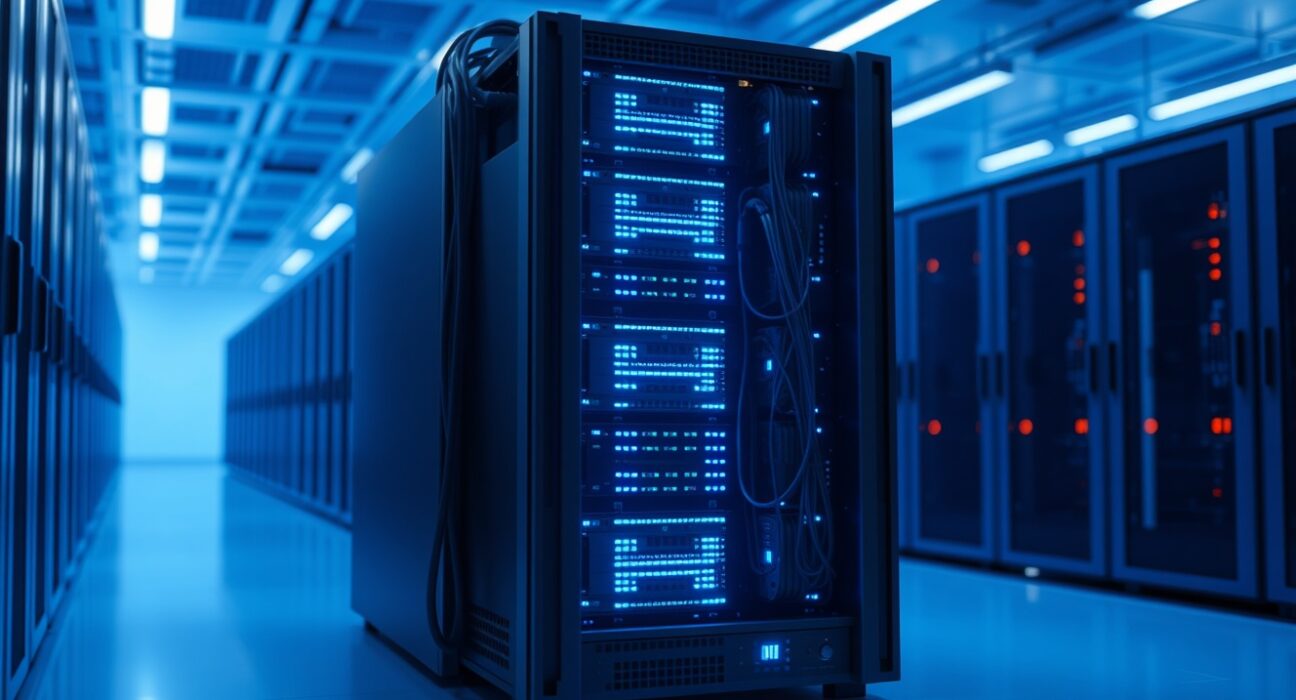
AI chip startup Etched, founded by three Harvard dropouts in 2022, has closed a $300 million Series C funding round at a $10.3 billion valuation, the company’s co-founder and COO Robert Wachen confirmed. The round was led by Sequoia Capital, with participation from Andreessen Horowitz, SK Hynix, Jane Street, and Diffusion Capital, alongside earlier backers including Peter Thiel, Andrej Karpathy, Dylan Field, and Amjad Masad.
The new valuation doubles the company’s worth from $5 billion in December 2024, when it raised a $500 million round. Etched claims this is the highest valuation ever achieved in a Sequoia-led Series C round.
From garage servers to $1 billion in orders
Etched’s trajectory has been anything but conventional. The company designs specialized chips — sold as full rack systems — optimized for transformer-based AI models, the architecture behind systems like ChatGPT and Claude. Last month, Etched announced it had successfully manufactured its first chips through TSMC, that initial systems were being tested by clients, and that it had already booked $1 billion in orders.
Wachen recalled the company’s humble beginnings, sleeping on a friend’s floor in the Bay Area after dropping out of Harvard. The founders ran their chip design tools on servers kept in an early employee’s garage, requiring that employee’s wife to manually reboot the system when needed. Today, Etched employs 400 people and operates a 2-megawatt data center.
How Etched’s chips work: prefill and decode
Etched’s technology addresses two distinct phases of AI inference. The “prefill phase” involves understanding the user’s prompt — a compute-intensive mathematical process. The “decode phase” generates the output tokens the user sees, requiring less computation but massive memory bandwidth.
For prefill, Etched designed a chip that operates at significantly lower voltage than competing AI chips, reducing heat and allowing more transistors to be packed in. For decode, the company created a new memory and interconnect technology called “cluster scale memory,” which enables many chips to share a memory pool with very low latency. The result, according to Wachen, is higher speeds at lower cost.
Addressing skepticism about specialized hardware
When Etched launched, the idea of building a chip specifically for transformer-based AI models was considered risky. The company still battles the perception that its systems only run specific large language models. Wachen clarified that Etched’s systems can run any AI model, including Mixture of Experts architectures like DeepSeek and Qwen, as well as non-transformer designs like Mamba, which uses a state-space model architecture.
Notably, the broader industry is moving in a similar direction. Google is reportedly developing its Frozen v2 chip specifically for Gemini, suggesting the concept of etching model-specific features into silicon is gaining mainstream acceptance.
Investor confidence through hands-on demos
Etched secured its prominent investor list by offering private hardware demonstrations in its office. Wachen noted that Andrej Karpathy from Anthropic, Noam Brown from OpenAI, Geoffrey Hinton, and all the investors in the funding round actually tested the hardware before committing. “These are all people who actually tried the hardware and are very excited about it,” he said.
Despite the progress, Wachen acknowledged the challenges ahead. “We had no idea how hard it was going to be,” he said. “I think we still have to be humbled by what it will take to actually get to scale.”
Why this matters for the AI industry
Etched’s rapid growth and investor confidence signal a shift in the AI hardware landscape. As AI models grow more complex, specialized inference chips that reduce cost and power consumption could become critical infrastructure. If Etched delivers on its promises, it could challenge Nvidia’s dominance in AI compute by offering a purpose-built alternative for the transformer-based models that dominate today’s market.
Conclusion
Etched has transformed from a trio of Harvard dropouts with no office to a $10.3 billion company with a manufactured chip, $1 billion in orders, and backing from some of the most prominent names in tech and venture capital. Whether the company can scale production and deliver on its technical promises remains to be seen, but its journey so far illustrates the high stakes and rapid evolution of the AI chip market.
FAQs
Q1: What makes Etched’s AI chips different from Nvidia’s?
Etched designs chips specifically optimized for transformer-based AI models, the architecture behind most modern AI systems. The company claims its chips operate at lower voltage, generate less heat, and offer faster inference at lower cost compared to general-purpose AI accelerators.
Q2: Can Etched’s systems run models other than transformers?
Yes. According to co-founder Robert Wachen, Etched’s systems can run any AI model, including Mixture of Experts architectures like DeepSeek and Qwen, as well as non-transformer designs like Mamba, which uses a state-space model architecture.
Q3: Who are Etched’s major investors and customers?
Investors include Sequoia Capital, Andreessen Horowitz, SK Hynix, Jane Street, Peter Thiel, Andrej Karpathy, and others. The company has booked $1 billion in orders and is working with some of the largest AI companies in the world, though specific customer names have not been disclosed.
Disclaimer: The information provided is not trading advice, Bitcoinworld.co.in holds no liability for any investments made based on the information provided on this page. We strongly recommend independent research and/or consultation with a qualified professional before making any investment decisions.