

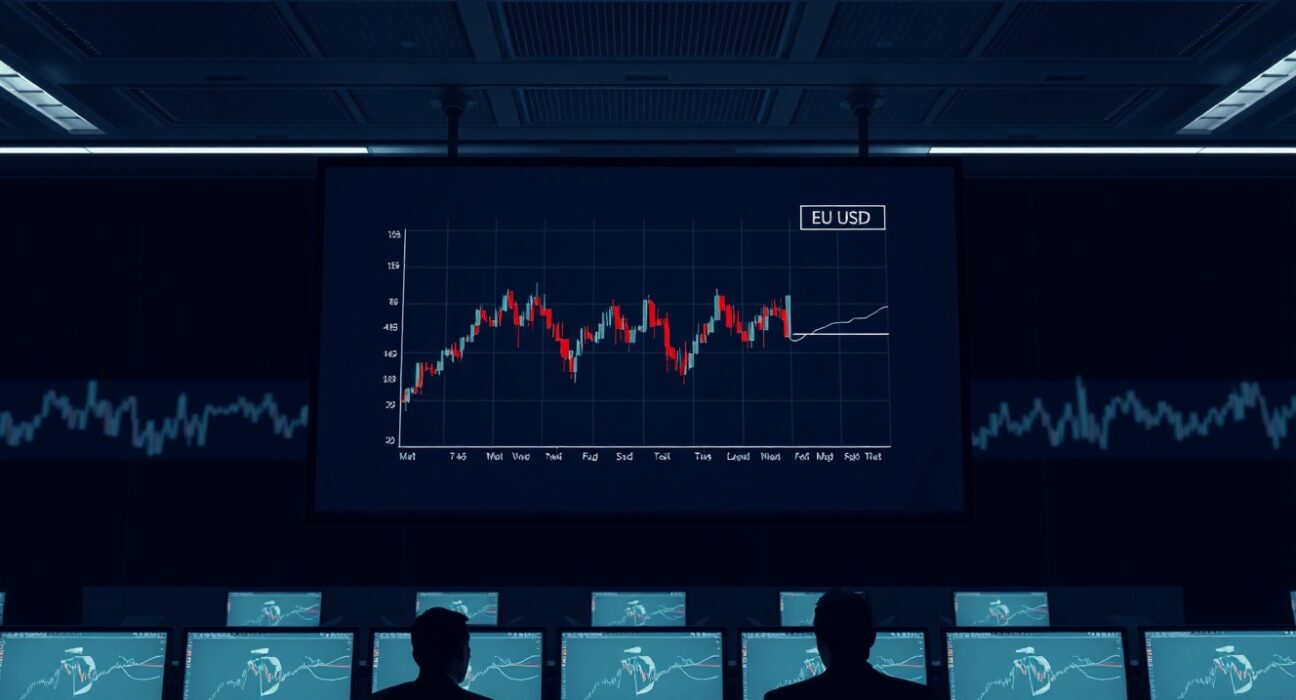
The EUR/USD currency pair continues to struggle for clear direction as global markets adopt a cautious stance amid ongoing US-Iran nuclear negotiations. This uncertainty has left the euro pinned against the dollar, with traders closely watching diplomatic signals from Vienna. The EUR/USD exchange rate reflects the delicate balance between geopolitical risk and monetary policy expectations.
EUR/USD Trading in a Narrow Range Amid US-Iran Talks
On Wednesday, the EUR/USD pair hovered near the 1.0850 level, showing minimal movement for a third consecutive session. The lack of volatility stems directly from the market’s wait-and-see approach regarding the US-Iran talks. Traders hesitate to place large bets before clarity emerges on potential sanctions relief and its impact on global oil supplies.
This caution is visible across major currency pairs. The euro remains sensitive to energy price fluctuations, which the US-Iran talks directly influence. A potential deal could increase Iranian oil exports, lowering energy costs for Europe and supporting the euro. Conversely, a breakdown in negotiations could spike oil prices and pressure the single currency.
Market Sentiment and Technical Levels
Technical analysts point to a consolidation pattern on the EUR/USD chart. The pair trades between support at 1.0800 and resistance at 1.0900. These levels have held firm since the start of the week. The Relative Strength Index sits near 50, indicating no clear momentum in either direction.
- Key Support: 1.0800 – A break below could trigger a move toward 1.0720
- Key Resistance: 1.0900 – A breakout above might target 1.0980
- 50-Day Moving Average: Currently at 1.0835, providing dynamic support
How US-Iran Talks Influence the EUR/USD Exchange Rate
The connection between US-Iran talks and EUR/USD may not be obvious to casual observers. However, the link runs through energy markets and risk appetite. Iran holds some of the world’s largest oil and gas reserves. Any agreement that lifts sanctions would increase global supply, potentially lowering crude oil prices.
Lower oil prices benefit the eurozone, a major energy importer. Reduced import costs improve the region’s trade balance and support economic growth. This positive outlook typically strengthens the euro against the dollar. On the other hand, failed talks or heightened tensions drive oil prices higher, hurting the eurozone economy and weakening EUR/USD.
Geopolitical Risk and Safe-Haven Flows
Beyond energy, the US-Iran talks affect broader risk sentiment. Progress in negotiations reduces geopolitical risk, encouraging investors to move away from safe-haven assets like the US dollar. A weaker dollar naturally lifts EUR/USD. Stalled talks or aggressive rhetoric from either side pushes capital back into the greenback.
This dynamic creates a direct feedback loop. Every headline from the negotiations in Vienna triggers a measurable response in the currency markets. Traders monitor these updates in real time, adjusting their positions accordingly.
European Central Bank Policy vs. Federal Reserve Outlook
Monetary policy divergence adds another layer to the EUR/USD equation. The European Central Bank recently signaled a cautious approach to rate cuts, citing persistent inflation in the services sector. This stance provides some support for the euro. Meanwhile, the Federal Reserve maintains a data-dependent posture, with markets pricing in potential rate cuts later this year.
The interplay between central bank expectations and the US-Iran talks creates a complex trading environment. A hawkish ECB combined with a diplomatic breakthrough could propel EUR/USD higher. Conversely, a dovish ECB shift alongside failed talks would likely push the pair lower.
Economic Data Releases to Watch
This week’s economic calendar adds potential catalysts. Key reports include:
- Eurozone GDP (Q1): Expected to show modest growth of 0.3% quarter-on-quarter
- US Durable Goods Orders: Forecast to decline 0.5% in March
- US Core PCE Price Index: The Fed’s preferred inflation gauge, due Friday
These data points could either confirm or challenge the current market narrative. Strong eurozone data would support the euro, while weak US data could undermine the dollar. Either way, the US-Iran talks remain the primary driver of near-term price action.
Expert Perspectives on the EUR/USD Outlook
Currency strategists at major banks offer varied views on the pair’s trajectory. Analysts at ING suggest that a successful US-Iran deal could push EUR/USD toward 1.1000 in the coming weeks. They cite lower energy costs and improved eurozone growth prospects as key drivers.
Conversely, strategists at Morgan Stanley warn that any escalation in tensions could send the pair back below 1.0700. They emphasize that the dollar’s safe-haven appeal remains strong during periods of geopolitical uncertainty. The wide range of forecasts highlights the binary nature of the current setup.
Historical Context: Previous Negotiations and Market Reactions
Past US-Iran talks provide useful context. In 2015, the Joint Comprehensive Plan of Action (JCPOA) led to a sustained rally in EUR/USD. The pair rose from 1.0500 to over 1.1500 in the six months following the agreement. Oil prices fell sharply during the same period, confirming the energy channel mechanism.
The 2018 US withdrawal from the deal had the opposite effect. EUR/USD dropped from 1.2500 to 1.1300 as sanctions were reimposed and oil prices surged. This historical precedent suggests that the current negotiations carry significant weight for the currency market.
Technical Analysis: EUR/USD Chart Patterns
The daily chart shows a symmetrical triangle formation, indicating a period of consolidation before a potential breakout. The triangle’s apex converges around the 1.0850 level, suggesting an imminent directional move. Volume indicators remain subdued, confirming the market’s indecision.
Bollinger Bands have narrowed considerably, a classic sign of low volatility that often precedes a sharp expansion. The last time the bands were this tight, EUR/USD moved over 200 pips within a week. Traders should prepare for a similar scenario once the US-Iran talks produce a clear outcome.
Options Market Signals
The options market provides additional clues. One-week risk reversals for EUR/USD show a slight premium for puts over calls, indicating a bearish bias. However, the skew is modest compared to previous geopolitical events. This suggests that while traders are cautious, they are not aggressively betting on a breakdown.
Implied volatility remains elevated, with one-week options pricing in a potential move of 80-100 pips in either direction. This reflects the market’s expectation of a significant price swing once the talks conclude. The direction of that swing depends entirely on the outcome.
Practical Trading Strategies for the Current Environment
Given the binary nature of the US-Iran talks, traders should consider strategies that account for both scenarios. Straddle or strangle options strategies allow participation in a large move without predicting direction. For spot traders, waiting for a confirmed breakout above 1.0900 or below 1.0800 provides a clearer entry point.
Position sizing becomes critical during such events. The potential for sudden, sharp moves requires conservative leverage. Setting stop-losses beyond the current range helps protect against false breakouts. Patience remains the most valuable tool in this uncertain environment.
Conclusion
The EUR/USD pair faces a pivotal moment as the market remains cautious on US-Iran talks. The currency’s direction hinges on whether negotiations succeed or fail. A successful deal could boost the euro through lower energy costs and reduced risk aversion. A breakdown would likely strengthen the dollar as a safe haven. Traders must monitor diplomatic developments closely, as the next major move in EUR/USD appears imminent.
FAQs
Q1: How do US-Iran talks directly affect the EUR/USD exchange rate?
A1: The talks influence oil prices and global risk sentiment. A successful deal lowers oil prices, benefiting the eurozone economy and supporting EUR/USD. Failed talks increase geopolitical risk, driving demand for the US dollar as a safe haven and weakening EUR/USD.
Q2: What are the key technical levels to watch for EUR/USD?
A2: Key support sits at 1.0800, with a break below targeting 1.0720. Key resistance stands at 1.0900, with a breakout above aiming for 1.0980. The 50-day moving average at 1.0835 provides additional support.
Q3: How do European Central Bank policies impact EUR/USD during this period?
A3: The ECB’s cautious approach to rate cuts provides some support for the euro. If the ECB maintains a hawkish stance while the Fed signals cuts, it could strengthen EUR/USD. However, the US-Iran talks currently overshadow monetary policy as the primary driver.
Q4: What historical precedent exists for EUR/USD during US-Iran negotiations?
A4: The 2015 JCPOA led to a sustained EUR/USD rally from 1.0500 to 1.1500 as oil prices fell. The 2018 US withdrawal reversed this, pushing the pair from 1.2500 to 1.1300. These examples highlight the strong correlation between talks and currency movements.
Q5: What trading strategies work best during such uncertain geopolitical events?
A5: Options strategies like straddles or strangles allow participation in large moves without predicting direction. For spot traders, waiting for a confirmed breakout above 1.0900 or below 1.0800 provides clearer entries. Conservative position sizing and stop-losses are essential.
Q6: When can traders expect a resolution to the US-Iran talks?
A6: The timeline remains uncertain. Negotiators have not set a firm deadline, but diplomatic sources suggest a framework agreement could emerge within weeks. Markets will react to any incremental progress or setbacks along the way.
Disclaimer: The information provided is not trading advice, Bitcoinworld.co.in holds no liability for any investments made based on the information provided on this page. We strongly recommend independent research and/or consultation with a qualified professional before making any investment decisions.
