

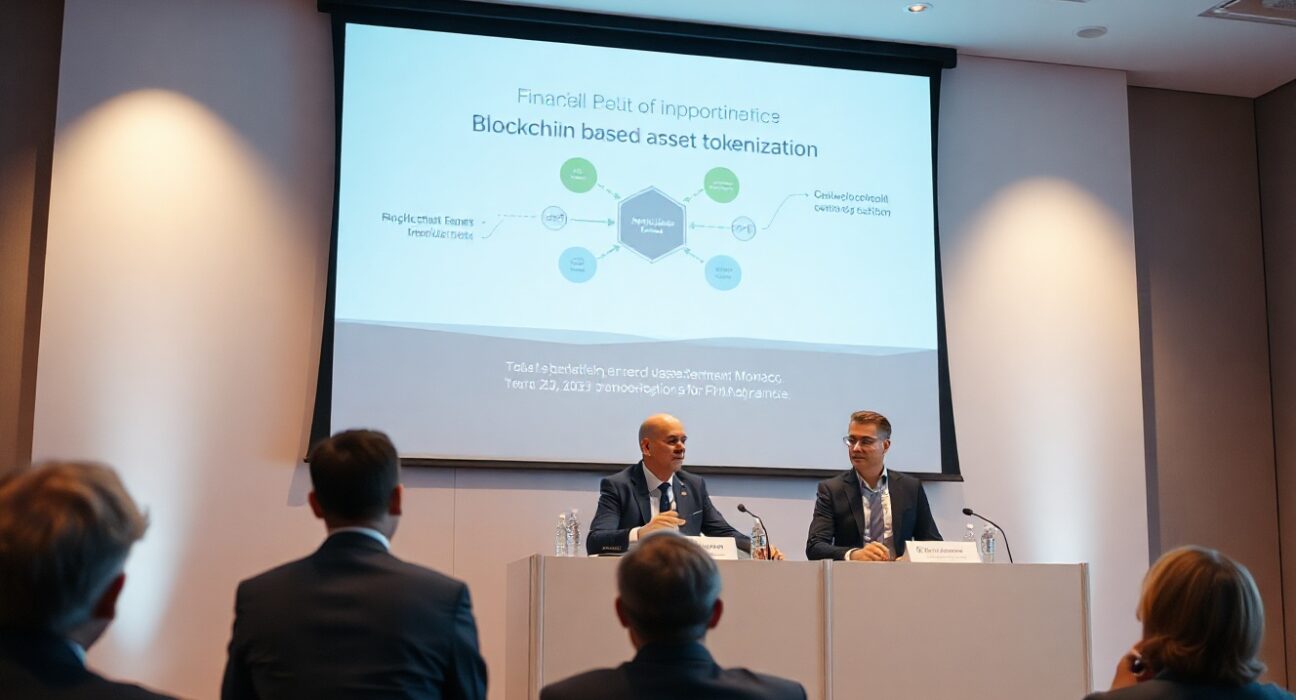
Major global financial institutions are accelerating their adoption of asset tokenization, citing improvements in capital efficiency and liquidity. Speaking at the WAIB Summit 2026 panel discussion in Monaco, Rafael Mastroberardino, head of digital asset partnership development at Franklin Templeton, said that tokenization offers institutions more options and flexibility, which is driving banks and large corporations to launch tokenized products.
Tokenization Gains Traction Among Traditional Finance Giants
The panel, held in early 2026, highlighted how tokenization—the process of representing real-world assets as digital tokens on a blockchain—is moving from experimental projects to mainstream financial infrastructure. Mastroberardino emphasized that Franklin Templeton sees tokenization as a natural evolution for asset management, enabling faster settlement, fractional ownership, and broader access to previously illiquid assets.
Julien Clausse, head of the tokenization platform at BNP Paribas CIB, added that placing multiple asset types on the same blockchain could unlock new institutional use cases. By allowing different assets to interact programmatically, Clausse explained, financial institutions can create more complex and efficient products, such as automated collateral management or cross-asset swaps.
Why This Matters for the Broader Market
The comments from two of the world’s largest asset managers and banks signal a shift in how traditional finance views blockchain technology. For years, tokenization was discussed in theoretical terms. Now, with regulatory frameworks maturing in Europe and parts of Asia, institutions are moving toward live deployments.
For readers, this development means that tokenized assets—ranging from real estate and bonds to private equity and commodities—could become more accessible to both institutional and retail investors. The flexibility Mastroberardino referenced could translate into lower costs, faster transactions, and new investment products that were not feasible in traditional systems.
Key Drivers Behind the Shift
Several factors are converging to push tokenization forward:
- Regulatory clarity: The EU’s Markets in Crypto-Assets (MiCA) framework and similar regulations in other jurisdictions provide legal certainty for tokenized assets.
- Infrastructure maturity: Blockchain networks and custody solutions have improved in scalability, security, and compliance capabilities.
- Demand for efficiency: Institutions are seeking ways to reduce settlement times, lower operational costs, and unlock liquidity from traditionally illiquid holdings.
- Competitive pressure: As early movers like BlackRock and Franklin Templeton launch tokenized products, other firms are following to avoid being left behind.
Implications for the Digital Asset Ecosystem
The involvement of institutions like Franklin Templeton and BNP Paribas lends credibility to the broader digital asset market. Their participation suggests that tokenization is not a passing trend but a structural change in how financial assets are issued, traded, and managed.
However, challenges remain. Interoperability between different blockchain networks, standardization of token formats, and robust custody solutions are still areas requiring further development. The panel acknowledged these hurdles but expressed confidence that industry collaboration would address them over time.
Conclusion
The WAIB Summit 2026 panel in Monaco reinforced that tokenization is no longer an experimental concept but a practical tool being adopted by major financial institutions. As Franklin Templeton and BNP Paribas continue to develop tokenized products, the financial industry is likely to see increased efficiency, new investment opportunities, and a gradual shift toward blockchain-based infrastructure. For investors and market participants, understanding tokenization will become increasingly important as it reshapes traditional finance.
FAQs
Q1: What is asset tokenization?
Asset tokenization is the process of converting ownership rights of a real-world asset—such as real estate, bonds, or commodities—into a digital token on a blockchain. This allows for fractional ownership, faster settlement, and easier transfer of assets.
Q2: Why are traditional banks like BNP Paribas interested in tokenization?
Banks see tokenization as a way to improve capital efficiency, reduce operational costs, and create new financial products. By placing multiple assets on the same blockchain, they can automate processes like collateral management and enable more complex transactions.
Q3: How does tokenization benefit institutional investors?
Institutional investors gain access to assets that were previously difficult to trade or fractionalize, such as private equity or real estate. Tokenization also offers faster settlement, lower transaction costs, and the ability to program smart contracts for automated compliance and distribution.
Disclaimer: The information provided is not trading advice, Bitcoinworld.co.in holds no liability for any investments made based on the information provided on this page. We strongly recommend independent research and/or consultation with a qualified professional before making any investment decisions.
