

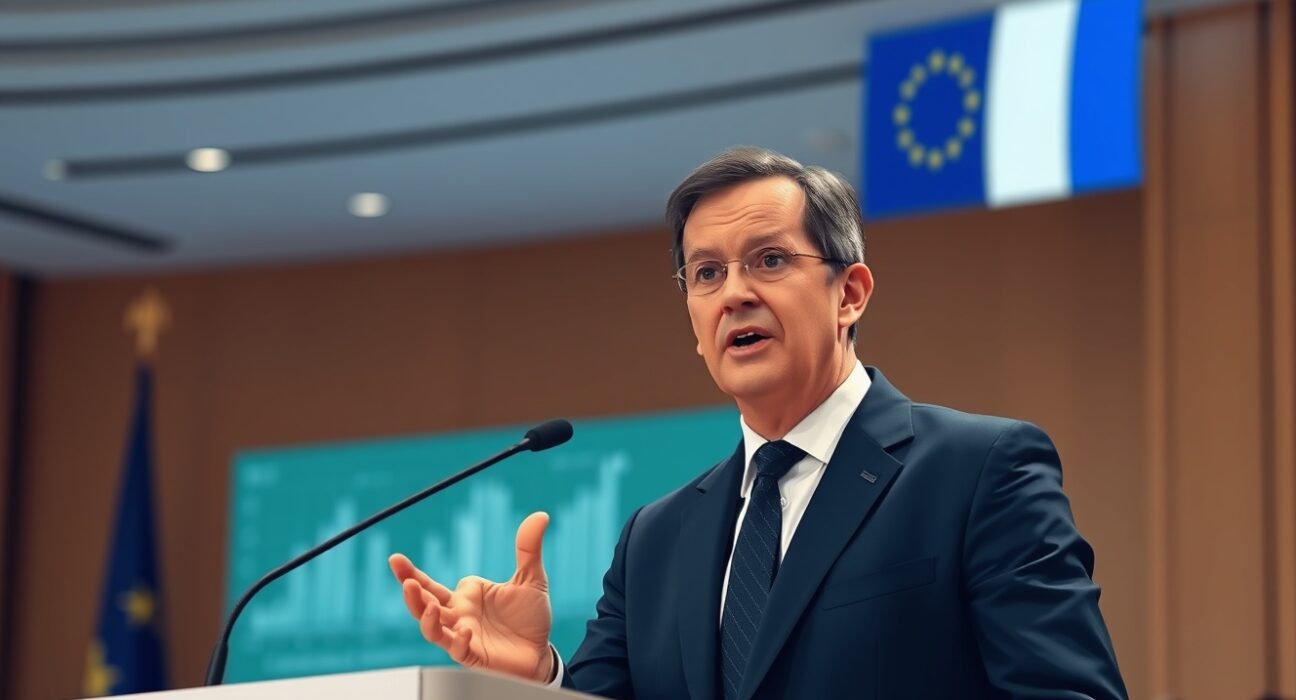
In a significant move for Europe’s digital finance future, French Finance Minister Roland Lescure has issued a compelling call for the rapid expansion of euro-denominated stablecoins. Speaking at a major cryptocurrency conference in Paris on March 15, 2025, Lescure directly challenged European banks to accelerate their adoption of digital deposit tokens. This push aims to reduce the European Union’s reliance on U.S. dollar-dominated digital assets and bolster the euro’s role in the burgeoning global cryptocurrency ecosystem.
The Current State of Euro Stablecoins
Minister Lescure expressed clear dissatisfaction with the present landscape. He highlighted the stark disparity between the scale of euro stablecoins and their U.S. dollar counterparts. Currently, dollar-pegged stablecoins like USDT and USDC dominate the market, representing over 90% of the total stablecoin supply. Conversely, euro-pegged alternatives collectively hold a market share of less than 3%. This imbalance presents a strategic vulnerability for the European financial system. Consequently, European transactions in decentralized finance (DeFi) and other crypto sectors predominantly rely on dollar-based instruments. This reliance effectively exports monetary policy influence outside the Eurozone.
The minister’s remarks underscore a growing consensus among European policymakers. They recognize that the digitization of money is inevitable. Therefore, the euro must have a robust digital representation on both public and private ledgers. The European Central Bank’s (ECB) digital euro project, a central bank digital currency (CBDC), progresses in parallel. However, Lescure’s focus on private-sector deposit tokens and stablecoins suggests a complementary, two-track strategy. This approach leverages innovation from regulated financial institutions.
Understanding Deposit Tokens and Stablecoins
To grasp the minister’s directive, one must distinguish between key digital asset types. A stablecoin is a cryptocurrency designed to maintain a stable value relative to a specified asset, like the euro. It operates primarily on public blockchains. A deposit token is a newer concept. It represents a digital claim on a commercial bank deposit, issued and managed on a permissioned blockchain network. These tokens are the direct evolution of traditional bank money into a programmable, digital form.
European banks have been cautiously exploring these technologies. For instance, a consortium of major banks recently completed a pilot for a euro-denominated deposit token for wholesale settlements. However, Lescure’s speech signals a need to move from pilot phases to broader, retail-facing applications. He explicitly encouraged banks to “more actively consider offering deposit token products.” This call to action implies regulatory support for such initiatives, provided they meet strict compliance standards.
The Strategic Imperative for Europe
The drive for euro digital currency supremacy is not merely economic; it is geopolitical. The U.S. dollar’s dominance in traditional finance has extended seamlessly into crypto. This extension grants U.S. entities and regulators outsized influence. A thriving ecosystem of euro stablecoins could mitigate this influence. Furthermore, it would provide European consumers and businesses with a familiar, low-volatility digital currency for everyday crypto transactions.
Experts point to the European Union’s Markets in Crypto-Assets (MiCA) regulation as a foundational element. MiCA, fully applicable from December 2024, establishes a comprehensive regulatory framework for stablecoin issuers. It mandates stringent reserve backing, redemption rights, and governance. This regulatory clarity, unique globally, is designed to foster trustworthy euro stablecoins. Analysts believe MiCA creates a “regulatory moat” that could make EU-licensed stablecoins the global gold standard for compliance.
Potential Impacts on Banking and Finance
The widespread adoption of bank-issued deposit tokens would fundamentally reshape European finance. First, it could drastically reduce transaction settlement times from days to seconds. Second, it would enable programmable money, where payments automatically execute upon meeting predefined conditions. This capability could revolutionize trade finance, supply chain payments, and escrow services.
However, challenges remain. Banks must invest significantly in blockchain infrastructure and cybersecurity. They must also navigate complex interoperability issues between different bank-led networks and public blockchains. Consumer adoption is another critical hurdle. The public must trust these digital forms of the euro as much as physical cash or current account balances. The table below outlines the key comparisons driving this policy shift.
| Aspect | U.S. Dollar Stablecoins (e.g., USDC) | Current Euro Stablecoins | Potential Euro Deposit Tokens |
|---|---|---|---|
| Primary Issuer | Private Crypto Firms (Circle) | Private Crypto Firms & Fintechs | Licensed European Banks |
| Regulatory Framework | Evolving State-by-State | EU’s MiCA Regulation | MiCA + Banking Regulations (CRD/CRR) |
| Underlying Asset | U.S. Dollar Reserves | Euro Reserves | Bank Deposit Liability |
| Typical Use Case | Trading, DeFi on Public Chains | Limited Trading Pairs | Corporate Payments, Settlements |
Market reaction to Lescure’s comments has been cautiously optimistic. Observers note that France, under President Macron, has consistently positioned itself as a leader in European fintech innovation. This announcement aligns with that strategy. It also places pressure on other major Eurozone economies, notably Germany and Italy, to clarify their stance on bank-issued digital money.
The Road Ahead for Digital Euro Adoption
The path forward involves close collaboration between regulators, central banks, and private institutions. The ECB will likely play a coordinating role, ensuring that private euro stablecoins and the public digital euro are complementary, not competitive. Technical standards for interoperability will be crucial. The European Commission may also propose additional legislation to streamline the issuance process for deposit tokens.
Industry groups have welcomed the minister’s clarity. They argue that European banks possess the trust, customer base, and regulatory expertise to launch successful digital currency products. The key will be moving with sufficient speed to capture market share before global tech giants or established dollar stablecoins further entrench their positions. The next 12-18 months will be critical for proof-of-concepts to transition into live, scalable platforms.
Conclusion
Finance Minister Roland Lescure’s call for expanding euro stablecoins marks a pivotal moment in Europe’s digital asset strategy. It reflects a strategic decision to actively contest the dollar’s dominance in the digital currency sphere through private sector innovation. By urging banks to develop deposit tokens, the EU aims to leverage its regulatory framework and banking strength to create a safer, more sovereign digital financial system. The success of this initiative will depend on execution speed, technological robustness, and ultimately, market acceptance. The expansion of euro stablecoins is no longer a niche technical discussion but a clear political and economic priority for the European Union’s financial future.
FAQs
Q1: What is a euro stablecoin?
A euro stablecoin is a type of cryptocurrency whose value is pegged, or tied, to the euro. It is designed to maintain a stable value of 1:1 with the euro, using reserves of cash and cash-equivalents held in custody.
Q2: How is a deposit token different from a stablecoin?
A deposit token is a digital liability issued directly by a licensed bank, representing a claim on a deposit at that bank. A stablecoin is often issued by a non-bank entity and backed by reserves held elsewhere. Deposit tokens are seen as a more integrated form of digital bank money.
Q3: Why does Europe want more euro stablecoins?
Europe seeks to reduce dependence on U.S. dollar-based digital currencies, maintain monetary sovereignty, provide its citizens and businesses with a trusted digital euro option, and foster innovation within its regulated financial sector.
Q4: What is the MiCA regulation?
The Markets in Crypto-Assets (MiCA) is a comprehensive regulatory framework for cryptocurrencies and stablecoins in the European Union. For stablecoins, it imposes strict rules on reserve backing, redemption, governance, and licensing, aiming to ensure consumer protection and financial stability.
Q5: When might we see widespread use of euro deposit tokens?
Following the minister’s push, pilot programs could scale within 12-24 months. However, widespread retail use likely depends on further regulatory clarity, bank infrastructure development, and achieving critical mass in merchant acceptance, potentially within a 3-5 year horizon.
Disclaimer: The information provided is not trading advice, Bitcoinworld.co.in holds no liability for any investments made based on the information provided on this page. We strongly recommend independent research and/or consultation with a qualified professional before making any investment decisions.
