Future of Bitcoin Mining: 5 Key Trends for 2030
In this article
The Future of Bitcoin Mining: 5 Trends That Could Transform the Industry by 2030
Bitcoin mining is approaching a period of transformation that could reshape the industry more dramatically than previous cryptocurrency market cycles. Rising competition, changing energy markets, advances in computing technology, and the next Bitcoin halving are forcing operators to reconsider how they generate revenue and maintain profitability. At the same time, the broader blockchain economy continues developing applications that extend beyond cryptocurrency production, with companies such as Blockpool focusing on digital asset authentication, ownership management, and business-oriented blockchain solutions. Although these services operate differently from Bitcoin’s proof-of-work network, they illustrate the growing diversity of an industry that was once associated almost exclusively with digital currency. For mining companies, the years leading to 2030 may determine whether they remain specialized cryptocurrency producers or evolve into more sophisticated energy and computing businesses.
The central challenge is that Bitcoin mining has become increasingly industrialized. What began as an activity performed on ordinary computers has developed into a global competition involving specialized processors, large electricity contracts, complex financing arrangements, and facilities capable of consuming substantial amounts of power. Success now depends on much more than correctly predicting Bitcoin’s price. Operators must manage equipment replacement, electricity volatility, network difficulty, and changing regulatory conditions while preparing for a future in which block rewards continue to decline.
A Different Kind of Mining Cycle Is Taking Shape
Previous Bitcoin mining cycles were often defined by a familiar sequence. Rising cryptocurrency prices encouraged investment in new machines, additional computing power increased network competition, and weaker market conditions eventually forced inefficient operators to reduce activity.
That pattern has not disappeared, but the industry’s structure is changing. Publicly traded mining companies now compete for electricity connections, industrial property, and access to institutional financing. Some are developing relationships with artificial intelligence companies, while others are concentrating on improving the efficiency of traditional mining operations.
These developments suggest that the next phase of growth may be less dependent on simply installing more hardware. Mining businesses increasingly need strategies capable of surviving difficult market conditions without relying on continuous appreciation in Bitcoin’s price.

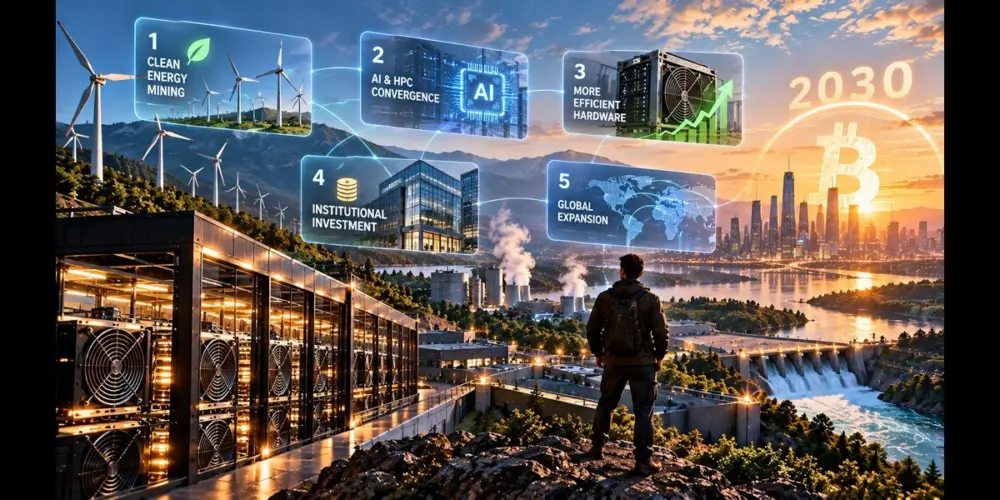
The five trends explored below illustrate how technology, energy economics, and financial discipline could influence the industry’s development through 2030.
Trend One: The 2028 Halving Could Accelerate a Major Industry Restructuring
Bitcoin’s monetary system includes a mechanism that periodically reduces the number of new coins awarded to miners. Approximately every four years, the block subsidy is cut in half, gradually slowing the issuance of new Bitcoin.
The April 2024 halving reduced the subsidy from 6.25 BTC to 3.125 BTC per block. The next halving, expected in 2028, will reduce it further to 1.5625 BTC, assuming the protocol continues operating according to its established rules.
This reduction creates a significant challenge for mining companies. The electricity required to operate existing machines does not automatically decline when block rewards are reduced. Unless Bitcoin prices, transaction fees, or competitive conditions change sufficiently, miners may experience lower revenue from the same equipment.
The impact is unlikely to be distributed evenly. Operators with inexpensive electricity and efficient hardware may remain competitive, while businesses facing high costs could struggle to cover operating expenses.
Why the Next Halving Could Be More Difficult Than the Last
The mining industry is now more capital-intensive than it was during earlier halving cycles. Large companies operate industrial facilities, maintain specialized equipment fleets, and often rely on external financing to support expansion.
This structure creates financial obligations that cannot easily be reduced when market conditions deteriorate. Interest expenses, equipment commitments, and infrastructure maintenance can continue even when mining revenue declines.
The 2028 halving may therefore encourage companies to reassess expansion plans and focus more closely on profitability.
Some operators could postpone equipment purchases, sell facilities, or merge with financially stronger competitors. Others may redirect capital toward businesses that generate revenue independently of Bitcoin mining.
The outcome will depend partly on Bitcoin’s market price, but operational efficiency and balance sheet strength are likely to remain important.
Mining Difficulty Will Continue Separating Efficient Operators From Weak Ones
Bitcoin’s mining difficulty adjusts periodically according to the computing power participating in the network. The mechanism helps maintain an average block interval of approximately ten minutes.
When additional miners enter the network, competition generally increases. Individual operators may need more computing power to maintain their share of rewards.
Conversely, when substantial capacity leaves the network, difficulty can adjust downward over time.
This mechanism means that industry-wide profitability cannot be evaluated solely by looking at Bitcoin’s price. A rising cryptocurrency market may encourage new investment, eventually increasing competition and reducing the revenue available to individual machines.
By 2030, successful mining companies may need to manage these dynamics more carefully, balancing expansion against the risk of investing heavily near the peak of a market cycle.
Trend Two: Mining Hardware Will Become an Efficiency Race
The performance of specialized mining equipment has improved significantly over time. Modern application-specific integrated circuits, commonly known as ASICs, can perform Bitcoin’s required calculations using substantially less electricity than earlier generations.
This matters because electricity represents one of the industry’s largest operating expenses. Even modest efficiency improvements can influence profitability when thousands of machines operate continuously.
The Cambridge Centre for Alternative Finance reported that Bitcoin mining hardware efficiency improved by approximately 24% year over year, reaching an estimated 28.2 joules per terahash in June 2024.
The figure demonstrates the pace of technological development, but it does not imply that future improvements will continue at the same rate. Semiconductor manufacturing faces physical, economic, and engineering constraints.
Nevertheless, competition among hardware manufacturers is likely to remain a major influence on mining economics.
Why Owning More Machines May Become Less Important
Mining companies have traditionally emphasized the amount of computing power they control. Hash rate remains an important measure of operational scale, but it does not directly indicate profitability.
Two operators with similar computing capacity can have very different electricity requirements. A company using older equipment may consume substantially more power to generate the same amount of computational work.
As competition intensifies, investors may increasingly focus on energy efficiency rather than raw expansion.
A smaller fleet of modern machines operating under favorable electricity contracts could potentially generate better financial results than a larger collection of inefficient hardware.
This shift may encourage more selective equipment purchases and a greater emphasis on extending the economic value of existing facilities.
The Equipment Replacement Problem Will Not Disappear
ASIC machines can remain technically functional long after they become economically unattractive.
When newer hardware provides better efficiency, older machines may struggle to generate enough revenue to justify their electricity consumption. This creates a recurring need for capital investment.
Mining companies must decide whether to purchase new equipment, relocate older machines to lower-cost locations, or discontinue certain operations.
These decisions become particularly difficult when cryptocurrency prices are volatile.
Buying equipment during periods of strong market enthusiasm can expose operators to high acquisition costs. Delaying purchases may preserve capital but leave the business operating less competitive machines.
By 2030, the ability to manage equipment replacement cycles could become an important distinction between disciplined operators and companies pursuing expansion without sufficient regard for returns.
Trend Three: Bitcoin Mining Will Become More Closely Connected to Energy Markets
Electricity has always influenced mining profitability, but the relationship between mining operations and energy infrastructure is becoming more complex.
Miners are no longer simply customers purchasing electricity at a fixed price. Some are developing strategies involving flexible consumption, direct relationships with energy producers, and participation in electricity market programs.
The attraction is partly economic. Bitcoin mining equipment can sometimes be switched off relatively quickly, allowing operators to reduce consumption when electricity becomes expensive or grid conditions require lower demand.
This flexibility distinguishes mining from many industrial activities that cannot easily interrupt operations.
However, the value of flexible demand depends on local regulations, electricity pricing arrangements, and the technical characteristics of the grid.
The Growing Importance of Flexible Power Consumption
A mining facility operating under a suitable electricity agreement may reduce activity during periods of unusually high demand.
For example, if electricity prices increase beyond the expected revenue generated by mining, temporarily reducing consumption may be financially preferable to continuing operations.
In certain markets, flexible industrial customers can also participate in demand-response arrangements that compensate them for reducing electricity use under specified conditions.
The Cambridge Digital Mining Industry Report documented substantial electricity curtailment among surveyed operators, demonstrating that some mining companies already use this flexibility.
However, these arrangements are not universally available. The economic benefits depend on contractual terms and the actual needs of the electricity system.
Mining can contribute to grid flexibility in suitable circumstances, but it can also increase electricity demand and infrastructure pressure.
Renewable Energy Could Change Where Mining Facilities Are Built
Mining companies have increasingly explored locations associated with hydroelectric, wind, solar, and other electricity sources.
The Cambridge Centre for Alternative Finance reported that sustainable energy sources represented approximately 52.4% of the electricity mix among surveyed mining operations, including renewable and nuclear generation.
The finding suggests that electricity sourcing has become an important strategic consideration, although the survey should not be interpreted as a perfectly representative measurement of every mining facility worldwide.
Renewable energy can provide competitive electricity costs in certain locations. However, intermittent generation creates operational challenges when production varies with weather conditions.
Some mining facilities may be able to adjust consumption according to available electricity, while others require more consistent supply arrangements.
The commercial attractiveness of renewable-powered mining will depend on local energy prices, infrastructure investment, and the reliability of electricity delivery.
Waste Heat Could Become an Additional Economic Resource
Bitcoin mining equipment produces heat during operation. Traditionally, much of that heat has been treated as a problem requiring cooling and ventilation.
Some operators are exploring ways to recover and reuse thermal energy for nearby facilities.
Potential applications include building heating, agricultural operations, and certain industrial processes where the temperature and availability of recovered heat are suitable.
These projects may improve overall energy utilization, but their economics depend heavily on location and infrastructure requirements.
Transporting heat over long distances can be expensive, and potential customers may not require the same amount of heating throughout the year.
By 2030, waste-heat recovery could become more common in specialized projects, although it is unlikely to provide a universal solution to mining’s energy challenges.
Trend Four: AI Computing Will Create a New Identity for Some Mining Companies
Artificial intelligence has introduced a major new opportunity for businesses that originally developed infrastructure for cryptocurrency mining.
AI systems require substantial computing capacity, and building new data centers can involve complicated electrical connections, cooling systems, and construction requirements.
Some Bitcoin mining companies already possess industrial sites with established power infrastructure. These assets may become valuable to businesses seeking additional computing capacity.
However, Bitcoin mining and AI computing are technically different activities.
Bitcoin mining relies on specialized ASIC processors, while advanced AI workloads typically use GPUs and other high-performance computing systems.
Converting a mining facility into an AI data center can therefore require extensive investment in networking, cooling, electrical distribution, and operational systems.
Why the AI Transition Is More Than a Marketing Strategy
Several publicly traded mining companies have pursued agreements involving AI infrastructure and high-performance computing.
The attraction is the possibility of generating revenue through long-term commercial contracts rather than relying exclusively on cryptocurrency rewards.
These agreements can potentially provide greater visibility into future income, particularly when customers are financially strong and facilities operate according to contractual requirements.
However, announced contract values should not be confused with realized revenue.
Data center projects may require years of development, and companies often need substantial financing before services begin.
The transition also introduces new risks involving construction delays, customer concentration, and technological change.
The mining companies that succeed in AI infrastructure will need to demonstrate genuine operational capabilities rather than relying solely on their existing electricity connections.
Hybrid Infrastructure Could Become More Common
Some operators may continue mining Bitcoin while developing AI infrastructure at selected locations.
This hybrid approach could allow companies to retain exposure to cryptocurrency markets while building alternative sources of revenue.
However, combining the two activities is not always straightforward.
AI computing customers may require consistent service availability, while Bitcoin miners can sometimes benefit from adjusting electricity consumption according to market conditions.
The facilities also have different hardware and cooling requirements.
Companies pursuing hybrid strategies must therefore determine whether shared infrastructure creates genuine economic advantages or simply increases operational complexity.
By 2030, the industry may include a wider variety of business models, ranging from dedicated Bitcoin miners to companies generating most of their revenue from computing services.
Trend Five: The Mining Industry Could Become More Concentrated and Financially Sophisticated
Bitcoin mining has evolved from an activity accessible to individual computer users into a capital-intensive industry.
Large operators can negotiate electricity contracts, purchase equipment at scale, and access financing arrangements that may be unavailable to smaller competitors.
These advantages can become more important when mining profitability declines.
Companies with strong balance sheets may be able to acquire distressed assets, purchase equipment during downturns, or continue investing when competitors reduce spending.
This could encourage consolidation as the industry approaches 2030.
However, concentration is not inevitable across every part of the market. Smaller operators may remain competitive when they possess access to unusually inexpensive electricity or specialized local opportunities.
Institutional Capital Will Demand Better Financial Discipline
The expansion of publicly traded mining companies has increased attention on financial reporting and corporate governance.
Investors can evaluate revenue, operating expenses, equipment depreciation, debt obligations, and capital expenditure through financial statements.
As the industry matures, the quality of these disclosures may become increasingly important.
A company announcing rapid growth in hash rate does not necessarily create value if the expansion requires excessive borrowing or repeated shareholder dilution.
Investors may increasingly prioritize free cash flow, return on invested capital, and the sustainability of operating margins.
This could encourage mining companies to adopt more conservative expansion strategies and provide clearer explanations of their financial performance.
Mining Pools May Face Greater Scrutiny
Mining pools allow participants to combine computing power and receive more regular payouts according to the pool’s rules.
This arrangement reduces the uncertainty associated with independently attempting to discover Bitcoin blocks.
However, the concentration of mining activity among large pools raises questions about operational influence and network decentralization.
A mining pool’s share of reported hash rate does not necessarily mean it owns all the equipment contributing to that pool. Individual participants may retain control of their machines and can sometimes switch between pools.
Nevertheless, pool-level coordination remains relevant to discussions about Bitcoin network security.
By 2030, transparency around block construction, payout policies, and pool governance may become more important as the industry continues expanding.
The Transaction Fee Question Will Become Harder to Ignore
Bitcoin miners receive revenue from newly issued coins and transaction fees.
Because the block subsidy declines through successive halvings, transaction fees are expected to become increasingly important to the network’s long-term economic model.
However, future fee revenue is uncertain.
It depends on demand for Bitcoin transactions, network usage patterns, and the development of technologies that allow users to transact through different mechanisms.
Periods of high transaction activity can increase fees, but such conditions may not persist.
Mining companies should therefore avoid assuming that transaction fees will automatically replace declining block subsidies.
The industry’s financial sustainability will continue depending on the relationship between mining rewards, operating costs, and the total computing power competing for revenue.
Will Bitcoin Mining Become More Environmentally Sustainable?
The environmental impact of Bitcoin mining remains an important issue for governments, investors, and local communities.
Electricity consumption can create emissions depending on the energy sources used. Mining facilities can also influence local electricity demand and infrastructure requirements.
Technological improvements may reduce the electricity required to perform a given amount of computational work, but greater total mining activity can offset those efficiency gains.
This means more efficient hardware does not necessarily lead to lower industry-wide electricity consumption.
Environmental assessments must also consider the characteristics of individual facilities, including electricity sourcing, equipment replacement, and local grid conditions.
By 2030, companies may face greater pressure to provide transparent information about their energy consumption and environmental performance.
Could New Regulations Change the Global Mining Map?
Bitcoin mining operates across jurisdictions with different approaches to cryptocurrency regulation, electricity markets, and industrial development.
Some governments view mining as a potential source of investment and economic activity. Others express concerns about electricity consumption, environmental impacts, or financial risks.
Regulatory changes can influence the attractiveness of particular locations.
A region offering inexpensive electricity may become less competitive if new restrictions increase costs or limit operating hours.
Conversely, clear legal frameworks and reliable infrastructure can encourage long-term investment.
Mining companies planning expansion must therefore consider regulatory stability alongside electricity prices and equipment efficiency.
The industry’s geographical distribution could change substantially before 2030, but predicting which countries will dominate remains difficult.
The Future of Home Mining Looks Different From Industrial Mining
Large industrial operations have clear advantages in equipment purchasing, electricity procurement, and infrastructure management.
These advantages make direct competition difficult for many individual miners.
However, smaller-scale mining may continue serving different purposes.
Some individuals operate mining equipment to participate directly in Bitcoin’s network, experiment with technology, or use available electricity under favorable local conditions.
Others may explore ways to reuse heat generated by their machines.
The economics depend on electricity prices, hardware costs, noise, cooling requirements, and expected mining revenue.
For most participants, home mining should not be treated as a guaranteed source of passive income.
Its attractiveness must be evaluated according to actual operating costs and the possibility that equipment becomes uneconomic.
Why Bitcoin’s Price Alone Cannot Predict Mining Profitability
Bitcoin’s market price remains an important influence on mining revenue, but it is only one part of the equation.
A higher cryptocurrency price can encourage additional mining investment. As more computing power enters the network, competition increases and revenue per unit of hash rate may decline.
Electricity prices and equipment efficiency also affect profitability.
A mining company can therefore experience rising Bitcoin prices without achieving proportional improvements in financial performance.
Similarly, an operator with exceptionally low costs may remain profitable during conditions that force competitors to shut down.
Investors evaluating mining businesses should examine the interaction between market prices, network difficulty, operating costs, and capital requirements.
The Mining Business Models That Could Emerge by 2030
The industry may become more specialized as companies pursue different sources of competitive advantage.
Some businesses could concentrate on highly efficient Bitcoin production, using modern hardware and favorable electricity contracts to maintain low operating costs.
Others may focus on flexible electricity consumption, developing operations that respond to changes in power markets.
A separate group could increasingly resemble digital infrastructure providers, generating revenue from data center hosting or computing services.
These approaches are not mutually exclusive, but they require different capabilities.
The most successful operators will likely be those that understand which activities match their assets and financial resources.
Attempting to participate in every emerging opportunity could increase complexity without producing attractive returns.
What the 2030 Mining Market Might Look Like
By the end of the decade, Bitcoin mining could be characterized by fewer inefficient operators, more sophisticated energy management, and a broader range of commercial strategies.
The 2028 halving may accelerate pressure on high-cost facilities, while improvements in ASIC technology could continue influencing the competitive landscape.
Energy infrastructure may become an increasingly important source of differentiation, particularly where electricity availability is constrained.
Meanwhile, the expansion of AI computing could encourage some mining companies to redirect substantial portions of their operations toward alternative workloads.
However, the industry could also experience periods of financial stress if Bitcoin prices remain weak, equipment costs rise, or infrastructure investments fail to generate expected returns.
The direction of development is becoming clearer, but the financial outcome remains uncertain.
Why the Next Mining Boom May Reward a Different Kind of Investor
Historically, investors often approached Bitcoin mining stocks as a way to gain exposure to cryptocurrency price movements.
That relationship remains important, but the industry’s increasing complexity requires a broader analytical framework.
Financial performance may depend on electricity contracts, equipment efficiency, debt management, data center development, and the quality of commercial agreements.
Companies that expand aggressively without maintaining financial discipline may struggle even when the overall industry grows.
Conversely, operators with strong balance sheets and competitive infrastructure may be better positioned to withstand difficult conditions.
The next investment cycle could therefore reward careful analysis of operating economics rather than enthusiasm for rising hash rate alone.
Bitcoin Mining in 2030 Will Be About More Than Producing Coins
The five trends shaping Bitcoin mining’s future are connected by a common theme: the industry is becoming more demanding.
The next halving will place additional pressure on mining revenue, hardware improvements will intensify competition, and energy markets will influence where facilities can operate profitably.
Artificial intelligence may create opportunities for infrastructure diversification, while institutional investment could encourage greater financial discipline and industry consolidation.
None of these developments guarantees that mining companies will become more profitable. Some operators may struggle to adapt, and ambitious infrastructure projects can create substantial financial risks, the team of BlockPool shared their thoughts.
Nevertheless, the industry is evolving beyond the simple relationship between cryptocurrency prices and mining equipment.
By 2030, the strongest Bitcoin mining businesses may be defined not by how much computing power they control, but by how efficiently they manage electricity, technology, capital, and commercial opportunities.
The future of Bitcoin mining will still depend on the security and economics of the Bitcoin network. Yet the companies supporting that network may increasingly resemble sophisticated industrial and digital infrastructure businesses, operating at the intersection of cryptocurrency, energy, and advanced computing.