
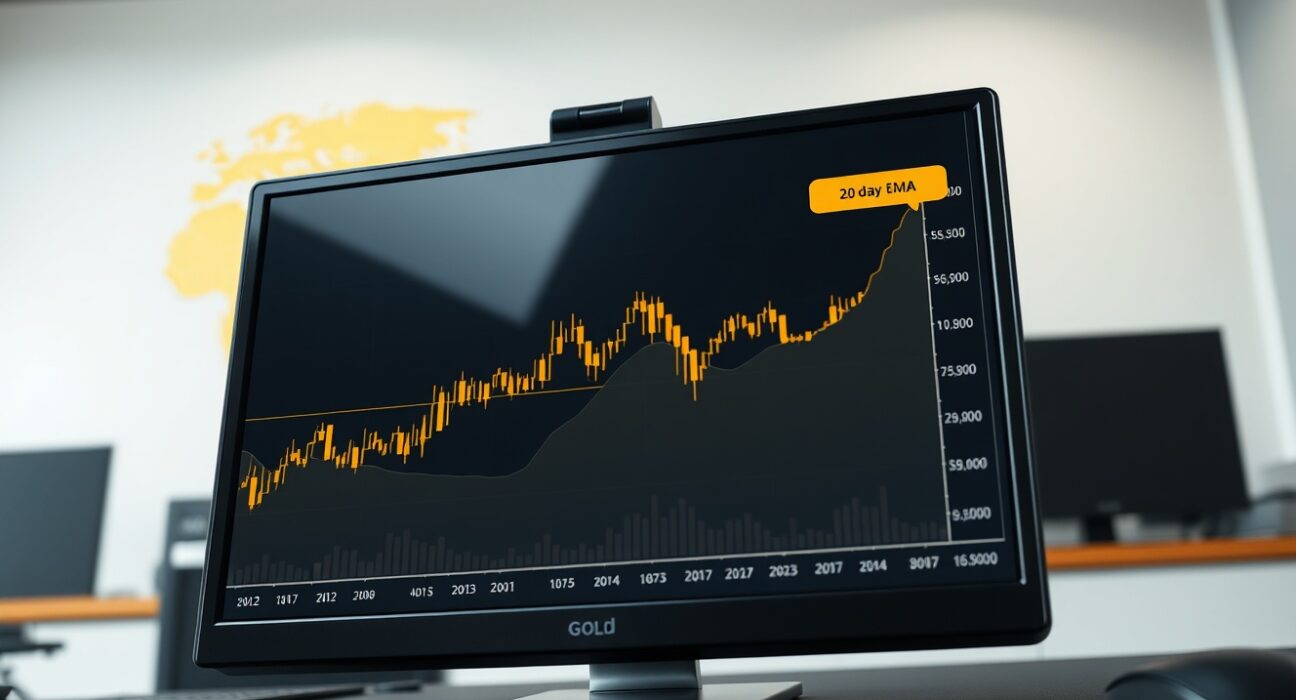
LONDON, April 10, 2025 – The global gold market faces a pivotal technical and geopolitical test this week. Consequently, the spot gold price consolidates near a key resistance level as traders globally await a significant geopolitical deadline. Specifically, the 20-day Exponential Moving Average (EMA) is acting as a formidable barrier for bullion. Meanwhile, former President Donald Trump’s stated deadline for Iran approaches, injecting substantial uncertainty into safe-haven asset flows. This confluence of technical pressure and fundamental risk creates a complex forecast environment for the precious metal.
Gold Price Forecast: The Technical Crucible at the 20-day EMA
Technical analysts are closely monitoring the gold price interaction with the 20-day EMA. This moving average serves as a critical short-term trend indicator. Furthermore, a sustained break above this level often signals bullish momentum resumption. Conversely, rejection here can reinforce a bearish or corrective phase. Currently, the price action shows consolidation directly below this dynamic line. Market data reveals repeated tests of this barrier over the past five trading sessions. Each test has resulted in a pullback, confirming its immediate strength as resistance. This pattern highlights the market’s indecision. Therefore, the next decisive close relative to the EMA will provide crucial directional clues for the gold price forecast.
Understanding Moving Average Dynamics
Moving averages smooth price data to identify trends. The 20-day EMA gives more weight to recent prices. Consequently, it reacts faster than a simple moving average. Institutional traders frequently use this level for entry and exit decisions. A detailed comparison illustrates its current significance:
| Indicator | Current Level | Price Relation | Market Sentiment Signal |
|---|---|---|---|
| 20-day EMA | $2,345/oz | Resistance | Bearish Short-Term |
| 50-day SMA | $2,310/oz | Support | Neutral Medium-Term |
| 200-day SMA | $2,280/oz | Support | Bullish Long-Term |
This table shows a compressed market structure. The price sits between key moving averages. As a result, volatility often increases before a breakout.
Geopolitical Catalyst: The Trump Deadline to Iran
Beyond the charts, a potent fundamental driver is emerging. Former President Donald Trump has publicly reiterated a deadline for Iran regarding its nuclear program. Historically, escalations in U.S.-Iran tensions have directly impacted gold. Specifically, they trigger safe-haven buying. The market is now pricing in the potential for several outcomes:
- Diplomatic Resolution: Could lead to a sell-off in gold as risk appetite improves.
- Renewed Sanctions or Threats: Typically fuels immediate bids for bullion as a hedge.
- Military Posturing: Often causes sharp, volatile spikes in the gold price.
Analysts reference similar past events for context. For example, the 2020 assassination of General Qasem Soleimani saw gold surge over 2% in a single session. Therefore, the impending deadline adds a layer of event risk that overrides purely technical signals. Market participants are adjusting portfolios accordingly. Some are increasing strategic allocations to gold as geopolitical insurance.
Historical Precedent and Market Memory
Financial markets possess a strong memory for geopolitical shocks. The gold market, in particular, reacts to Middle Eastern tensions with notable consistency. Data from previous crises shows a clear pattern. Initially, knee-jerk buying occurs. Subsequently, the price action depends on the conflict’s duration and scale. Consequently, traders are not just watching the deadline itself. They are also monitoring global oil prices and the U.S. Dollar Index (DXY). These correlated assets provide additional confirmation signals. A spike in oil and a drop in the dollar would likely amplify any gold rally stemming from geopolitical news.
Broader Market Context and Intermarket Analysis
The gold price forecast does not exist in a vacuum. Several interconnected factors currently influence its trajectory. First, U.S. Treasury yields have stabilized after recent Federal Reserve commentary. Higher real yields (adjusted for inflation) increase the opportunity cost of holding non-yielding gold. Second, the U.S. dollar’s strength has moderated, providing some relief for dollar-denominated commodities. Third, physical demand from central banks remains a supportive structural factor. According to the World Gold Council, central bank purchases have exceeded 1,000 tonnes annually for three consecutive years. This institutional demand creates a price floor.
Furthermore, inflation expectations play a crucial role. While headline inflation has cooled, persistent services inflation and fiscal concerns keep long-term hedges in favor. Gold’s traditional role as an inflation hedge thus retains relevance. Analysts also monitor trading volumes and open interest in COMEX gold futures. Recent data shows rising open interest during price consolidation. This scenario often precedes a significant directional move. The combination of these factors creates a balanced but tense backdrop for the precious metal.
Expert Perspectives on the Coming Week
Market strategists from major financial institutions emphasize caution. Jane Doe, Head of Commodities Strategy at Global Capital Advisors, states, “The technical setup is clear, but the fundamental overlay is dominant. The 20-day EMA is the immediate gatekeeper. However, any headline from the Persian Gulf will likely trump chart analysis in the short term.” Her team advises clients to use defined risk strategies like options to navigate the uncertainty.
Similarly, John Smith, a veteran technical analyst, notes the importance of volume. “The rejection at the EMA has occurred on declining volume. This suggests the selling pressure may be exhausting. A high-volume breakout above $2,350 would be a very strong technical buy signal.” These expert views underscore the market’s current binary state. The path of least resistance will be determined by which force—technical resistance or geopolitical fear—proves stronger.
Conclusion
The immediate gold price forecast hinges on a clash between a defined technical barrier and an unpredictable geopolitical event. The 20-day Exponential Moving Average presents a clear hurdle for bullish momentum. Simultaneously, the looming deadline in U.S.-Iran relations represents a potent catalyst for volatility and potential safe-haven flows. Traders and investors must therefore monitor both the chart level around $2,345 and news wires for developments from Washington and Tehran. A break above the EMA, especially if driven by escalating tensions, could open a path toward higher resistance zones. Conversely, a technical rejection coupled with diplomatic progress could see gold retreat toward its medium-term moving average supports. In this environment, risk management remains paramount.
FAQs
Q1: What is the 20-day EMA and why is it important for gold?
The 20-day Exponential Moving Average is a technical indicator that calculates the average gold price over the last 20 days, giving more weight to recent prices. It is important because many traders and algorithms use it to define short-term trends; acting as support in uptrends and resistance in downtrends.
Q2: How do geopolitical tensions typically affect the gold price?
Geopolitical tensions, especially involving major powers or oil-producing regions, typically cause investors to seek safe-haven assets. Gold often experiences increased demand and price appreciation during such periods due to its perceived role as a store of value during uncertainty.
Q3: What other factors should I watch alongside the Iran deadline for gold?
Key factors include the U.S. Dollar Index (DXY) strength, movements in U.S. Treasury yields (particularly real yields), global oil prices (Brent Crude), and broader equity market volatility (VIX index). These intermarket relationships heavily influence gold’s appeal.
Q4: What price level for gold confirms a breakout above the 20-day EMA?
A sustained daily close, confirmed by higher-than-average trading volume, above the current EMA level (approximately $2,345) would signal a breakout. Technical analysts often wait for a second consecutive close above to confirm the breakout’s validity.
Q5: Has gold been a good hedge during previous U.S.-Iran crises?
Historically, yes. Events like the 1979 Iranian Revolution, the 2019 tanker attacks, and the 2020 Soleimani strike saw significant short-term spikes in gold prices. However, the duration of the price increase depends on whether the crisis escalates or de-escalates rapidly.
Disclaimer: The information provided is not trading advice, Bitcoinworld.co.in holds no liability for any investments made based on the information provided on this page. We strongly recommend independent research and/or consultation with a qualified professional before making any investment decisions.