

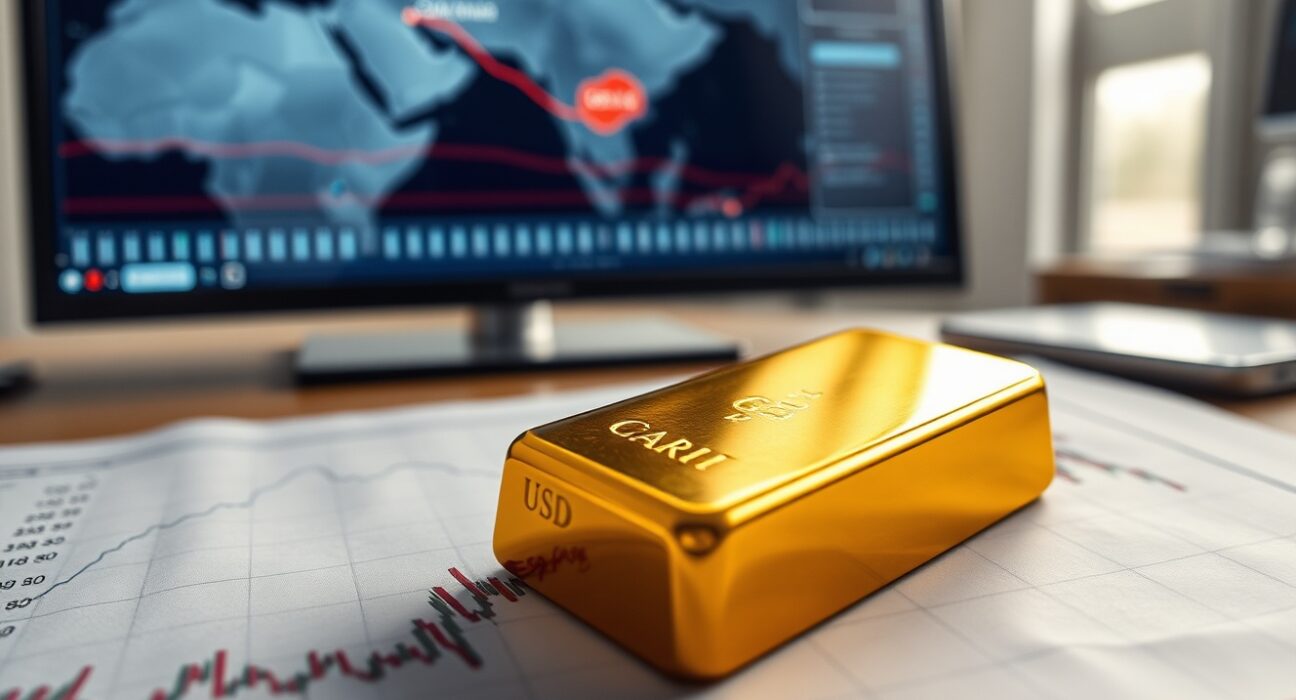
LONDON, March 15, 2025 – Global financial markets witnessed a seismic shift today as the spot price of gold shattered the $4,850 per ounce barrier. This historic gold price surge directly correlates with the official reopening of the Strait of Hormuz, a geopolitical event that has triggered a profound and rapid devaluation of the US Dollar. Consequently, investors are now flocking to traditional safe-haven assets.
Gold Price Surge Reaches Unprecedented Levels
The London Bullion Market Association (LBMA) recorded the benchmark price at $4,852.30 per ounce in afternoon trading. This figure represents a staggering single-day gain of over 8.5%. Market analysts immediately linked the movement to breaking news from the Persian Gulf. Furthermore, trading volumes for gold futures on the COMEX exchange reportedly tripled their 30-day average.
This price action marks the most significant intraday rally for the precious metal since the 2008 financial crisis. Historical data shows gold breaking key psychological resistance levels in rapid succession. For instance, the $4,800 level held for less than an hour before the surge continued. The chart below illustrates the dramatic ascent over the past five trading sessions.
Market technicians note the move has pushed the 14-day Relative Strength Index (RSI) into extreme overbought territory. However, fundamental drivers are currently overpowering traditional technical signals. Central bank demand, a key support for gold in recent years, is expected to intensify following this event.
Strait of Hormuz Reopening Triggers Market Avalanche
The catalyst for this financial turbulence was the joint announcement by regional powers. They confirmed the full and safe reopening of the Strait of Hormuz to all commercial maritime traffic. This vital waterway handles approximately 20-30% of the world’s seaborne oil trade. Its closure in late 2024, due to regional tensions, had created a persistent risk premium across all energy and financial markets.
The reopening removes a major supply chain bottleneck that had supported the US Dollar’s role as the primary petrocurrency. With the immediate threat to oil flows eliminated, the dollar’s recent strength has evaporated. The US Dollar Index (DXY), which measures the dollar against a basket of six major currencies, plummeted 2.9% on the news.
- Immediate Oil Price Drop: Brent crude futures fell by 12% to $78 per barrel.
- Currency Market Reaction: The Euro (EUR/USD) jumped 2.1%, while the Swiss Franc (USD/CHF) gained 1.8%.
- Treasury Yield Shift: US 10-year Treasury yields dropped 15 basis points as demand for safe assets shifted.
This sequence demonstrates the intricate link between geopolitics, energy security, and global currency valuations. The dollar’s decline is not an isolated event but a direct consequence of reduced global risk perception.
Expert Analysis on the Dollar’s Decline
Dr. Anya Sharma, Chief Strategist at Global Macro Insights, provided context. “The US Dollar has been acting as a geopolitical hedge for the past nine months,” she explained. “Investors priced in persistent instability. The Hormuz reopening is a definitive de-risking event. Consequently, capital is rotating out of the dollar and into assets like gold, which serve as a hedge against currency debasement itself.”
This sentiment is echoed by historical precedent. The dollar often weakens when broad global tensions ease, as its safe-haven appeal diminishes. The speed of this decline, however, is notable. It suggests markets were heavily positioned for continued uncertainty, leading to a violent unwind of those bets.
Broader Impacts on Precious Metals and Commodities
The rally is not confined to gold. The entire precious metals complex is experiencing significant upward momentum. Silver, often more volatile than gold, surged 14% to break above $68 per ounce. Platinum and palladium also posted double-digit percentage gains. This broad-based move confirms a sector-wide revaluation rather than a single-asset anomaly.
| Commodity | Price (March 15, 2025) | 24-Hour Change |
|---|---|---|
| Gold (XAU/USD) | $4,852.30 | +8.5% |
| Silver (XAG/USD) | $68.45 | +14.2% |
| Platinum (XPT/USD) | $1,420.10 | +11.8% |
| Palladium (XPD/USD) | $2,150.75 | +9.3% |
Mining equities and related exchange-traded funds (ETFs) also saw massive inflows. The VanEck Gold Miners ETF (GDX) was up over 22% at the market close. This outperformance relative to the physical metal is typical in powerful bull markets for the sector. It reflects anticipated higher future profits for producers.
Conversely, cryptocurrency markets presented a mixed picture. Major tokens like Bitcoin initially sold off but later recovered. This dynamic suggests some investors may view digital gold and physical gold as complementary, not strictly substitutable, hedges in this specific scenario.
Historical Context and Future Trajectory
To understand the magnitude of this event, a historical comparison is useful. The current gold price in real, inflation-adjusted terms is now approaching its 1980 peak. However, the global financial system is vastly more complex and interconnected today. The driving force in 1980 was hyperinflation fears. Today’s driver is a multifaceted combination of geopolitical resolution and a loss of confidence in fiat currency stability.
Central banks will be closely monitoring this development. A sustained weaker dollar could complicate Federal Reserve policy decisions. It potentially imports inflation by making foreign goods more expensive. However, it also makes US exports more competitive. The net effect on interest rate policy remains uncertain and will be a key focus for analysts in the coming weeks.
Looking ahead, the key question is whether this represents a short-term spike or the beginning of a new long-term trend. Technical analysts will watch for a consolidation pattern above the $4,800 level. Fundamental analysts will monitor physical gold flows into ETFs and central bank vaults for confirmation of sustained demand.
Conclusion
The gold price surge past $4,850 is a direct and powerful market verdict on a changing geopolitical landscape. The reopening of the Strait of Hormuz has acted as a release valve for pent-up financial stress, crushing the US Dollar’s risk-premium and triggering a historic flight to tangible assets. This event underscores the profound connection between strategic geography and global capital flows. It serves as a stark reminder that in times of systemic shift, gold’s millennia-old role as a store of value can reassert itself with dramatic force. The coming days will be critical in determining if this is a defining moment for a new commodities supercycle or a spectacular, yet transient, market anomaly.
FAQs
Q1: Why did the Strait of Hormuz reopening cause the US Dollar to fall?
The US Dollar had strengthened as a ‘safe-haven’ asset during the period of regional tension and closure. The reopening reduced global risk perception, eliminating the primary reason for that recent dollar strength and triggering a rapid sell-off as investors reallocated capital.
Q2: Is the gold price likely to stay above $4,850?
While today’s move is extreme, sustainability depends on follow-through demand. Key factors include continued central bank buying, the dollar’s trajectory, and whether physical investment (like ETF inflows) confirms the futures market move. A period of consolidation is typical after such a large spike.
Q3: How does this affect other investments like stocks and bonds?
Equity markets reacted negatively initially due to the volatility but sector performance varied. Energy stocks fell with oil prices, while gold miners soared. Bond prices rose (yields fell) as some safety-seeking capital moved from currencies to government debt, alongside gold.
Q4: What does this mean for everyday consumers and inflation?
A weaker dollar can lead to higher prices for imported goods over time, which is inflationary. However, the simultaneous large drop in oil prices is disinflationary. The net effect on consumer inflation is uncertain and will depend on which force proves more persistent.
Q5: Are silver and other precious metals a good investment now after such a big jump?
Investing after a historic surge carries high risk. The metals are technically overbought. While the fundamental story of dollar weakness is strong, entering the market now requires a high risk tolerance and a long-term perspective, as significant short-term pullbacks are possible.
Disclaimer: The information provided is not trading advice, Bitcoinworld.co.in holds no liability for any investments made based on the information provided on this page. We strongly recommend independent research and/or consultation with a qualified professional before making any investment decisions.
