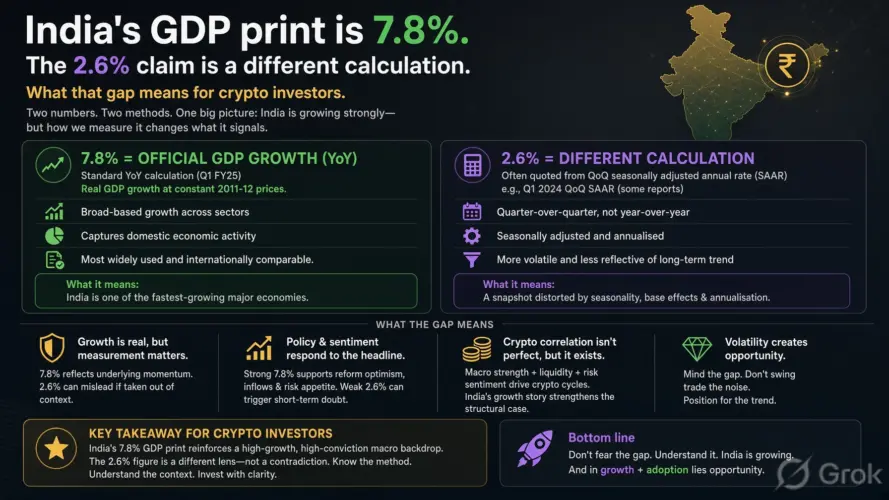
India’s GDP print is 7.8%. The 2.6% claim is a different calculation. What that gap means for crypto investors.
In this article
India’s economy grew by 7.8 percent in the April to June quarter of this year. This number came from the government’s statistics ministry on 31 August 2026. In money terms, the economy grew by 10.3 percent. The real value of what India produced was about 81.36 lakh crore rupees, compared to 75.46 lakh crore rupees in the same quarter last year. In plain money terms without adjusting for prices, it was 88.27 lakh crore rupees against 80 lakh crore rupees before. This number was even higher than what the Reserve Bank had expected, which was 7 percent. The Prime Minister called this achievement a huge accomplishment.
But within two days, people stopped talking about the growth number itself. Instead, a new argument started. Some people said the number was not real and had been created on purpose to look good.
A former finance secretary named Subhash Chandra Garg raised this doubt. He said that last year the same quarter’s economy size in plain money terms was first reported as around 86 lakh crore rupees. Later this number was reduced to about 80 lakh crore rupees. He argued that if you use the older higher number instead of the revised lower number, then this year’s growth in money terms is only around 2.6 percent, not the double digit growth the government is claiming. The opposition party Congress shared this claim widely. Government officials responded by saying this way of calculating is wrong. But regular people and investors were left wondering something simpler. Is this growth actually showing up in people’s income, in what people are spending, and in how much money is moving in the markets.
What Garg is actually comparing
Garg is not creating a new way to measure growth. He is simply taking this year’s total money value of the economy, which is 88.27 lakh crore rupees, and dividing it by last year’s older estimate of around 86.05 lakh crore rupees. That gives a growth of about 2.6 percent. If you then remove the effect of price increases, which is usually around 2 to 2.5 percent, he says the real growth would be almost zero. He has also pointed out that manufacturing and consumer spending look weak in the details behind the headline number. He called the 6 lakh crore rupee downward revision of last year’s number unusually large.

What this means for investors and crypto traders
A government report about GDP does not by itself make banking easier, does not reduce the 30 percent tax on crypto assets, and does not add more buyers and sellers in the rupee market. Real money movement depends on how much cash households have, how willing big investors both foreign and domestic are to take risks, and how easily people can move money on Indian platforms.
If the government spending and investment shown in the official data is genuine, then it does support stocks and other risky investments. But if Garg is right that spending by regular people and parts of manufacturing are weaker than the headline suggests, then stocks and crypto will show this first through lower trading volumes, and only later through investor mood. It will not show up as a simple choice between 2.6 percent and 7.8 percent. Every five to seven years, the government updates its base year for calculations, and this always creates confusion when comparing old and new numbers. The smart approach is to stick to one consistent series, track the real growth rate after adjusting for prices, and then check if wages, tax collections, bank lending, and trading activity actually match what the headline number is saying.
Editor’s note, the main point
Garg’s 2.6 percent figure is not the real growth rate inside the government’s current official system. It comes from comparing last year’s money value using the old base year system, around 86 lakh crore rupees, with this year’s money value using the new base year system, which is 88.27 lakh crore rupees. The statistics ministry says mixing these two different systems this way is not correct. Under the new system, last year’s comparable number is about 80 lakh crore rupees, which gives 10.3 percent money growth and 7.8 percent real growth. For investors, the real question is not who wins this argument on television. It is whether household income, spending, and market liquidity are actually keeping pace with the official 7.8 percent figure, or falling behind it.