

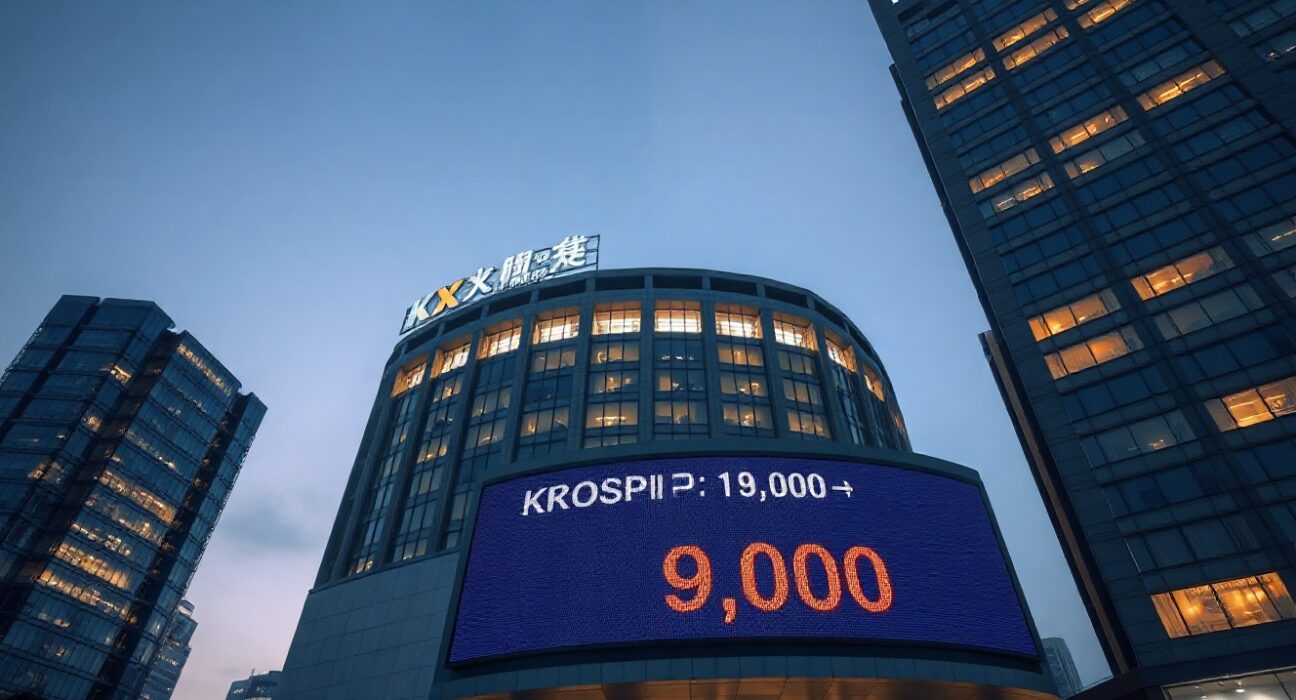
South Korea’s benchmark KOSPI index closed above the 9,000 mark for the first time in its history on [Date of event], marking a watershed moment for the country’s capital markets. The index surged [X]% to finish at [X], driven by a powerful rally in technology and semiconductor heavyweights.
What Drove the Historic Rally
The milestone was propelled by sustained foreign investor buying, particularly in the semiconductor sector, which accounts for a significant portion of the index’s weighting. Shares of Samsung Electronics and SK Hynix, the world’s two largest memory chipmakers, posted strong gains amid a global artificial intelligence boom that has fueled demand for high-performance chips. The rally also reflected optimism over South Korea’s export-driven economy, with the government’s recent policy measures to boost corporate valuations and enhance shareholder returns providing additional support.
Market Context and Comparisons
The KOSPI’s breach of 9,000 places it among the best-performing major indices globally this year. The index has more than doubled from its pandemic-era lows in 2020, underscoring the resilience of South Korea’s corporate sector. In comparison, the S&P 500 and Japan’s Nikkei 225 have also reached record highs during the same period, reflecting a broader global equity rally. However, the KOSPI’s ascent is particularly notable given the country’s heavy reliance on cyclical industries such as semiconductors and automobiles.
Implications for Investors
For domestic and international investors, the milestone signals confidence in South Korea’s economic fundamentals and corporate governance reforms. The government’s ‘Corporate Value-Up’ program, aimed at encouraging better shareholder returns and transparency, has been a key catalyst. Analysts caution, however, that valuations are becoming stretched in some sectors, and geopolitical risks—including tensions on the Korean Peninsula and global trade uncertainties—remain potential headwinds.
Conclusion
The KOSPI’s historic rise above 9,000 is a testament to the strength of South Korea’s technology-driven economy and the effectiveness of recent policy initiatives. While the milestone is a cause for celebration, market participants will be watching closely for sustainability in earnings growth and global demand trends. The index’s future trajectory will likely depend on the continued performance of the semiconductor sector and broader macroeconomic conditions.
FAQs
Q1: What is the KOSPI index?
The KOSPI (Korea Composite Stock Price Index) is the primary stock market index of South Korea, representing all common stocks traded on the Korea Exchange. It is the equivalent of the S&P 500 in the United States.
Q2: Why did the KOSPI surpass 9,000 now?
The rally was driven by strong foreign investment, a boom in the semiconductor industry fueled by AI demand, and government-led corporate reforms aimed at improving shareholder value and market transparency.
Q3: Is the KOSPI overvalued at this level?
Some analysts believe valuations are elevated in certain sectors, particularly technology. However, strong earnings growth and economic fundamentals provide support. Investors should consider individual stock valuations and broader market risks.
Disclaimer: The information provided is not trading advice, Bitcoinworld.co.in holds no liability for any investments made based on the information provided on this page. We strongly recommend independent research and/or consultation with a qualified professional before making any investment decisions.
