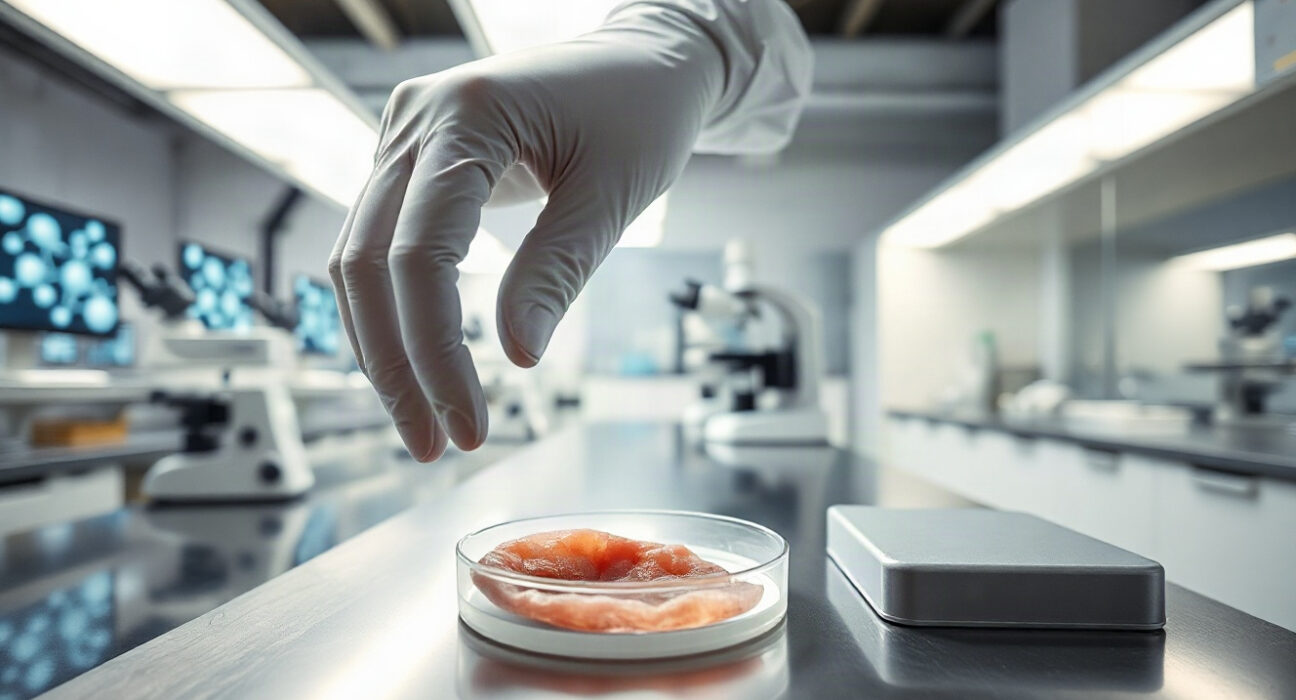
Michael Polansky, co-founder and CEO of Outer Biosciences, is training an AI model on living human skin that his company keeps alive outside the body for up to a month — a breakthrough that could dramatically accelerate the discovery of new cosmetic ingredients. The startup, which has raised about $23 million to date, is now revealing its work publicly for the first time, after years of operating in stealth.
What Outer Biosciences is doing
Outer Biosciences has developed a proprietary system that sustains human skin tissue — sourced from plastic surgery leftovers through vetted biobanks — for weeks, far beyond the industry norm of a few days. This extended viability allows researchers to observe slow biological processes like collagen remodeling, pigmentation changes, and barrier repair that typically unfold over weeks, not hours. The company then feeds this tissue into a closed loop: an AI model predicts which untested chemicals might benefit a specific skin function, the chemicals are tested on the living tissue, and the results—whether the prediction was right or wrong—are fed back into the model to improve its next guesses.
Why this matters for the beauty and pharma industries
The current universe of skin-active ingredients is surprisingly small—only about 120 to 130 active ingredients are approved by the FDA for over-the-counter skin drugs, and that number rises to roughly 200 when you include cosmetic ingredients backed by real research. Outer Biosciences aims to expand this list by discovering new cosmetic ingredients that can be licensed to beauty and pharmaceutical companies. Already, the company has generated six active leads, with four likely to reach commercialization, and it’s generating revenue through collaborative research partnerships with pharma and consumer beauty brands.
How the technology works
Instead of relying on synthetic organs or animal models, Outer Biosciences uses real human skin that would otherwise be discarded after surgery. The tissue is sourced through nonprofit and commercial biobanks like the National Disease Research Interchange and the Cooperative Human Tissue Network, with donor consent and institutional review board oversight. The company’s support system feeds the tissue nutrients and removes metabolic waste, preserving its day-zero architecture and molecular programs for up to 30 days. This approach provides a more accurate representation of how human skin actually behaves, enabling researchers to track responses to UVB damage, for example, over weeks rather than just hours.
Competitive landscape and challenges
Outer Biosciences is not alone in this space. Vivodyne, a Philadelphia-based competitor, is building lab-grown human organ tissue and recently raised nearly $80 million. Other companies are exploring organ-on-a-chip technologies. However, Polansky notes that there’s no “biology internet” to scrape—the data Outer Biosciences generates doesn’t exist anywhere else, giving it a defensible moat. The company also runs its AI workloads on-premise to keep data secure, and its compute needs are modest compared to large language model training.
What’s next for Outer Biosciences
Polansky says the company’s immediate goal is to build out a product-development team to take promising compounds through formulation, manufacturing scale-up, and safety testing—steps that are currently done manually by the same scientists who discover them. The company plans to license or sell its finished ingredients to beauty or pharma brands rather than launch its own consumer line. As of now, Outer Biosciences employs 19 people, with most based near Cambridge, Massachusetts.
Conclusion
Outer Biosciences is a prime example of how AI and biology are converging to solve real-world problems. By keeping human tissue alive longer and training AI on that data, the company is poised to accelerate the discovery of new cosmetic ingredients and potentially transform how the beauty and pharmaceutical industries approach skin health. While challenges remain—including regulatory hurdles and the need for more investment—the potential for information gain in dermatology is significant.
FAQs
Q1: What is Outer Biosciences?
Outer Biosciences is a startup co-founded by Michael Polansky in 2022 that develops AI models trained on living human skin tissue. The company keeps skin alive outside the body for up to a month, enabling faster discovery of new cosmetic ingredients.
Q2: How does Outer Biosciences get human skin?
The company sources human skin that would otherwise be discarded after plastic surgery, through vetted nonprofit and commercial biobanks operating under institutional review board oversight and documented donor consent. The tissue is de-identified before it arrives.
Q3: What makes Outer Biosciences different from other biotech startups?
Unlike competitors using synthetic organs or animal models, Outer Biosciences uses real human tissue and keeps it alive for weeks, allowing observation of slower biological processes. This, combined with a closed AI feedback loop, gives the company a unique data advantage.
Disclaimer: The information provided is not trading advice, Bitcoinworld.co.in holds no liability for any investments made based on the information provided on this page. We strongly recommend independent research and/or consultation with a qualified professional before making any investment decisions.