

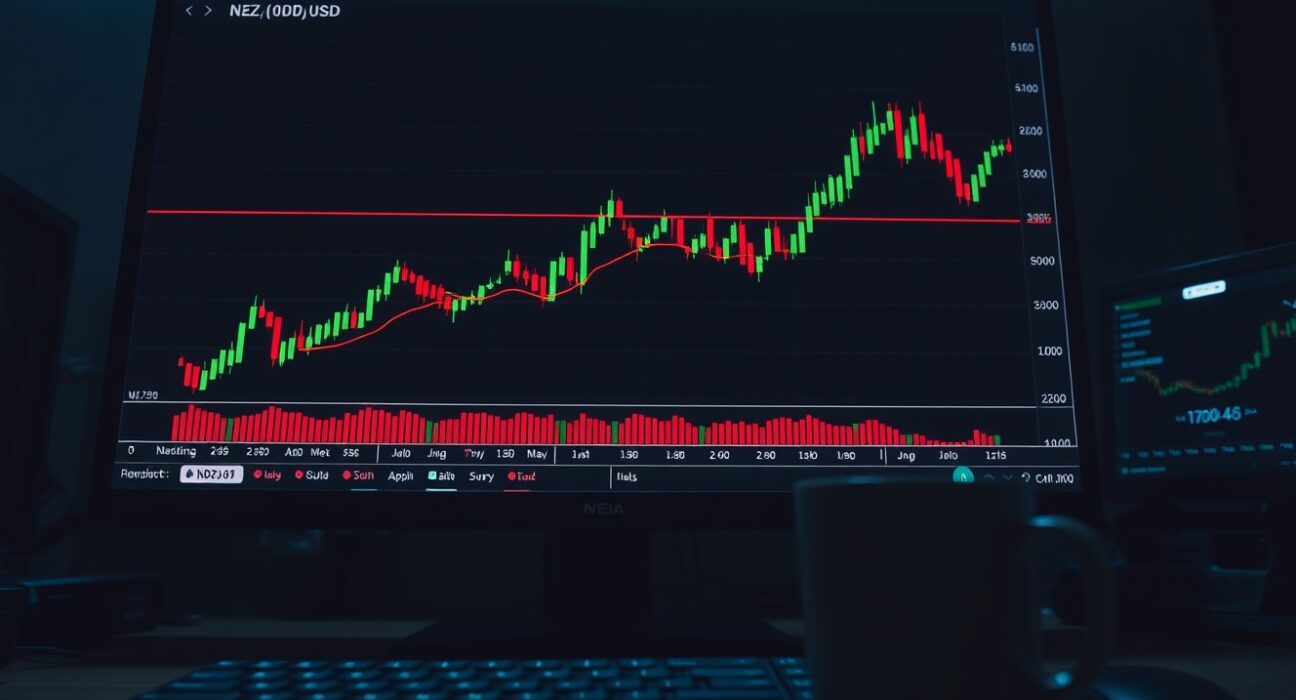
The New Zealand dollar extended its recovery against the US dollar during Tuesday’s trading session, though the pair continues to face significant technical resistance from overhead simple moving averages (SMAs). The NZD/USD pair edged higher, attempting to build on recent gains, but the presence of key moving averages on the daily chart is capping upside momentum, leaving the currency pair in a cautious consolidation phase.
Technical Resistance Levels in Focus
From a technical perspective, the NZD/USD is currently trading below the 50-day and 100-day SMAs, which are converging in the 0.6150–0.6180 region. These levels have acted as a formidable barrier in recent sessions, preventing a more decisive breakout. The pair’s ability to reclaim these moving averages would signal a shift in near-term momentum, potentially opening the door for a test of the 200-day SMA near 0.6250. However, failure to overcome this resistance could see the pair resume its broader downtrend, with immediate support located at the 0.6050 level, followed by the 2024 low near 0.5980.
The Relative Strength Index (RSI) on the daily chart has climbed above the 50 mark, indicating that buying pressure is building, but the Moving Average Convergence Divergence (MACD) remains below its signal line, suggesting the recovery is not yet fully confirmed. This mixed signal underscores the indecision in the market.
Fundamental Drivers Weigh on the Kiwi
The NZD/USD’s recovery is unfolding against a backdrop of persistent headwinds. The Reserve Bank of New Zealand (RBNZ) has signaled a more dovish stance compared to the Federal Reserve, with markets pricing in potential rate cuts later this year. In contrast, the Fed has maintained a higher-for-longer interest rate narrative, which continues to support the US dollar on a relative basis.
Furthermore, New Zealand’s economic data has been mixed, with recent GDP figures showing a contraction, raising concerns about the health of the domestic economy. Weakness in China, New Zealand’s largest trading partner, also adds to the downside risk for the Kiwi dollar. Any sustained recovery in NZD/USD would likely require a significant shift in these fundamental dynamics, such as a more dovish turn from the Fed or a meaningful improvement in Chinese economic data.
What This Means for Traders
For forex traders, the current price action suggests a ‘sell on rallies’ approach remains prudent as long as the overhead SMAs hold. A break and close above the 50-day and 100-day SMA confluence zone would invalidate this bearish bias and could attract momentum buyers. Conversely, a rejection from these levels and a subsequent drop below 0.6050 would reinforce the dominant downtrend. The upcoming US inflation data and RBNZ commentary will be critical in determining the pair’s next directional move.
Conclusion
The NZD/USD recovery is a technical bounce within a broader bearish structure, with overhead SMAs acting as a clear ceiling. While short-term momentum is improving, the fundamental backdrop remains unfavorable for the Kiwi. Traders should watch for a decisive break of the 0.6150–0.6180 resistance zone for a more sustained recovery, or a rejection that could lead to a retest of recent lows.
FAQs
Q1: What is the key resistance level for NZD/USD right now?
The key resistance zone is between 0.6150 and 0.6180, where the 50-day and 100-day simple moving averages converge.
Q2: Why is the NZD/USD struggling to rally despite the recent recovery?
The recovery is capped by technical resistance from overhead moving averages and a fundamental backdrop that favors the US dollar due to the Federal Reserve’s higher-for-longer interest rate stance.
Q3: What would signal a stronger bullish trend for NZD/USD?
A daily close above the 0.6180 resistance area, followed by a move toward the 200-day SMA near 0.6250, would signal a stronger bullish shift in momentum.
Disclaimer: The information provided is not trading advice, Bitcoinworld.co.in holds no liability for any investments made based on the information provided on this page. We strongly recommend independent research and/or consultation with a qualified professional before making any investment decisions.
