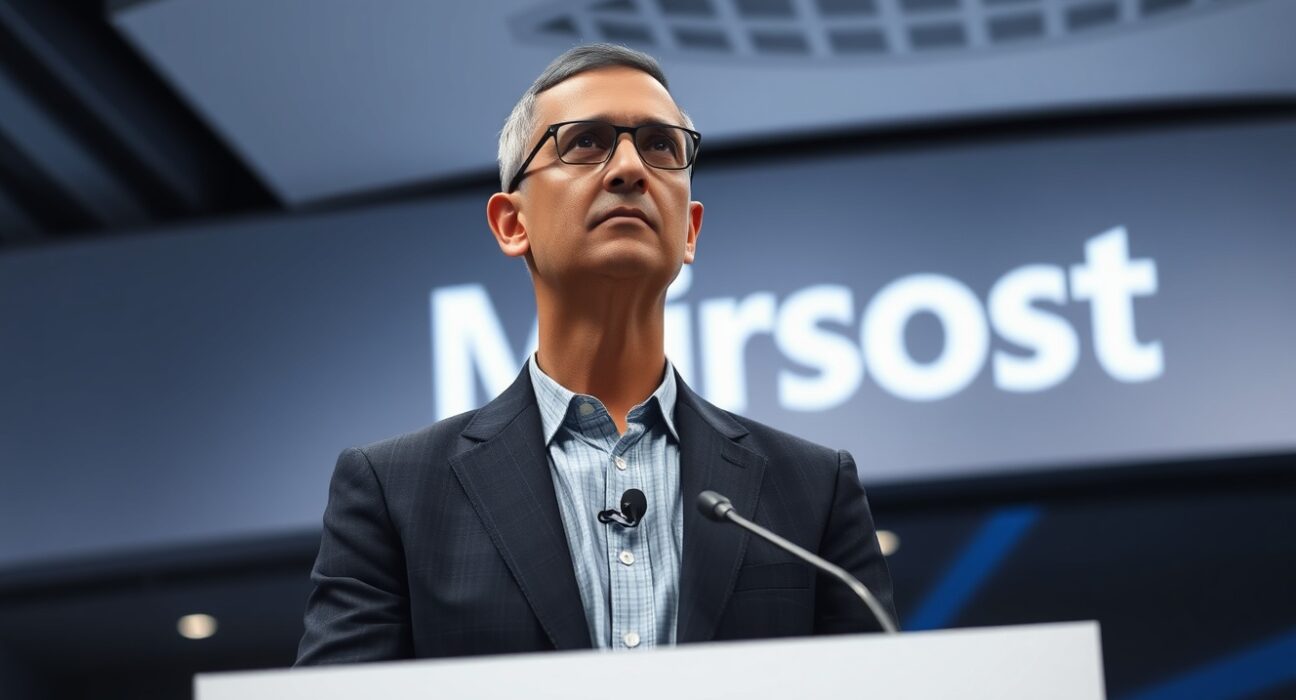
Microsoft CEO Satya Nadella has issued a striking warning to enterprises using proprietary artificial intelligence models, arguing that companies may be unknowingly handing over their most sensitive business data to the very AI labs they rely on. In a blog post published Monday, Nadella joined a growing chorus of tech leaders — including Palantir CEO Alex Karp and venture capitalist Jason Calacanis — who have raised concerns that AI model makers could become competitors to their own customers.
Nadella’s Core Argument: You Pay for Intelligence Twice
Nadella’s warning centers on what he describes as a hidden cost of using proprietary AI models. “You essentially pay for intelligence twice, once with money, and again with something even more valuable: the proprietary knowledge you must reveal to make that intelligence useful,” he wrote. He argues that as enterprises feed proprietary models with prompts, corrections, and usage data, they are essentially training those models on the nuances of their own businesses — knowledge that a competitor could never buy.
The Microsoft CEO specifically pointed to what he calls “exhaust” data — the prompts people write, the tools agents use, and the corrections made when a model is wrong. “Every correction is distilled into institutional know-how,” he wrote, warning that this creates a dangerous asymmetry where AI labs gain deep insight into their customers’ operations while offering little transparency in return.
The Distillation Debate: A Double Standard?
Nadella’s blog post also took aim at the growing controversy around model distillation — the practice of using one AI model’s outputs to train another, often cheaper, model. He argued that it is hypocritical for AI labs to freely scrape public internet data to train their models while imposing restrictive terms on customers who want to study or distill those models. “While the great innovation that comes from model providers having fair use rights to train models on public data is needed, I find it ironic that the status quo is to then turn around and impose restrictive terms on distillation,” he wrote.
The timing is notable. In February, Anthropic accused Chinese open-source model developers of sending millions of prompts to its Claude model in an effort to improve their own systems, urging the U.S. government to tighten export controls. Nadella’s point is that model makers cannot have it both ways — benefiting from open data while restricting others from doing the same.
What Nadella’s Warning Means for Enterprises
For businesses that have rushed to integrate AI tools from labs like OpenAI and Anthropic, Nadella’s message is clear: you may be giving away your competitive edge. The Microsoft CEO is particularly concerned when model makers “reserve the right to learn from customer usage and interaction data.” He urged companies to “retain ownership” of their data, including prompts and feedback, and to build “proprietary learning environments” on the cloud — a suggestion that naturally aligns with Microsoft’s Azure cloud business.
Nadella also advocated for building “orchestration layers” that allow companies to easily switch between AI models from different providers, rather than becoming locked into a single vendor. Tools like AI gateways, which facilitate this kind of model switching, have become increasingly popular among enterprises.
The Growing Shift Toward Open-Source and On-Premise AI
Nadella’s warning comes as many large enterprises are already moving in the direction he suggests. Idit Levine, founder and CEO of Solo.io — which makes networking and security software for managing AI systems — told Bitcoin World that she is seeing a clear shift among her customers. After experimenting with proprietary models, they are asking: “Can I take an open-source model and run it on-prem? It will do almost 90% of what the big one’s doing. It will cost way less,” she said. “They understand that, and they can control it.”
Solo.io’s technology was selected last year to power the Linux Foundation’s Agentgateway project, and its customers include T-Mobile, ADP, and SAP. Levine sees the move to on-premise open-source models as the next major wave in enterprise AI adoption.
Other companies are reporting similar trends. Vercel, a platform for building and hosting websites that recently added AI model-switching tools, and OpenRouter, which helps developers route requests across different AI models, are both seeing a surge in traffic to open-source models. Open models accounted for 29% of all traffic routed through Vercel’s gateway last month.
Conclusion
Nadella’s intervention is significant because it comes from the CEO of a company that has invested heavily in both OpenAI and Anthropic. His message — that enterprises should retain ownership of their data and avoid becoming locked into proprietary ecosystems — signals a potential shift in the AI industry’s power dynamics. As more companies explore open-source and on-premise alternatives, the balance between proprietary AI convenience and data sovereignty is likely to become one of the defining debates in enterprise technology over the next year.
FAQs
Q1: What exactly did Satya Nadella warn about regarding AI?
Nadella warned that enterprises using proprietary AI models may be unknowingly handing over sensitive business data to AI labs, which could use that knowledge to become competitors. He argued that companies pay for AI twice — once in token fees and again in proprietary knowledge.
Q2: What is model distillation and why is it controversial?
Model distillation is the practice of using one AI model’s outputs to train another, often cheaper, model. It is controversial because AI labs like Anthropic have accused others of using their models without permission, while the labs themselves freely train on public internet data.
Q3: What solution does Nadella propose for enterprises?
Nadella recommends that companies retain ownership of their data, build proprietary learning environments on the cloud, and create orchestration layers to easily switch between AI models. He also implicitly endorses open-source models as a way to maintain control.
Q4: Are enterprises actually moving away from proprietary AI models?
Yes. According to industry executives, many large companies are increasingly adopting open-source models that can run on their own premises, offering 90% of the capability of proprietary models at a lower cost with greater data control.
Disclaimer: The information provided is not trading advice, Bitcoinworld.co.in holds no liability for any investments made based on the information provided on this page. We strongly recommend independent research and/or consultation with a qualified professional before making any investment decisions.