

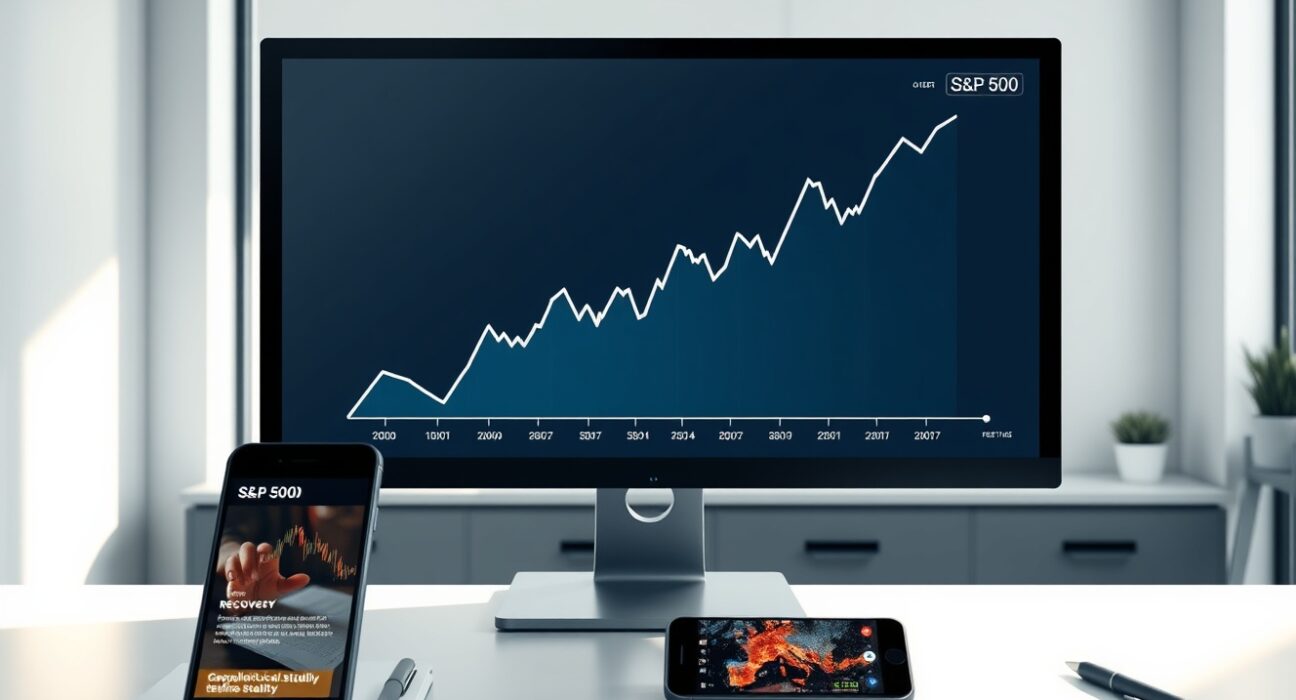
NEW YORK – March 21, 2025 – The S&P 500 index has surged to unprecedented record highs, a powerful rally that leading analysts at Deutsche Bank attribute directly to a significant and broad-based geopolitical recovery. This milestone follows a period of notable market volatility and underscores a dramatic shift in global investor sentiment. Consequently, market participants are now closely examining the underlying drivers and sustainability of this bullish trend.
S&P 500 Charts Signal a Historic Breakout
Technical charts of the S&P 500 reveal a compelling narrative. The benchmark index decisively broke through previous all-time resistance levels, confirming a robust bullish trend. Moreover, trading volume spiked during the ascent, providing strong confirmation of institutional buying pressure. Key moving averages, such as the 50-day and 200-day, now slope upward in a supportive formation. This chart pattern, often called a ‘breakout,’ typically indicates sustained positive momentum. Therefore, the technical picture strongly supports the fundamental thesis of a recovering market environment.
Deutsche Bank’s research team highlighted several critical chart-based observations in their latest report. First, the Relative Strength Index (RSI) moved from neutral territory into a strong, but not overbought, position. Second, the advance-decline line, a breadth indicator, expanded in tandem with the price rise. This suggests the rally was broad-based and not driven by a handful of mega-cap stocks alone. Finally, volatility, as measured by the VIX index, collapsed to multi-month lows. This decline in the ‘fear gauge’ directly correlates with the reduction in geopolitical risk premiums.
The Geopolitical Recovery Driving Market Sentiment
The term ‘geopolitical recovery’ refers to a measurable de-escalation in several long-standing international tensions. For instance, recent diplomatic breakthroughs in key regional conflicts have reduced the immediate risk of supply chain disruptions. Additionally, progress in multinational trade negotiations has alleviated fears of escalating tariff wars. These developments have collectively removed a substantial overhang from equity valuations. As a result, investors have rapidly repriced risk assets, leading to the powerful rally in the S&P 500 and other major indices.
This shift is not merely speculative. Hard data supports the changing landscape. Global shipping costs, a sensitive barometer of trade friction, have normalized after previous spikes. Similarly, commodity prices, especially for oil and industrial metals, have stabilized within predictable ranges. This stability allows corporations to plan and invest with greater confidence. Central banks, including the Federal Reserve, have acknowledged this improved backdrop in their recent policy statements. They cite reduced external headwinds as a factor supporting economic resilience.
Deutsche Bank’s Expert Market Analysis
Deutsche Bank’s equity strategists provided a detailed framework for understanding this market move. Their analysis connects specific geopolitical events directly to sector rotations within the S&P 500. For example, the industrials and materials sectors outperformed significantly as infrastructure and global trade prospects brightened. Meanwhile, the technology sector, a perennial leader, continued its advance but now faces less regulatory uncertainty from international data governance disputes. The bank’s report emphasizes that this is a ‘re-rating’ based on changed fundamentals, not a speculative bubble.
The analysis further incorporates macroeconomic models that weigh geopolitical risk factors. These models showed a sharp decline in their risk-adjusted discount rates for corporate earnings. In simpler terms, future profits are now worth more in today’s dollars because the perceived risk of catastrophic global events has diminished. This mathematical shift is a primary engine behind the market’s climb to new highs. Historical comparisons, such as the market recovery following the resolution of the 2011 debt ceiling crisis, provide contextual precedent for such moves.
Economic Impacts and Sector Performance
The rally’s effects extend far beyond the index itself. Firstly, corporate borrowing costs have decreased as credit spreads tightened. This makes it cheaper for companies to fund expansion and buy back shares. Secondly, consumer confidence indices have ticked upward, partly fueled by stabilizing energy prices. A confident consumer typically spends more, boosting corporate revenues. Thirdly, merger and acquisition activity has increased, as executives feel more certain about the long-term strategic environment.
A brief analysis of S&P 500 sector performance during this period reveals clear winners:
- Industrials (+12%): Direct beneficiaries of renewed global capital expenditure.
- Financials (+9%): Gain from a steeper yield curve and improved loan demand.
- Consumer Discretionary (+8%): Leverage stronger consumer balance sheets and sentiment.
- Information Technology (+7%): Continue growth, albeit with less regulatory overhang.
This sector rotation indicates a healthy, broadening rally rather than a narrow, tech-led advance. It suggests investors are betting on a classic economic expansion cycle.
Historical Context and Future Trajectory
Market history shows that breakouts to new highs often precede extended periods of positive returns. However, analysts caution that sustainability depends on earnings growth catching up to valuation expansion. The forward price-to-earnings (P/E) ratio for the S&P 500 has expanded, but it remains within historical norms given the current low-interest-rate environment. The crucial test will be the upcoming Q1 2025 corporate earnings season. Companies must demonstrate that the improved geopolitical climate is translating into tangible profit growth.
Potential risks remain on the horizon. Any resurgence of geopolitical tensions could swiftly reverse the ‘recovery’ premium. Furthermore, central banks must navigate inflation management without derailing the growth narrative. Market technicians are now watching for the S&P 500 to establish a new, higher support level. A successful ‘retest’ of this support would confirm the durability of the breakout and likely invite more capital into the equity market.
Conclusion
The S&P 500’s ascent to record highs represents a significant financial milestone driven by a tangible geopolitical recovery. Deutsche Bank’s analysis provides a clear, evidence-based link between easing international tensions and surging equity valuations. This rally, supported by strong chart patterns, broad sector participation, and improving economic fundamentals, reflects a renewed confidence in global stability. While future challenges persist, the current market trajectory underscores the profound impact of geopolitics on financial markets and the S&P 500’s role as a barometer of global risk sentiment.
FAQs
Q1: What does ‘geopolitical recovery’ mean for the stock market?
A geopolitical recovery refers to a reduction in international tensions and risks, such as trade wars or regional conflicts. For markets, this lowers the ‘risk premium’ investors demand, making future corporate earnings more valuable and leading to higher stock prices, as seen with the S&P 500.
Q2: Why is the S&P 500 considered a key market indicator?
The S&P 500 tracks 500 of the largest publicly traded companies in the U.S., representing about 80% of the total market capitalization. Its performance is viewed as a primary gauge of overall U.S. corporate health and investor sentiment.
Q3: How does Deutsche Bank’s analysis use charts?
Deutsche Bank analysts use technical charts to identify trends, breakouts, and trading volume patterns. In this case, charts showed the S&P 500 breaking above previous all-time highs with strong volume, confirming the bullish move was supported by broad market participation.
Q4: Could this S&P 500 record high lead to a market bubble?
While record highs can raise concerns, analysts note this rally is supported by improving fundamentals—lower geopolitical risk and stronger economic indicators—rather than pure speculation. Sustainability will depend on continued earnings growth to justify valuations.
Q5: Which sectors benefit most from a geopolitical recovery?
Sectors most sensitive to global trade and economic cycles, such as Industrials, Materials, and Financials, often see significant outperformance. These sectors directly benefit from increased business investment, trade flows, and borrowing that accompany a more stable world.
Disclaimer: The information provided is not trading advice, Bitcoinworld.co.in holds no liability for any investments made based on the information provided on this page. We strongly recommend independent research and/or consultation with a qualified professional before making any investment decisions.
