The Blockchain Work Behind NipsApp Game Studios’ TechBehemoths Award
In this article
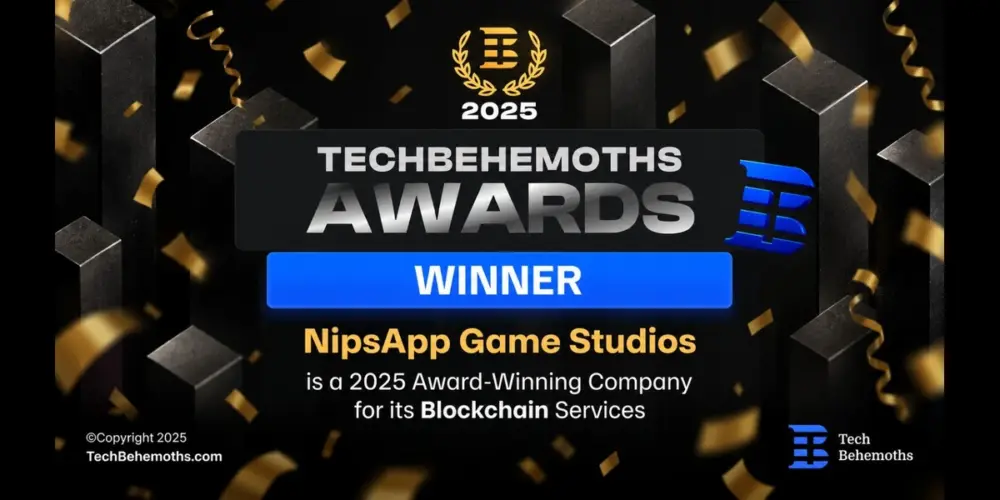
Most game studios that added “blockchain” to their service list in 2021 have quietly removed it since. NipsApp Game Studios kept the word, and in 2025 it was the reason TechBehemoths named the Trivandrum studio a Global Excellence Award winner for Blockchain Development. That award is the easy headline. The more interesting story is what the studio actually shipped to earn it, and why some of that work deliberately avoided putting anything on a chain at all.
An award you cannot buy
TechBehemoths is a directory of more than 54,000 IT companies, and its annual awards are not an open entry competition. Companies do not apply, and they cannot pay for placement. The platform ranks providers on verified client reviews, project completion records, profile verification and service focus, then names the top tier in each category. In 2025, the year the platform described as its most competitive yet, NipsApp came out of that process with three awards: Blockchain development, ReactJS Development and WordPress Development.
For a studio founded in 2010 that spent its first decade on mobile, VR and arcade games, the blockchain category is the one worth examining. It was not an obvious fit. Blockchain work arrived at NipsApp the way it arrives at most game studios, as a request from a client around 2020 and 2021 rather than a strategic bet. What separated the studio from the crowd that followed the same path is that it treated token systems and smart contracts as engineering problems with the same discipline it applied to multiplayer netcode, and it kept delivering after the market cooled. That is the standard the studio now applies as a blockchain game development company: the contract, the token economy and the game it lives in are designed by the same team, together.
The recognition that followed
The blockchain award turned out to be the first of a run. Early in 2026 the studio received a Global Recognition Award, with the citation describing “an exceptional combination of technical depth, reliability, and client focused service.” In summer 2026 Clutch named NipsApp a Global Award winner for AR and VR development, a distinction decided by verified client reviews rather than by submission. Cubix included the studio in its 2026 list of the best MVP game development companies in the USA, specifically for teams that want to test a gameplay concept before committing to full production.
Then in October 2026 Tech Times ran a feature on how a studio from Kerala built a global outsourcing business, pegged to the news that The RoyaLand Company Ltd., led by Emanuele Filiberto di Savoia, grandson of Italy’s last king, had contracted NipsApp to build its first three mobile games. The same piece named Codebara in Poland and Cozy Bear Studios in Mumbai among the clients willing to go on record, alongside the Sanad and Rahma educational app the studio built for the UAE Ministry of Health and Prevention.
None of those later recognitions are about blockchain. They matter here because they show the pattern: a Clutch rating of 5.0 across more than 130 verified reviews, judged by clients and third-party platforms rather than by the studio’s own marketing. The full list is on the studio’s awards and achievements page. The blockchain award sits inside that record, not apart from it.

GrabCoinClub: a full Web3 economy on Polygon
The project most closely tied to the blockchain award is GrabCoinClub, a 3D metaverse role-playing game set in a world called MetaMind. Players take the role of FiHunters, tiger and dragon “wealth hunters” who travel from the exoplanet FiToria to a blockchain planet named Polarity. The game mixes economic strategy with shooter, RPG and space-simulation elements, and its MVP shipped with multiplayer, VR support, MetaMask login and voice and text chat.
NipsApp’s role covered the parts that make or break a Web3 game: the smart contracts, the custom token, and the front-end interfaces that connect a player’s wallet to what happens on screen. The project runs on Polygon, chosen for low fees and fast confirmation, because a play-to-earn loop that charges mainnet Ethereum gas on every reward is dead on arrival.
The economy is built on three token standards doing three different jobs. GC, the ERC-20 utility token, is the in-game currency with a fixed supply of six billion. FiHunter avatars and artifacts such as weapons, armour and pets are ERC-721 NFTs, 15,555 of them in the founding collection. ERC-1155 semi-fungible tokens handle items that need to exist in quantity. The split matters because it lets a sword be unique while ammunition stays cheap to mint and trade. This is the kind of layered design the studio applies across its NFT game development work, where the token standard is picked for what the item does in play rather than what is fashionable.
The project’s token allocation was published in full, with 16.67 percent reserved for play-to-earn rewards, another 16.67 percent for staking and NFT bonuses, and 10 percent set aside for a DAO treasury that the project plans to hand governance to over time. The smart contracts were audited by CertiK before GC was listed on LBank Exchange on 28 May 2023, trading against USDT. Two NFT collections sold out ahead of that listing.
The design decisions NipsApp made under the surface are the ones that outlast a token price. Rewards are released in phases rather than dumped at launch, so the economy does not inflate before there are enough players to absorb it. Wallet setup is introduced gradually instead of being forced on a player in the first minute. And the NFTs are functional: an avatar changes how the game plays, not just how a profile looks. These are the choices that let a Web3 game survive its first six months.
King Coin and tokens built for clients
GrabCoinClub’s GC token was not a one-off. NipsApp has built custom tokens for a run of client projects since, covering the contract, the supply schedule and the in-game logic that gives the token a reason to exist. The studio also maintains a token of its own, King Coin, which it uses as a working reference for the kind of economy design it recommends to clients. Having its own coin means the studio has sat on both sides of the table: it has written contracts for other people’s money and managed the supply, liquidity and community questions that come with running one.
Blockchain Botany: knowing when not to use a chain
The second project that explains the award is almost the opposite of GrabCoinClub, and that is the point.
Blockchain Botany is a casual simulation game commissioned by Michele Edington, a US-based founder who evaluated studios in the US and Europe before choosing NipsApp. Players run a greenhouse on Mars, planting, growing and harvesting crops, staking mature plants for enhanced rewards, and joining 72-hour community garden projects. The game’s actual purpose is to teach blockchain concepts: staking is explained through a visible garden stake locking a plant in its pot, an in-game guidebook covers more than 18 blockchain terms through gardening analogies, and nine tutorial pop-ups surface the right concept at the moment a player needs it.
Here is what NipsApp did not do: put any of it on a real blockchain. Phase 1 simulates wallets, transactions, staking and the immutable ledger on a centralised backend. The reason is Apple’s App Store policy on cryptocurrency and on-chain assets, which would have blocked the iOS build and with it the educational licence the client needed for schools. NipsApp built the Unity codebase so that real chain integration can be switched on in a later phase, and structured the project as two builds from one codebase: a free consumer version with optional Martian Diamond purchases, and a closed school edition with no purchases, ads or external links.
The MVP shipped in weeks. The client walked into her funding round with a playable demo instead of a pitch deck and is now applying for Phase 2 funding. A studio that only knew how to deploy contracts would have shipped something that could not go on the App Store. The award recognises the judgement as much as the code.
Crypto Oracle: the prediction engine
The third project in the studio’s blockchain portfolio is Crypto Oracle, a trading simulation for iOS and Android that teaches market behaviour without risking real money. Players predict whether a price will move up or down inside a window calibrated to historical volatility, with wider windows at early levels and tighter ones later. The game runs on a live market data feed with caching and validation so a stale price never decides a round, and it holds a hard rule that in-app purchases can speed up level unlocks but never change a prediction’s outcome. The same oracle and feed-handling work appears in the studio’s DeFi integrations for client projects.
The stack underneath
Across these projects the studio works on Ethereum, Polygon, BNB Chain, Solana and Avalanche, writing in Solidity for EVM chains and Rust for Solana. The tooling is the current standard: Foundry and Hardhat for contracts, Anchor for Solana, thirdweb and Wagmi with Viem for front ends, IPFS for asset storage, and wallet support for MetaMask, WalletConnect, Phantom and Coinbase Wallet. Account abstraction is on the list because it removes the seed-phrase problem that loses most new players before they finish onboarding.
Blockchain remains one practice inside a larger studio. NipsApp has delivered more than 3,000 projects across mobile, VR, AR and PC for clients in over 25 countries, from offices in Trivandrum and Abu Dhabi’s Masdar City, and the rest of that output is documented in its game development case studies. That breadth matters for blockchain clients in a practical way: the same team that writes the token contract also builds the game it lives in, so the economy and the gameplay are designed together rather than bolted on by separate vendors.
What the award actually measures
It is worth being clear about what a TechBehemoths award is and is not. It is not a prize for the best game. It is a ranking of service providers on verified client outcomes, in a category where plenty of companies claimed expertise and far fewer shipped anything that survived contact with real users.
NipsApp shipped a Polygon economy that passed a CertiK audit and listed on an exchange. It built an educational Web3 game that knew to stay off-chain until the platform rules allowed otherwise. It built a prediction engine that treats data integrity as a gameplay feature. And it has done this while running its own token and writing tokens for clients, which means it has lived with the consequences of its own economy designs.
That is the work. The award is just the receipt.
NipsApp Game Studios is a full-cycle game development studio founded in 2010 in Trivandrum, Kerala, with an office in Masdar City, Abu Dhabi. Blockchain and NFT game development starts at $28 per hour.