The BTC Ecosystem: New Opportunities in Digital Asset Infrastructure
In this article
Since May 2026, the cryptocurrency market has evolved into something far more than just a conventional trading venue. As the Bitcoin ecosystem matures, an increasing number of investors are turning their attention toward the digital asset infrastructure sector, with cloud mining once again moving to the forefront of market interest.
A key driver behind this resurgence is the fact that barriers to entry for traditional mining remain relatively high. In the early days, participating in Bitcoin mining required independently purchasing expensive ASIC miners, incurring significant electricity costs, and managing complex issues such as hardware maintenance, data center cooling, and long-term operational logistics.
The cloud computing model changes everything.
The advancement of cloud computing enables new users to remotely access computing resources via cloud infrastructure platforms—without the need to purchase hardware—and to easily participate in the operation of blockchain networks and the digital asset ecosystem. This model significantly lowers the barriers associated with complex technical expertise and substantial capital investment, thereby opening up the digital asset infrastructure space to a broader audience of everyday users.
Amidst the continuous expansion of global blockchain applications, market interest in distributed computing networks and cloud mining ecosystems is steadily on the rise. In contrast to the short-term volatility often associated with high-frequency trading exchanges, an increasing number of investors are focusing on participation methods characterized by long-term infrastructure attributes.
Amidst the multitude of emerging platforms, the BTC Ecosystem is gradually capturing the market’s attention.
According to information published on the company’s official website, the BTC Ecosystem has established data centers and computing infrastructure—integrated with renewable energy sources—in regions such as Texas, Canada, and Australia. Furthermore, the company is actively implementing energy solutions—including hydroelectric, wind, and solar power—to enhance overall energy efficiency.
The growing emphasis on “green computing power” stems from the fact that the energy consumption associated with Bitcoin mining has become a subject of ongoing debate within the global market. Investors no longer focus solely on a platform’s profitability; increasingly, they prioritize its energy mix, operational transparency, and long-term sustainability.
At the same time, traditional mining models continue to face numerous practical challenges, including:
- High costs associated with purchasing mining hardware
- Technical complexities regarding equipment deployment and maintenance
- Cooling systems and power management
- Operational pressures related to ensuring continuous, long-term, and uninterrupted operation
- The rapid pace of hardware evolution and modernization
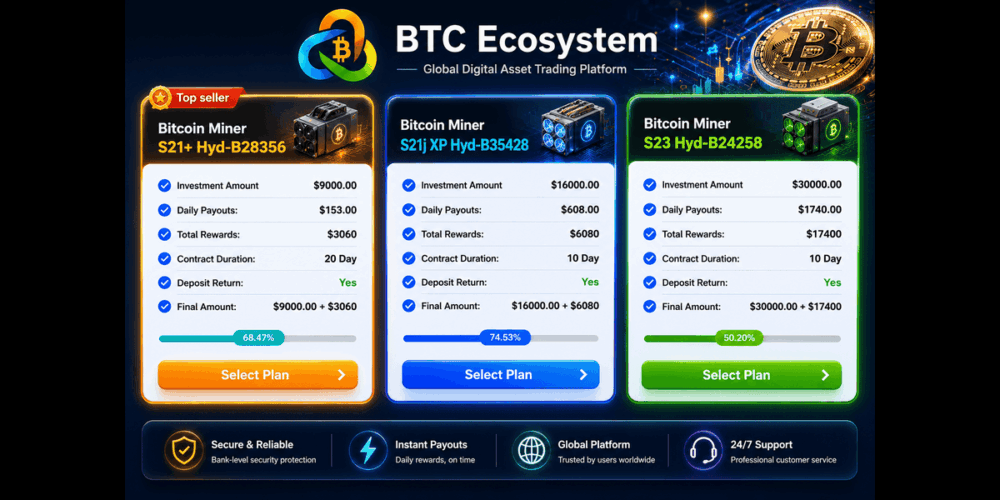
In contrast, the BTC Ecosystem cloud mining platform streamlines the user participation process through centralized infrastructure management, thereby lowering the barrier to entry and enabling a broader audience to access the digital asset infrastructure market.
Shifting from Speculation to Long-Term Value Positioning
Against the backdrop of global inflationary concerns, currency volatility, and the growing trend of institutional Bitcoin adoption, an increasing number of investors are beginning to seek ways to engage with digital assets that extend beyond mere price speculation. Compared to short-term price speculation, sectors such as blockchain infrastructure, computing power networks, and decentralized computing are gradually being perceived as areas holding greater potential for long-term value.
Given that the cryptocurrency industry remains in a phase of dynamic evolution, the market continues to exhibit certain disparities regarding regulation, informational transparency, and industry standards. Consequently, when selecting a platform, investors typically prioritize the following key aspects:
✅ The company’s operational track record and market reputation
✅ The scale of data centers and infrastructure
✅ Contractual mechanisms and profit-generation structures
✅ Payout and capital management policies
✅ Energy sourcing and sustainability models
Blockchain infrastructure and eco-friendly computing power are emerging as new focal points within the industry.
As the digital asset sector matures, cloud computing platforms prioritizing renewable energy sources, infrastructure scalability, and user accessibility are likely to continue gaining traction in the global market.
Regardless of market cycle fluctuations, the importance of underlying blockchain infrastructure continues to grow steadily. Companies such as BTC Ecosystem are increasingly positioning themselves at the convergence point where blockchain technology, green energy, and next-generation digital infrastructure intersect.
Learn more about development trends in cloud computing power and digital infrastructure.
We invite you to visit our official website: https://btcecosystem.com/