

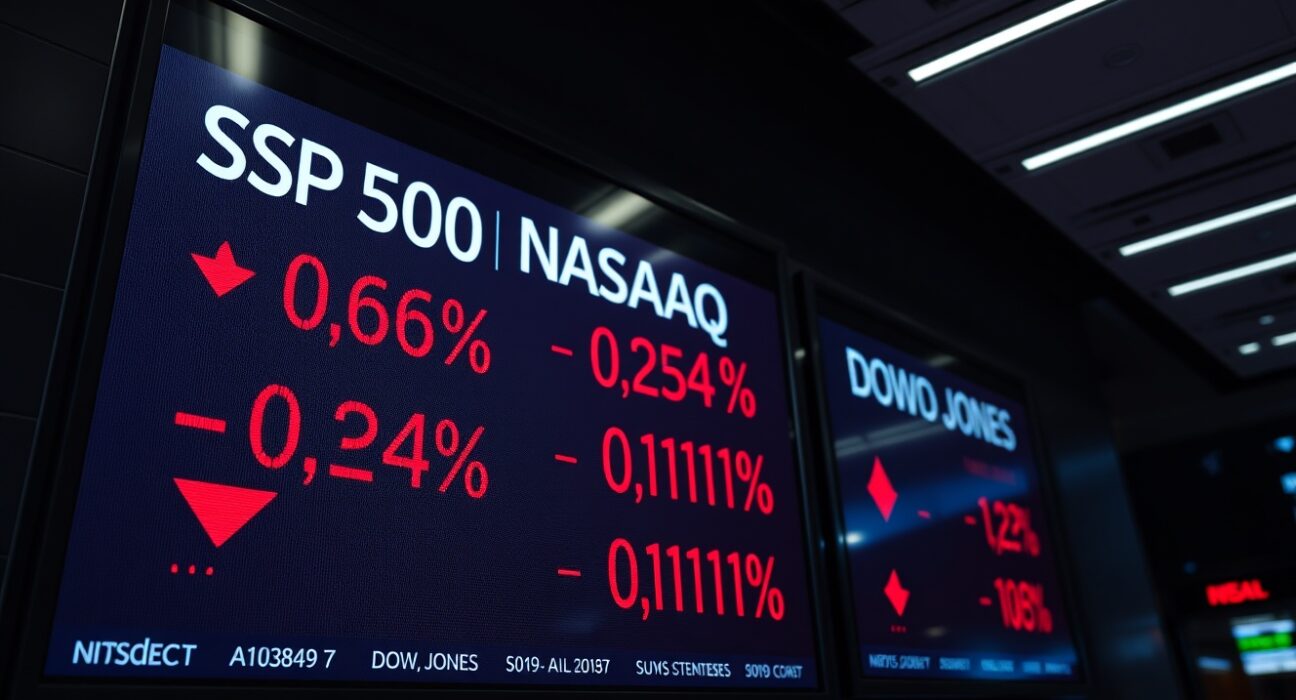
The three major U.S. stock indices closed lower on Tuesday, extending a quiet but cautious tone across Wall Street. The S&P 500 slipped 0.06%, the Nasdaq Composite fell 0.24%, and the Dow Jones Industrial Average declined 0.11%.
Market Overview: A Day of Modest Losses
The declines were relatively mild compared to recent volatility, suggesting a market in wait-and-see mode. Trading volumes were slightly below average, with investors digesting a mix of corporate earnings reports and economic data released earlier in the day.
The S&P 500’s marginal drop of less than 0.1% reflects broad but shallow selling pressure across multiple sectors. The Nasdaq’s larger decline of 0.24% points to continued weakness in technology and growth stocks, which have faced headwinds from rising interest rate expectations.
The Dow Jones, often viewed as a bellwether for the industrial economy, posted a 0.11% loss, indicating that even traditionally defensive sectors felt the weight of the day’s cautious sentiment.
What Drove the Market Lower?
While no single catalyst dominated headlines, several factors contributed to the subdued session. Investors continued to monitor the Federal Reserve’s policy trajectory, with recent comments from Fed officials reinforcing a cautious approach to rate cuts.
Additionally, geopolitical uncertainties and mixed signals from global markets added to the cautious tone. European and Asian markets also traded in a narrow range overnight, providing little directional impetus for U.S. traders.
Why This Matters for Investors
Days like Tuesday, where the market moves in a tight range with modest losses, are often interpreted as consolidation phases. For long-term investors, such sessions typically do not signal a major trend change. However, they can indicate that the market is awaiting clearer signals—whether from upcoming economic reports, corporate earnings, or central bank decisions.
The technology sector’s underperformance, as reflected in the Nasdaq’s larger decline, is worth noting. Tech stocks have been sensitive to interest rate expectations, and any shift in the Fed’s stance could amplify moves in this space.
Conclusion
Tuesday’s session was a reminder that markets do not always move on dramatic news. The modest declines across the S&P 500, Nasdaq, and Dow Jones reflect a market in a holding pattern, with investors weighing competing narratives around inflation, interest rates, and economic growth. For now, the path of least resistance appears sideways, with attention turning to upcoming economic data releases and corporate earnings reports for the next directional cue.
FAQs
Q1: Why did US stocks close lower on Tuesday?
A: The declines were driven by a combination of cautious investor sentiment, ongoing uncertainty about Federal Reserve interest rate policy, and a lack of strong positive catalysts. The losses were modest across all three major indices.
Q2: Should investors be concerned about a 0.24% drop in the Nasdaq?
A: A decline of this magnitude is considered minor and within normal daily volatility. It may reflect short-term repositioning rather than a fundamental shift in market outlook. Investors should monitor broader trends rather than react to a single day’s move.
Q3: What sectors were most affected in Tuesday’s trading?
A: Technology and growth stocks, as represented by the Nasdaq, experienced slightly larger losses. The S&P 500 and Dow Jones showed more resilience, indicating that selling was relatively broad but not concentrated in any single sector.
Disclaimer: The information provided is not trading advice, Bitcoinworld.co.in holds no liability for any investments made based on the information provided on this page. We strongly recommend independent research and/or consultation with a qualified professional before making any investment decisions.
