

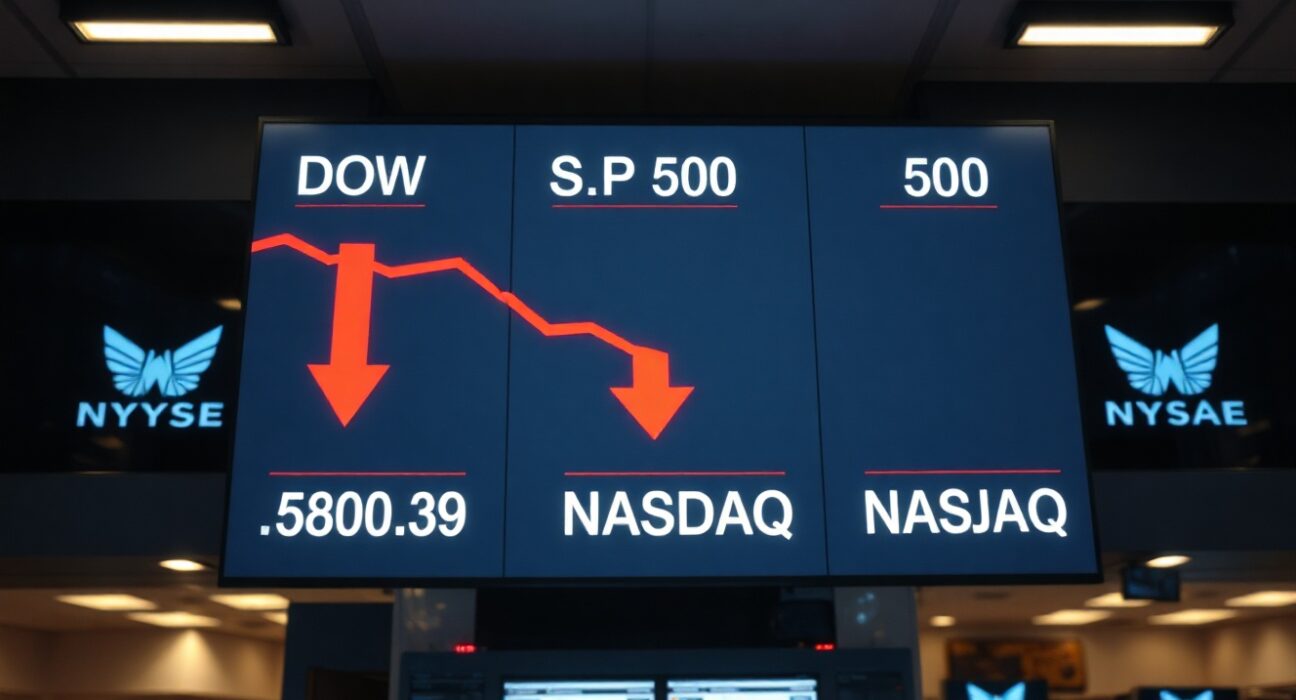
Major U.S. stock indices declined in the immediate aftermath of the Federal Reserve’s latest interest rate announcement, as investors digested the central bank’s policy stance and forward guidance. The Dow Jones Industrial Average slipped 0.1%, the S&P 500 fell 0.44%, and the tech-heavy Nasdaq Composite dropped 0.47%.
Market Reaction to the Fed’s Decision
The Federal Reserve’s decision to hold interest rates steady — or adjust them as part of its ongoing effort to manage inflation — was closely anticipated by traders. The modest declines across major indices suggest a market recalibrating expectations rather than a broad panic. The S&P 500’s decline of nearly half a percentage point reflects a cautious tone among investors, particularly in growth-oriented sectors that are more sensitive to borrowing costs.
The Nasdaq’s slide of 0.47% underscores continued pressure on technology and high-valuation stocks, which often face headwinds when interest rates remain elevated. The Dow’s relatively smaller loss of 0.1% indicates that more traditional, dividend-paying sectors showed relative resilience.
Why This Matters for Investors
Interest rate decisions by the Federal Reserve have far-reaching implications for the economy and financial markets. Higher rates typically increase the cost of borrowing for businesses and consumers, which can slow economic growth and reduce corporate earnings. Conversely, lower rates tend to stimulate spending and investment. The market’s immediate negative reaction suggests that the Fed’s accompanying commentary may have signaled a longer-than-expected period of restrictive policy.
For everyday investors, this environment calls for a focus on portfolio diversification and a long-term perspective. Sectors such as utilities, healthcare, and consumer staples often perform more steadily during periods of rate uncertainty, while growth stocks may experience increased volatility.
What the Fed’s Statement Indicated
Beyond the rate decision itself, the Federal Reserve’s accompanying statement and press conference provided key insights into its economic outlook. Policymakers reiterated their commitment to bringing inflation down to the 2% target, while acknowledging that the labor market remains strong. The central bank’s tone struck a balance between vigilance against persistent price pressures and caution about the pace of future policy moves.
Conclusion
The immediate sell-off in U.S. stocks following the Federal Reserve’s rate decision reflects a market adjusting to the reality of sustained higher borrowing costs. While the declines were modest, they signal that investors are pricing in a longer runway for restrictive monetary policy. For market participants, the focus now shifts to upcoming economic data, corporate earnings reports, and the Fed’s next policy meeting for further clarity on the trajectory of interest rates.
FAQs
Q1: Why did U.S. stocks fall after the Fed’s rate decision?
The market reacted to the Federal Reserve’s interest rate decision and its forward guidance, which suggested that rates may remain higher for longer than some investors had anticipated. This created uncertainty about future economic growth and corporate earnings.
Q2: Which stock indices were most affected?
The Nasdaq Composite fell the most at 0.47%, followed by the S&P 500 at 0.44%, and the Dow Jones Industrial Average with a smaller decline of 0.1%. The Nasdaq’s larger drop reflects higher sensitivity among technology and growth stocks to interest rate changes.
Q3: What should investors do after a Fed rate decision?
Investors should review their portfolio allocation, consider diversifying across sectors that perform well in different rate environments, and maintain a long-term perspective. It’s also important to stay informed about upcoming economic data and Fed communications for further guidance.
Disclaimer: The information provided is not trading advice, Bitcoinworld.co.in holds no liability for any investments made based on the information provided on this page. We strongly recommend independent research and/or consultation with a qualified professional before making any investment decisions.
