

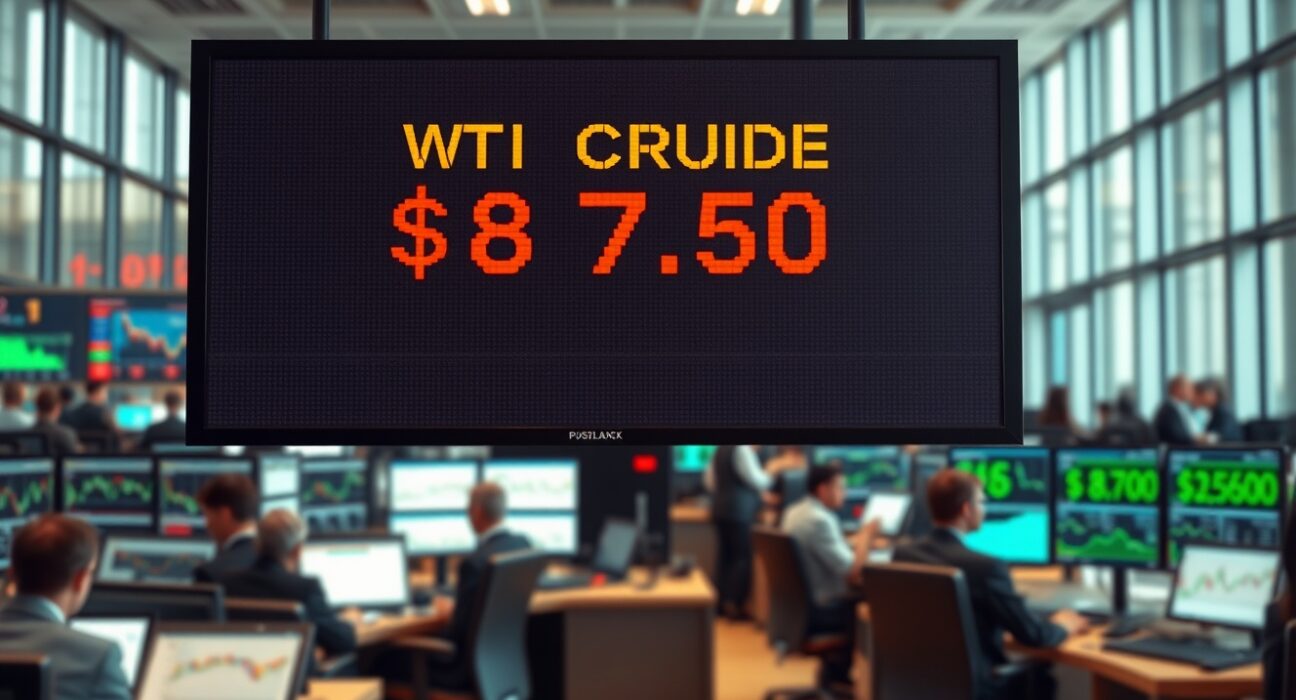
NEW YORK, April 2025 – West Texas Intermediate (WTI) crude oil futures demonstrate notable stability, trading near the $87.50 per barrel mark. This price consolidation follows significant political developments, specifically former President Donald Trump’s public signals about restarting comprehensive nuclear negotiations with Iran. Market analysts globally now scrutinize this diplomatic shift for its potential to reshape global oil supply dynamics and alter the fundamental price trajectory for the benchmark American crude.
WTI Crude Oil Price Holds Steady Amid Geopolitical Shifts
The front-month WTI contract exhibits remarkable resilience, maintaining a tight trading band between $86.80 and $88.20 over recent sessions. This price action reflects a market in careful equilibrium, balancing several opposing forces. On one side, persistent concerns about global economic growth and demand temper bullish sentiment. Conversely, ongoing production discipline from the OPEC+ alliance, particularly Saudi Arabia and Russia, provides a solid price floor. The immediate catalyst for the current subdued trading, however, stems directly from the geopolitical arena. The mere prospect of renewed dialogue between Washington and Tehran introduces a powerful variable into the global supply equation, prompting traders to adopt a cautious, wait-and-see approach.
Market participants recall the profound impact of the 2015 Joint Comprehensive Plan of Action (JCPOA) and its subsequent unraveling. The original nuclear deal led to a significant influx of Iranian oil onto global markets, contributing to a prolonged period of lower prices. Consequently, any diplomatic progress carries the potential to incrementally increase global supply, applying downward pressure on benchmarks like WTI and Brent. However, analysts caution that the path to a new agreement remains fraught with complexity. Key sticking points from previous negotiations, including the scope of sanctions relief and the duration of nuclear restrictions, persist. Furthermore, regional tensions and Iran’s advancing nuclear capabilities create a more challenging backdrop than in 2015.
Analyzing the Impact of Renewed Iran Nuclear Talks
The announcement of potential negotiations triggers immediate analysis of the volumetric implications for the oil market. According to data from the International Energy Agency (IEA), Iran currently holds substantial shut-in production capacity. Estimates suggest Iran could increase its exports by 500,000 to 1 million barrels per day within a relatively short timeframe following the lifting of stringent U.S. sanctions. This additional supply would enter a market that has grown accustomed to tight physical balances maintained by OPEC+ restraint.
Expert Perspectives on Market Fundamentals
Energy market strategists emphasize the nuanced relationship between diplomacy and oil flows. “The market is correctly pricing in a ‘negotiation premium,’ but it is a cautious one,” notes Dr. Anya Petrova, Lead Geopolitical Analyst at Global Energy Insights. “Traders remember that the previous negotiation process spanned years, not months. Furthermore, the logistical and investment challenges of ramping up Iranian production to pre-sanction levels are non-trivial. We are likely looking at a gradual supply return, not a sudden flood.” This perspective underscores why the WTI price reaction has been measured rather than precipitous. The market appears to be discounting a long and uncertain diplomatic process with an uncertain outcome.
The potential re-entry of Iranian oil also interacts with other critical market factors. The health of the global economy remains a primary driver of demand. Additionally, the production policies of other key players, notably the United States itself, will influence the net effect. U.S. shale production has shown signs of plateauing due to capital discipline and cost inflation, which could offset some of the bearish pressure from additional Iranian barrels. The following table summarizes the key bullish and bearish factors currently influencing WTI prices:
| Bullish Factors | Bearish Factors |
|---|---|
| OPEC+ production cuts remain in effect | Potential increase in Iranian oil supply |
| Stable U.S. shale output growth | Concerns over global economic demand |
| Geopolitical risks in other regions (e.g., Russia, Venezuela) | Strategic Petroleum Reserve releases |
| Low global oil inventories | Strength of the U.S. dollar |
The Historical Context and Future Trajectory for Oil Markets
The oil market possesses a long memory for geopolitical events. The current situation draws direct parallels to the 2014-2016 period, which saw a dramatic price collapse driven partly by the initial lifting of sanctions on Iran. However, the structural landscape of the market has evolved. The rise of the United States as the world’s top producer provides a new shock absorber. American production can respond more quickly to price signals than in the past, albeit within capital constraints. Furthermore, the global commitment to energy transition adds a longer-term demand overlay that did not exist a decade ago, influencing investment decisions across the hydrocarbon sector.
In the immediate term, traders will monitor several concrete indicators. These include:
- Diplomatic Communiques: The tone and substance of official statements from U.S. and Iranian officials.
- Shipping Data: Tracking Iranian oil tanker movements via satellite and shipping analytics.
- Inventory Reports: Weekly U.S. Energy Information Administration (EIA) data on crude stocks.
- OPEC+ Rhetoric: Any signals that the producer group might adjust its output strategy in response to potential new supply.
The technical chart picture for WTI reinforces the narrative of consolidation. The commodity has found consistent support near the $85 level while facing resistance around $90. A sustained break above $90 would likely require a breakdown in negotiations or a significant, unforeseen supply disruption elsewhere. Conversely, a break below $85 could accelerate if talks show rapid progress or if global demand concerns intensify markedly.
Conclusion
The WTI crude oil price, holding near $87.50, encapsulates a moment of significant geopolitical anticipation. The market’s subdued reaction reflects a sophisticated understanding of the complexities involved in U.S.-Iran diplomacy and its translation into physical barrels. While the potential for increased supply from Iran presents a clear bearish risk, it is tempered by OPEC+ discipline, structural limits on U.S. shale growth, and the inherent uncertainty of international negotiations. In the coming weeks, price action will serve as a real-time barometer of perceived diplomatic progress, making the WTI benchmark a critical watchpoint for investors and policymakers alike as the Trump administration’s outreach to Iran unfolds.
FAQs
Q1: Why does the potential for Iran talks affect the WTI crude oil price?
Iran holds the world’s fourth-largest proven oil reserves. Renewed nuclear talks and the potential lifting of U.S. sanctions could allow Iran to significantly increase its oil exports, adding more supply to the global market. This anticipated increase in supply creates downward pressure on benchmark prices like WTI, as traders price in the future availability of more barrels.
Q2: How much oil could Iran add to the market if sanctions are lifted?
Analysts estimate Iran has the capacity to increase its oil exports by approximately 500,000 to 1 million barrels per day within several months of sanctions relief. This represents a meaningful addition to global supply, which currently totals over 100 million barrels per day.
Q3: What is the difference between WTI and Brent crude oil?
WTI (West Texas Intermediate) is a light, sweet crude oil benchmark priced in Cushing, Oklahoma, and primarily reflects North American supply dynamics. Brent crude, sourced from the North Sea, is the international benchmark, more influenced by global geopolitical events and Middle Eastern supply. Both benchmarks move in correlation but can have different price spreads based on regional factors.
Q4: Could other factors offset the impact of more Iranian oil?
Yes. Continued production cuts by OPEC+ members, a decline in U.S. shale output, or an unexpected supply disruption in another major producing region (like Libya or Nigeria) could absorb the additional Iranian barrels and support prices. Stronger-than-expected global economic demand would also be a bullish counterweight.
Q5: How quickly can Iran ramp up its oil production?
While Iran has maintained some production capacity, bringing shut-in wells back online and increasing exports to pre-sanction levels requires investment, maintenance, and time. Most analysts project a gradual increase over 6-12 months rather than an immediate surge, as infrastructure and international buyer relationships need to be re-established.
Disclaimer: The information provided is not trading advice, Bitcoinworld.co.in holds no liability for any investments made based on the information provided on this page. We strongly recommend independent research and/or consultation with a qualified professional before making any investment decisions.
